



Foreigners required in KSA ‘for 40 more years’

May 9, 2014

Foreigners_in_KSA

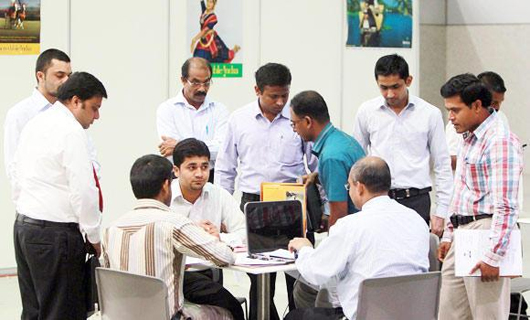
Jeddah, May 9: A prominent labor expert has suggested that the Kingdom will require expatriate manpower in various sectors over the next 40 years.

Abdullah Dahlan, former Saudi representative to the International Labor Organization (ILO) and chairman of the board of trustees of the University of Business and Technology, also reiterated the need for more Saudi men and women to match their specialties with labor market needs.

There are currently 2.5 million people out of work in the Kingdom, of which 44 percent are university graduates.

“While unemployment figures are on the decline according to a recent study conducted by the university, the relatively high unemployment rate among university graduates is due to the fact that more than two-thirds of these graduates are holders of theoretical academic degrees that offer no vocational skills, while the other third are science graduates,” he said.

Another reason for lack of employability, said Dahlan, is unsatisfactory education levels.

“A low-quality education results in less qualifications, thus requiring extensive training for requalification into the labor market,” he said.

Dahlan prefers not to blame authorities. He recommends instead focusing on educational reforms that will help enhance teaching levels, particularly with the support of Education Minister Prince Khaled Al-Faisal in revamping the education system.

“Women represent a significant component of the workforce and must have their rights met, especially since they account for the highest unemployment rates,” he said.

“There are three variables that must be altered to improve work environment and make employment more attractive, which include restructuring syllabi without placing special emphasis on religion and Arabic and introducing courses that are essential for today’s work market, such as English language courses.”

Dahlan also suggested introducing courses that teach simple business concepts in order to build students’ hands-on experience.

University disciplines should be similarly restructured to meet market demands, he said.

More than seven million of the 20 million Saudis are under the age of 15, while seven million are unemployable, according to a statistical study conducted in 2012.

Hussein Al-Alawy, the university’s director, said that his institution has sought to provide quality vocational education since it was founded a few years ago.

The founders are currently working on establishing a college of medicine and a university hospital over the next two years, he said, confirming that land has been purchased for the construction of buildings for these majors.

He also said that the Kingdom’s Higher Education minister has issued approval to introduce the insurance specialty from the beginning of the next academic year.

“New students will soon be able to apply for this major, which is one of the most sought after disciplines in the Saudi labor market today,” he said.

The current Saudi insurance market is estimated at more than SR21 billion and includes 34 licensed companies.

The market is expected to be worth SR34 billion by 2015.

Al-Alawy also said that the Kingdom, represented by the Ministry of Higher Education, seeks to equip highly qualified Saudi cadres in disciplines relevant to the labor market.

The university will open admissions for majors such as civil engineering at the College of Engineering to meet market needs, he said.

“The decision of Custodian of the Two Holy Mosques to give young Saudi men and women scholarships has allowed and supported many students to complete their undergraduate degrees,” he said. “Our ‘education for employment’ logo is a motto that is consistent with the modern-day era.”

The university will celebrate the graduation of 250 students on Thursday during a ceremony to be held in Jeddah in the presence of Jeddah Gov. Prince Mishaal bin Majed.

Comments

Add new comment

  • Coastaldigest.com reserves the right to delete or block any comments.
  • Coastaldigset.com is not responsible for its readers’ comments.
  • Comments that are abusive, incendiary or irrelevant are strictly prohibited.
  • Please use a genuine email ID and provide your name to avoid reject.
News Network
April 11,2020

Dubai, Apr 11: Saudi Arabia has reported another 382 new cases of coronavirus, bringing the total number of infections in the country to 4,033, the Ministry of Health announced on Saturday.

The ministry also confirmed five more deaths from the virus, pushing the death toll in Kingdom to 52.

A total of 35 people has made full recovery from the deadly disease, taking the tally of patients recovered to 720.

Comments

Add new comment

  • Coastaldigest.com reserves the right to delete or block any comments.
  • Coastaldigset.com is not responsible for its readers’ comments.
  • Comments that are abusive, incendiary or irrelevant are strictly prohibited.
  • Please use a genuine email ID and provide your name to avoid reject.
News Network
May 4,2020

Dubai, May 4: An Indian salesman in the UAE has won a whopping 10 million dirhams at an Abu Dhabi draw, a media report said.

Dileep Kumar Ellikkottil Parameswaran, from Kerala’s Thrissur, works with an auto spare parts company in Ajman and earns 5,000 dirhams (USD 1,361) a month, Gulf News reported on Sunday.

Parameswaran, who won the 10 million dirhams (USD 2.7 million) prize at the Big Ticket draw in Abu Dhabi, will spend a big part of the money to repay a loan of 700,000 dirhams (USD 190,574 ), according to the report.

He said that a good part of the prize money will be spent on the education of his two children.

Parameswaran, who has been a resident of the UAE for 17 years, lives in Ajman along with his family.

Big Ticket is the largest and longest-running monthly raffle draw for cash prizes and dream luxury cars in Abu Dhabi.

A live monthly draw is organized at the Abu Dhabi International Airport on 3rd of each month.

Tickets are sold for 500 dirhams (USD 136).

Comments

Add new comment

  • Coastaldigest.com reserves the right to delete or block any comments.
  • Coastaldigset.com is not responsible for its readers’ comments.
  • Comments that are abusive, incendiary or irrelevant are strictly prohibited.
  • Please use a genuine email ID and provide your name to avoid reject.
Agencies
August 2,2020

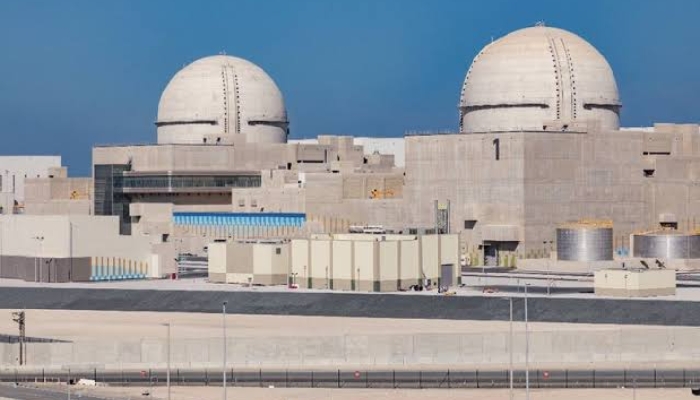
Dubai, Aug 2: The United Arab Emirates (UAE) announced on Saturday that it has started operations in the first of four reactors at the Barakah nuclear power station - the first nuclear power plant in the Arab world.

Emirates Nuclear Energy Corporation (ENEC), which is building and operating the plant with Korea Electric Power Corporation (KEPCO) said in a press release that its subsidiary Nawah Energy Company "has successfully started up Unit 1 of the Barakah Nuclear Energy Plant, located in the Al Dhafrah Region of Abu Dhabi".

That signals that Unit 1, which had fuel rods loaded in March, has achieved "criticality" - a sustained fission chain reaction.

"The start-up of Unit 1 marks the first time that the reactor safely produces heat, which is used to create steam, turning a turbine to generate electricity," said ENEC.

Barakah, which was originally scheduled to open in 2017, has been dogged by delays and is billions of dollars over budget. It has also raised myriad concerns among nuclear energy veterans who are concerned about the potential risks Barakah could visit upon the Arabian Peninsula, from an environmental catastrophe to a nuclear arms race.

Paul Dorfman, an honorary senior research fellow at the Energy Institute, University College London and founder and chair of the Nuclear Consulting Group, has criticised the Barakah reactors' "cheap and cheerful" design that he says cuts corners on safety.

Dorfman authored a report (PDF) last year detailing key safety features Barakah's reactors lack, such as a "core catcher" to literally stop the core of a reactor from breaching the containment building in the event of a meltdown. The reactors are also missing so-called Generation III Defence-In-Depth reinforcements to the containment building to shield against a radiological release resulting from a missile or fighter jet attack.

Both of these engineering features are standard on new reactors built in Europe, says Dorfman.

There have been at least 13 aerial attacks on nuclear facilities in the Middle East - more than any other region on earth.

The vulnerability of critical infrastructure in the Arabian Peninsula was further laid bare last year after Saudi Arabia's oil facilities at Abqaiq and Khurais were attacked by 18 drones and seven cruise missiles - an assault that temporarily knocked out more than half of the kingdom's oil production.

On Saturday, Dorfman reiterated his concern that there is no regional protocol in place to determine liability should an accident or incident at Barakah result in radioactive contamination spreading from the UAE to its neighbours. 

"Given Barakah has started up, because of all the well-rehearsed nuclear safety and security problems, it may be critically important that the Gulf states collectively evolve a Nuclear Accident Liability Convention, so that if anything does go wrong, victim states may have some sort of redress," Dorfman told Al Jazeera. 

The UAE has substantial oil and gas reserves, but it has made huge investments in developing alternative energy sources, including nuclear and solar.

Experts though have questioned why the UAE - which is bathed in sunlight and wind - has pushed ahead with nuclear energy - a far more expensive and riskier option than renewable energy sources.

When the UAE first announced Barakah in 2009, nuclear power was cheaper than solar and wind. But by 2012 - when the Emirates started breaking ground to build the reactors - solar and wind costs had plummeted dramatically.

Between 2009 and 2019, utility-scale average solar photovoltaic costs fell 89 percent and wind fell 43 percent, while nuclear jumped 26 percent, according to an analysis by the financial advisory and asset manager Lazard.

There are also concerns about the potential for Barakah to foment nuclear proliferation in the Middle East - a region rife with geopolitical fault lines and well-documented history of nuclear secrecy.

The UAE has sought to distance itself from the region's bad behaviour by agreeing not to enrich its own uranium or reprocess spent fuel. It has also signed up to the United Nation's nuclear watchdog's Additional Protocol, significantly enhancing inspection capabilities, and secured a 123 Agreement with the United States that allows bilateral civilian nuclear cooperation.

Comments

Add new comment

  • Coastaldigest.com reserves the right to delete or block any comments.
  • Coastaldigset.com is not responsible for its readers’ comments.
  • Comments that are abusive, incendiary or irrelevant are strictly prohibited.
  • Please use a genuine email ID and provide your name to avoid reject.