



Fresh boost to Saudi-Japanese ties

October 10, 2016

Riyadh, Oct 10: Sunday’s meetings between the visiting Japanese ministers and Saudi officials in Riyadh have given a fresh boost to their bilateral relations.
middle east

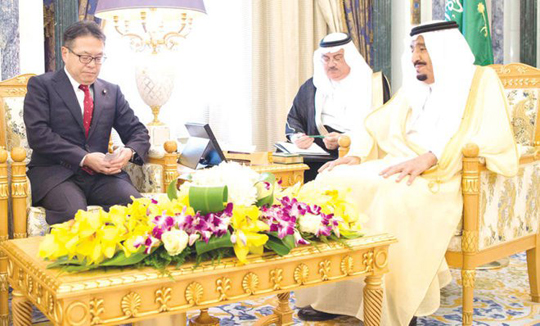
Custodian of the Two Holy Mosques King Salman received at Al-Yamamah Palace Japanese Minister of Economy, Trade and Industry, Hiroshige Seko and Minister of State for Foreign Affairs Kentaro Sonora and their accompanying delegation.

During the meeting, the relations between the Kingdom of Saudi Arabia and Japan as well as the prospects for bilateral cooperation between the two countries in various fields were reviewed. The audience was attended by a number of Saudi ministers and the ambassador of Japan to the Kingdom, Norihiro Okuda.

Deputy Crown Prince Mohammed bin Salman, second deputy premier and minister of defense, also reviewed with the visiting ministers the areas of partnership to realize Saudi Arabia’s Vision 2030.

The two parties discussed the role of Japanese companies and government in activating the achievement of the Vision, including the development of joint programs between the two countries since the start of the Joint Saudi-Japanese Group for Vision 2030. The meeting was attended by Minister of Economy and Planning Adel Fakeih.

At the meetings between the ministers, Japan and Saudi Arabia agreed to advance bilateral cooperation in fields such as network-connected devices and renewable energy.

In the first meeting held in the Saudi capital to support the Kingdom’s structural reform drive and help Japanese companies to make inroads, Trade Minister Hiroshige Seko said the occasion marks the beginning of bilateral cooperation in a concrete form.

"If combined with the Abenomics economy policy mix being pursued by the government of Prime Minister Shinzo Abe, Saudi Arabia’s reform efforts would create a “synergy” that yields great benefits,” Seko said at the outset of the meeting.

The ministerial-level meeting was attended by Adel Fakeih, minister of economy and planning, among other officials.

At the meeting, the two sides also agreed on Japanese support in such areas as talent development in animation and video games, energy conservation and nuclear power, martial arts seminars and athletic training, Japanese officials said.

Executives of about 30 Japanese companies accompanying Seko also met with Saudi officials and pitched their business plans.

The meeting was the result of an agreement reached between Abe and Deputy Crown Prince Mohammed bin Salman in Tokyo last month.

During the meeting between businessmen of the two countries held at the headquarters of the Council of Saudi Chambers on Sunday, Japan and Saudi Arabia agreed to advance bilateral trade cooperation between the two private sectors.

Speaking on behalf of the Saudi team at the headquarters of the Council of Saudi Chambers, Tariq Al-Qahtani told the Japanese officials that there is the second largest trade partner to the Kingdom enjoying a bilateral trade of $57 billion in 2013. He said the recent visit of the deputy crown prince to Japan and an earlier visit of King Salman when he was crown prince, had boosted trade between the two countries.

Al-Qahtani recalled that during these visits, a number agreements were signed and they are now being successfully implemented to derive mutual benefits. The results of these agreements will affect technology transfer and boost small and medium enterprises in the Kingdom.

The executive president of JETRO said that Japan’s largest volume of oil comes from the Kingdom and Japan in turn exports a variety of products including automobiles and machinery to Saudi Arabia.

Describing trade between two countries as significant, he said Japan is interested in taking part actively in the implementation of the 2030 program.

Leading Japanese bank Mizuho Financial Group, Inc. and state-owned Saudi Arabian Oil Co. (Saudi Aramco) recently signed a major agreement for business cooperation with the aim to support Japanese companies investing in the Kingdom. The move will go a long way in expanding ties between the two countries, especially in the energy sector.

With the memorandum of understanding, Mizuho, the sole Japanese bank to have an office in Saudi Arabia, is expected to work more closely with the Kingdom and provide enhanced support to Aramco, which works to transform its business portfolio, the Tokyo-based financial group said in a press statement, while referring to the visit of Deputy Crown Prince Mohammed bin Salman to Tokyo.

The statement said that “Mizuho will use Aramco’s knowhow and network to introduce Japanese companies, in particular SMEs and middle-marketers which have unique technological advantages, to Aramco and other Saudi companies as their business partners.”

Comments

Add new comment

  • Coastaldigest.com reserves the right to delete or block any comments.
  • Coastaldigset.com is not responsible for its readers’ comments.
  • Comments that are abusive, incendiary or irrelevant are strictly prohibited.
  • Please use a genuine email ID and provide your name to avoid reject.
News Network
January 16,2020

Abu Dhabi, Jan 16: The number of people being killed by terrorism activities worldwide has decreased significantly over the recent years, according to the latest Global Terrorism Index.

The 2019 Global Terrorism Index, which was presented at a forum in Abu Dhabi on Wednesday also showed that the UAE improved its ranking in the index by coming down to 130th rank among the 163 countries. The terrorism impact in the UAE is categorised as 'very low'. In the UAE, only two terrorism incidents were reported over the past decade - one in 2010 and another in 2014 - and there were no casualties.

Commenting on the report, Mansour Al Mansouri, director of the UAE National Media Council (NMC) said: "These findings rightly show the UAE as one of the safest countries in the world in terms of terror threat."

The index showed that the total number of deaths from terrorism declined for the fourth consecutive year in 2018, falling by 15.2 per cent to 15,952 deaths. This represents a 53 per cent reduction since its peak in 2014 when 33,555 people were killed in terrorist attacks.

The index published for the seventh year in a row, ranks 163 countries across the globe according to the relative impact of terrorism. This takes into account the number of terrorist incidents, deaths caused by terror and total value of property damage.

The latest results saw three Middle East countries - Iraq, Syria and Yemen - continue in the top 10 positions of the index.

The findings also showed Taleban overtaking Daesh as the deadliest terrorist group in the world, accounting for 38 per cent of all terrorist deaths. This is an increase of 71 per cent. Afghanistan is the country most affected by terrorism in 2018 followed by Iraq, Nigeria, Syria and Pakistan, according to the report. The least impacted nations were Belarus, Guinea-Bissau, Oman, The Gambia and North Korea.

During his presentation of the key findings of the index at the Foreign Correspondent's Club of the UAE (FCC), Serge Stroobants, director of Europe and Mena at the Institute of Economics and Peace, said lesser people were now being killed in terrorism activities.

"There have been long-term trends in global terrorism, with deaths caused by terror down by 52 per cent compared to high point of 2014, which saw Daesh and Boko Haram at their peak," said Stroobants attributing the decrease in the deaths to the increase in security measures and cooperation among nations in the fight against terrorism.

In contrast to this, there has been a 320 per cent increase in far-right terrorist incidents in the West, with political ideology being the driving force behind an increased proportion of terror motivation.

"There has been an increase in far-right terrorism in Western Europe, North America and Oceania for the third consecutive year," said Stroobants.

Terrorism still remains a global security threat, according the index, with 71 countries recording more than one death - the second highest number of countries since 2002.

Stroobants said conflicts remain the main cause of terrorism with 90 per cent of terrorist incidents occurring in places where there are conflicts or insurgencies.

The report said the global economic impact of terrorism was $33 billion in 2018, a substantial decrease of 38 per cent from the previous year.

Boko Haram was responsible for 80 per cent of all female suicide attacks, said the terrorism index.

Global Terrorism Index: Most affected countries

>Afghanistan (7379 deaths)

>Iraq (1,054 deaths)

>Nigeria (2,040 deaths)

>Syria (662 deaths)

>Pakistan (537 deaths)

>Somalia (646 deaths)

>India (350 deaths)

>Yemen (301 deaths)

>The Philippines (297 deaths)

>Democratic Republic of the Congo (410 deaths)

Comments

Add new comment

  • Coastaldigest.com reserves the right to delete or block any comments.
  • Coastaldigset.com is not responsible for its readers’ comments.
  • Comments that are abusive, incendiary or irrelevant are strictly prohibited.
  • Please use a genuine email ID and provide your name to avoid reject.
News Network
May 6,2020

A massive fire engulfed a residential tower in UAE's Sharjah last night. The building has been identified as one Abbco Tower in Al Nahda.

According to the latest inputs, Sharjah Civil Defence teams rushed to the spot and evacuated all residents. 

Firefighters managed to douse the blaze after several hours. The building in question is reportedly a 48-storey structure. Officials are yet to reveal the cause of the fire.

All residents of the building were evacuated while seven incurred minor injuries during the evacuation and were treated at local hospitals, reported the United Arab Emirates' local media.

More details are awaited as this is a developing story.

Comments

Add new comment

  • Coastaldigest.com reserves the right to delete or block any comments.
  • Coastaldigset.com is not responsible for its readers’ comments.
  • Comments that are abusive, incendiary or irrelevant are strictly prohibited.
  • Please use a genuine email ID and provide your name to avoid reject.
News Network
June 12,2020

Beirut, Jun 12: Angry Lebanese protesters blocked roads across the country with burning tyres, debris and their vehicles, incensed over the local currency's depreciation by more than 25 percent in just two days.

The demonstrations from northern Akkar and Tripoli to central Zouk, the eastern Bekaa Valley, Beirut and southern Tyre and Nabatieh on Thursday were some of the most widespread in months of upheaval over a calamitous economic and financial crisis.

Protesters set ablaze a branch of the Central Bank, vandalised several private banks and clashed with security forces in several areas. At least 41 people were injured in Tripoli alone, according to the Lebanese Red Cross.

"I'm really pissed off, that's all. If politicians think they can burn our hearts like this the fire is going to reach them too," unemployed computer engineer Ali Qassem, 26, told Al Jazeera after pouring fuel onto smouldering tyres on a main Beirut thoroughfare.

Tens of thousands of Lebanese have lost jobs in the past six months and hundreds of businesses have shuttered as a dollar shortage led the Lebanese pound to slide from 1,500 to $1 last summer - where it was pegged for 23 years - to roughly 4,000 for each US dollar last month.

But the slide turned into a freefall between Wednesday and Thursday when the pound plummeted to roughly 5,000 to $1 on black markets, which have become a main source of hard currency. There was widespread speculation the rate hit 6,000 or even 7,000 pounds to the dollar, though most markets stopped trading.

Protesters began amassing on streets across the country before sunset and increased into the thousands across the country as the night fell.

Prime Minister Hassan Diab cancelled all meetings scheduled for Friday to hold an emergency cabinet session at 9:30am and another at 3pm at the presidential palace to be headed by President Michel Aoun.

The pound's collapse is the perhaps the biggest challenge yet for Diab's young cabinet, which gained confidence in February after former prime minister Saad Hariri's government was toppled by an unprecedented October uprising that had the country's economic crisis at its core.

Economy Minister Raoul Nehme told Al Jazeera that there was "disinformation" being circulated about the exchange rate on social media and said he was investigating possible currency manipulation.

"I don't understand how the exchange rate increased by so much in two days," he said.

Many protesters have pitted blame on Central Bank governor Riad Salameh, nominally in charge of  keeping the currency stable. But they have also called on the government to resign.

"If people want reform between dawn and dusk, that's not going to work, and if someone thinks they can do a better job then please come forward," Nehme said.

"But what we can't have is a power vacuum - then the exchange rate won't be 5000, it'll be a catastrophe."

'Everyone paying the price'

When protesters set a large fire in Beirut's Riad al-Solh Square, which lies at the foot of a grand Ottoman-era building that serves as the seat of government, firefighters did not intervene to extinguish it.

It later became clear why: Civil Defence told local news channel LBCI they had run out of diesel to fuel their firetrucks.

Basic imports such as fuel have been hit hard by the currency crisis, making already-weak state services increasingly feeble.

A half-dozen or so police officers with Lebanon's Internal Security Forces observed the scene unfolding in front of them in the square.

"Why do you destroy shops and things and attack us security forces - do you think we're happy? Go and f****** break that wall or go to the politicians' houses," one police officer told Al Jazeera, referring to a large concrete barrier separating protesters from the seat of government.

"In the end we are with you and we want the country to change. Don't you dare think we're happy. My salary is now worth $130," the officer said.

The currency's spectacular fall seems to have pushed many Lebanese to put common interests above their differences.

Large convoys of men on motorbikes from Shia-majority areas of southern Beirut joined the demonstrations on Thursday, though they have clashed with protesters many times before - including at a protest on Saturday.

Some chanted sectarian insults, leading to brief clashes in areas that were formerly front lines during the country's devastating 15-year civil war.

Instead, the motorbike-riding demonstrators on Thursday chanted: "Shia, Sunni, F*ck sectarianism."

"We are Shia, and Sunnis and Christian are our brothers," Hisham Houri, 39, told Al Jazeera, perched on a moped with his fiancee behind him just a few metres from a pile of burning tyres.

The blaze sent thick black smoke into the sky towards an iconic blue-domed mosque and church in downtown Beirut.

"Politicians play on these sectarian issues and sometimes succeed, but in the end, they'll fail because all the people have been hurt," he said. "The dollar isn't just worth 6,000 for Shias or for Sunnis, everyone is paying that price."

Comments

Add new comment

  • Coastaldigest.com reserves the right to delete or block any comments.
  • Coastaldigset.com is not responsible for its readers’ comments.
  • Comments that are abusive, incendiary or irrelevant are strictly prohibited.
  • Please use a genuine email ID and provide your name to avoid reject.