



Future Decoded: Microsoft boosts Aadhaar with Skype Lite

February 22, 2017

Feb 22: The government's sustained efforts to implement the use-case scenarios for 12-digit Aadhaar got a major fillip from tech giant Microsoft when it launched new apps Linkedin Lite and Skype Lite.
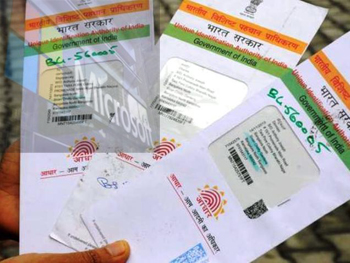
aadhar-bill-2Microsoft Chief Executive Satya Nadella, in his keynote speech at the company's Future Decoded summit in Mumbai, unveiled the apps explaining how they can revolutionise the way candidate verification processes can happen at big companies and SMEs.

"Skype will now support Aadhaar. Skype Lite will come in to help people connect in poor network areas and it is going to come with Aadhaar capabilities," Nadella said.

The Skype Lite app can verify Aadhaar data real time with the help of OTPs -- similar to the ones generated for online verification. Employers can chat with 'Aadhaar Verified' users on both the regular Skype app and the new Skype Lite app while interacting for job interviews and similar scenarios.

Nadella stressed on the importance of job creation and skill development as a plank for economic upliftment of individuals and the country. Microsoft plans to leverage the 39-million-strong LinkedIn user base in India.

"LinkedIn India is creating products just for India and the first one is LinkedIn Lite, a tool that will help people connect from low connectivity zones in the country," Nadella said.

Project Sangam

Microsoft's new programme Project Sangam will help Indians to skill themselves for jobs available, Nadella said. The ecosystem will allow skilled individuals pour content into a pool which can be used by anyone for training purposes, thereby making individuals better-skilled candidates.

Enrollment for Project Sangam is done through the government's Aadhaar Praman Service.

Comments

Add new comment

  • Coastaldigest.com reserves the right to delete or block any comments.
  • Coastaldigset.com is not responsible for its readers’ comments.
  • Comments that are abusive, incendiary or irrelevant are strictly prohibited.
  • Please use a genuine email ID and provide your name to avoid reject.
Agencies
March 12,2020

Thiruvananthapuram, Mar 12: In the wake of COVID-19 outbreak, Internet service providers in Kerala have agreed to step up the network capacity by 30 to 40 per cent of the present capacity to meet the demand, especially in view of the spurt in work-at-home mode.

"The decision was made at a meeting of representatives of various telecom service providers in Kerala circle and officials of the Telecommunication Department convened by the Secretary, Electronics and IT, following a direction by Chief Minister Pinarayi Vijayan to look into the issue," said a press release by the IT Department.

The decision will be beneficial for those working in IT institutions. The government has come out with a set of suggestions to avoid social gatherings at public places in view of coronavirus spread. Telecom service providers have assured the government that they are well equipped to face the current situation.

The major part of Internet consumption in Kerala is made available through local servers. Moreover, global Internet traffic is very low as compared to the overall consumption. So, increasing the capacity won't be difficult, service providers informed.

"Complaints regarding the low availability of the Internet due to the spurt in consumption of the Internet can be made to the service providers to their complaint redressal number or inform state government call centre (155300). But complaints regarding the insufficiency in the current network infrastructure should be strictly avoided," said the release.

The IT Department will also demand daily reports from various telecom service providers. By analysing these reports, steps for remedies will be taken after bringing the sudden increase in consumption to the service providers.

Comments

Add new comment

  • Coastaldigest.com reserves the right to delete or block any comments.
  • Coastaldigset.com is not responsible for its readers’ comments.
  • Comments that are abusive, incendiary or irrelevant are strictly prohibited.
  • Please use a genuine email ID and provide your name to avoid reject.
Agencies
July 2,2020

Leiden, Jul 2: Astronomers have discovered a luminous galaxy caught in the act of reionizing its surrounding gas only 800 million years after the Big Bang.

The research, led by Romain Meyer, PhD student at UCL in London, UK, has been presented at the virtual annual meeting of the European Astronomical Society (EAS).

Studying the first galaxies that formed 13 billion years ago is essential to understanding our cosmic origins. One of the current hot topics in extragalactic astronomy is 'cosmic reionization,' the process in which the intergalactic gas was ionized (atoms stripped of their electrons).

Cosmic reionization is similar to an unsolved murder: We have clear evidence for it, but who did it, how and when? We now have strong evidence that hydrogen reionization was completed about 13 billion years ago, in the first billion years of the universe, with bubbles of ionized gas slowly growing and overlapping.

The objects capable of creating such ionized hydrogen bubbles have however remained mysterious until now: the discovery of a luminous galaxy in which 60-100 percent of ionizing photons escape, is likely responsible for ionizing its local bubble. This suggests the case is closer to being solved.

The two main suspects for cosmic reionization are usually 1) a population of numerous faint galaxies leaking ~10 percent of their energetic photons, and 2) an 'oligarchy' of luminous galaxies with a much larger percentage (>50 percent) of photons escaping each galaxy.

In either case, these first galaxies were very different from those today: galaxies in the local universe are very inefficient leakers, with only <2-3 percent of ionizing photons escaping their host. To understand which galaxies governed cosmic reionization, astronomers must measure the so-called escape fractions of galaxies in the reionization era.

The detection of light from excited hydrogen atoms (the so-called Lyman-alpha line) can be used to infer the fraction of escaping photons. On the one hand, such detections are rare because reionization-era galaxies are surrounded by neutral gas which absorbs that signature hydrogen emission.

On the other hand, if this hydrogen signal is detected it represents a 'smoking gun' for a large ionized bubble, meaning we have caught a galaxy reionizing its surroundings. The size of the bubble and the galaxy's luminosity determines whether it is solely responsible for creating this ionized bubble or if unseen accomplices are necessary.

The discovery of a luminous galaxy 800 million years after the Big Bang supports the scenario where an 'oligarchy' of bright leakers emits most of the ionizing photons.

"It is the first time we can point to an object responsible for creating an ionized bubble, without the need for a contribution from unseen galaxies.

Additional observations with the upcoming James Webb Space Telescope will enable us to study further what is likely one of the best suspects for the unsolved case of cosmic reionization," said Meyer.

Comments

Add new comment

  • Coastaldigest.com reserves the right to delete or block any comments.
  • Coastaldigset.com is not responsible for its readers’ comments.
  • Comments that are abusive, incendiary or irrelevant are strictly prohibited.
  • Please use a genuine email ID and provide your name to avoid reject.
Agencies
March 7,2020

New Delhi, Mar 7: The Union government has issued a Global Invite for Expression of Interest for disinvestment in Bharat Petroleum Corporation Limited (BPCL) from prospective bidders with a minimum net worth of $10 billion as of Saturday.

The EoI submissions can be made till May 2, whereas investor queries will be entertained till April 4.

Another condition pertains to a maximum of four members are permitted in a consortium, and the lead member must hold 40 per cent in proportion. Other members of the consortium must have a minimum $1 billion net worth.

The EOI allows changes in the consortium within 45 days, though the lead member cannot be changed.

The GoI proposes to disinvest its entire shareholding in BPCL comprising 1,14,91,83,592 equity shares held through the Ministry of Petroleum and Natural Gas, which constitutes 52.98 per cent of BPCL's equity share capital, along with the transfer of management control to the strategic buyer (except BPCL's equity shareholding of 61.65 per cent in Numaligarh Refinery Limited (NRL) and management control thereon).

The shareholding of BPCL in NRL will be transferred to a Central Public Sector Enterprise operating in the oil and gas sector under the Ministry and accordingly is not a part of the proposed transaction.

Comments

Add new comment

  • Coastaldigest.com reserves the right to delete or block any comments.
  • Coastaldigset.com is not responsible for its readers’ comments.
  • Comments that are abusive, incendiary or irrelevant are strictly prohibited.
  • Please use a genuine email ID and provide your name to avoid reject.