



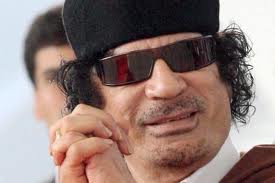
Gaddafi 'agreed to fund Nicolas Sarkozy's 2007 poll campaign'

April 28, 2012

gaddafi

Paris, April 28: Muammar Gaddafi's regime agreed to fund French President Nicolas Sarkozy's 2007 election campaign to the tune of 50 million euros, a news website reported Saturday, publishing what it said was documentary evidence.

The 2006 document in Arabic, which website Mediapart said was signed by Gaddafi's foreign intelligence chief Mussa Kussa, referred to an "agreement in principle to support the campaign for the candidate for the presidential elections, Nicolas Sarkozy, for a sum equivalent to 50 million euros."

The left-wing investigative website made similar assertions on March 12, based on testimony by a former doctor of a French arms dealer alleged to have arranged the campaign donation, which Sarkozy slammed as "grotesque."

"If he had financed it, I wasn't very grateful," Sarkozy said sarcastically in a television interview, in an apparent reference to the active role that France played in the Nato campaign that led to the strongman's ouster last year.

The latest report comes as Sarkozy trails Socialist rival Francois Hollande in opinion polls ahead of the run-off second round of presidential elections on May 6.

The green-bordered note published and translated by Mediapart said the agreement followed a meeting on October 6, 2006, attended by Gaddafi's spy chief Abdullah Senussi, the head of Tripoli's African investment fund Bashir Saleh, close Sarkozy associate Brice Hortefeux and arms dealer Ziad Takieddine.

A lawyer for Takieddine denied to Mediapart that her client was present but said, "he believes this document is credible, given the date and the persons named."

The latest report by Mediapart, a respected source seen as opposed to Sarkozy's right-wing government, strengthens long-running allegations that French political camps have benefited financially from kickbacks on arms deals with foreign regimes. Gaddafi's son Seif al-Islam last year claimed that Libya financed Sarkozy's campaign, after Paris abandoned its improving ties with Libya and threw its weight behind the rebellion that eventually deposed and killed the dictator.

"Sarkozy must first give back the money he took from Libya to finance his electoral campaign. We funded it and we have all the details and are ready to reveal everything," Seif told the Euronews network.

When asked about Seif's comments during the March 12 interview on France's TF1 television, Sarkozy replied: "I am sorry to see you in the role of a spokeswoman for Gaddafi's son, frankly I've known you in better roles."

"It's grotesque and I am sorry that I am being interrogated about declarations of Gaddafi or his son on an important channel like TF1," Sarkozy said.

"When one quotes Mr. Gaddafi, who is dead, his son, who has blood on his hands, that is a regime of dictators, assassins, whose credibility is zero... frankly, I think we have sunk low enough in the political debate."

The report published by Mediapart in March, which also referred to "BH" -- understood to be Hortefeux, who later became Sarkozy's interior minister -- was written by private operative Jean-Charles Brisard.

Takieddine is already under investigation for his alleged role in the funding of Edouard Balladur's failed 1995 presidential campaign for which Sarkozy was spokesman.

Investigators suspect Balladur's camp collected kickbacks on a deal to sell submarines to Pakistan and that a Karachi bombing that killed 11 French engineers was carried out by Pakistani agents in revenge after promised bribes went unpaid.

Sarkozy has always denied any wrongdoing in the 1995 campaign finance arrangements.


Comments

Add new comment

  • Coastaldigest.com reserves the right to delete or block any comments.
  • Coastaldigset.com is not responsible for its readers’ comments.
  • Comments that are abusive, incendiary or irrelevant are strictly prohibited.
  • Please use a genuine email ID and provide your name to avoid reject.
News Network
June 13,2020

Jun 13: Requiring the wearing of masks to prevent the spread of the novel coronavirus in areas at the epicenter of the global pandemic may have prevented tens of thousands of infections, a new study suggests.

Mask-wearing is even more important for preventing the virus' spread and the sometimes deadly COVID-19 illness it causes than social distancing and stay-at-home orders, researchers said, in the study published in PNAS: The Proceedings of the National Academy of Sciences of the USA.

Infection trends shifted dramatically when mask-wearing rules were implemented on April 6 in northern Italy and April 17 in New York City - at the time among the hardest hit areas of the world by the health crisis - the study found.

"This protective measure alone significantly reduced the number of infections, that is, by over 78,000 in Italy from April 6 to May 9 and over 66,000 in New York City from April 17 to May 9," researchers calculated.

When mask-wearing went into effect in New York, the daily new infection rate fell by about 3% per day, researchers said. In the rest of the country, daily new infections continued to increase.

Direct contact precautions - social distancing, quarantine and isolation, and hand sanitizing - were all in place before mask-wearing rules went into effect in Italy and New York City. But they only help minimize virus transmission by direct contact, while face covering helps prevent airborne transmission, the researchers say.

"The unique function of face covering to block atomization and inhalation of virus-bearing aerosols accounts for the significantly reduced infections," they said. That would indicate "that airborne transmission of COVID-19 represents the dominant route for infection."

The U.S. Center for Disease Control and Prevention on Friday urged organizers of large gatherings that involve "shouting, chanting or singing to strongly encourage the use of cloth face coverings to lower the risk of spreading the coronavirus."

Comments

Add new comment

  • Coastaldigest.com reserves the right to delete or block any comments.
  • Coastaldigset.com is not responsible for its readers’ comments.
  • Comments that are abusive, incendiary or irrelevant are strictly prohibited.
  • Please use a genuine email ID and provide your name to avoid reject.
News Network
January 30,2020

New York, Jan 30: Three Indian citizens were arrested by border patrol agents here for entering the US illegally.

US Border Patrol agents stopped a vehicle near Massena in New York state along the county's northern border on January 24. During the vehicle checking, the agents found that two of the passengers were Indian citizens who entered the US illegally and not at a designated port of entry.

Both the passengers were transported to the Border Patrol Station for processing and charged.

The vehicle driver, also an Indian citizen who originally entered illegally into the US in 2012 and was ordered removed from the country in absentia last December, was charged with alien smuggling, a felony, which carries a penalty of a fine and up to five years of imprisonment for each violation.

Comments

Add new comment

  • Coastaldigest.com reserves the right to delete or block any comments.
  • Coastaldigset.com is not responsible for its readers’ comments.
  • Comments that are abusive, incendiary or irrelevant are strictly prohibited.
  • Please use a genuine email ID and provide your name to avoid reject.
News Network
June 15,2020

Jun 15: Oil prices fell on Monday, with U.S. oil dropping more than 2%, as a spike in new coronavirus cases in the United States raised concerns over a second wave of the virus which would weigh on the pace of fuel demand recovery.

Brent crude futures fell 66 cents, or 1.7%, at $38.07 a barrel as of 0016 GMT, while U.S. West Texas Intermediate (WTI) crude futures fell 81 cents, or 2.2%, to $35.45 a barrel.

Both benchmarks ended down about 8% last week, their first weekly declines since April, hit by the U.S. coronavirus concerns: More than 25,000 new cases were reported on Saturday alone as more states, including Florida and Texas, reported record new infection highs.

"Concerns about the recent uptick in COVID-19 infections in the U.S. and a potential 'second wave' are weighing on oil at the moment," said Stephen Innes, chief global market strategist at AxiCorp.

Meanwhile, an OPEC-led monitoring panel will meet on Thursday to discuss ongoing record production cuts to see whether countries have delivered their share of the reductions, but will not make any decision, according to five OPEC+ sources.

The Organization of the Petroleum Exporting Countries (OPEC) and its allies, collectively known as OPEC+, have been reducing supplies by 9.7 million barrels per day (bpd), about 10% of pre-pandemic demand, and agreed in early June to extend the cuts for a month until end-July.

Iraq, one of the laggards in complying with the curbs, agreed with its major oil companies to cut crude production further in June, Iraqi officials working at the fields told Reuters on Sunday.

Comments

Add new comment

  • Coastaldigest.com reserves the right to delete or block any comments.
  • Coastaldigset.com is not responsible for its readers’ comments.
  • Comments that are abusive, incendiary or irrelevant are strictly prohibited.
  • Please use a genuine email ID and provide your name to avoid reject.