



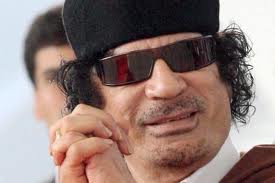
Gaddafi 'agreed to fund Nicolas Sarkozy's 2007 poll campaign'

April 28, 2012

gaddafi

Paris, April 28: Muammar Gaddafi's regime agreed to fund French President Nicolas Sarkozy's 2007 election campaign to the tune of 50 million euros, a news website reported Saturday, publishing what it said was documentary evidence.

The 2006 document in Arabic, which website Mediapart said was signed by Gaddafi's foreign intelligence chief Mussa Kussa, referred to an "agreement in principle to support the campaign for the candidate for the presidential elections, Nicolas Sarkozy, for a sum equivalent to 50 million euros."

The left-wing investigative website made similar assertions on March 12, based on testimony by a former doctor of a French arms dealer alleged to have arranged the campaign donation, which Sarkozy slammed as "grotesque."

"If he had financed it, I wasn't very grateful," Sarkozy said sarcastically in a television interview, in an apparent reference to the active role that France played in the Nato campaign that led to the strongman's ouster last year.

The latest report comes as Sarkozy trails Socialist rival Francois Hollande in opinion polls ahead of the run-off second round of presidential elections on May 6.

The green-bordered note published and translated by Mediapart said the agreement followed a meeting on October 6, 2006, attended by Gaddafi's spy chief Abdullah Senussi, the head of Tripoli's African investment fund Bashir Saleh, close Sarkozy associate Brice Hortefeux and arms dealer Ziad Takieddine.

A lawyer for Takieddine denied to Mediapart that her client was present but said, "he believes this document is credible, given the date and the persons named."

The latest report by Mediapart, a respected source seen as opposed to Sarkozy's right-wing government, strengthens long-running allegations that French political camps have benefited financially from kickbacks on arms deals with foreign regimes. Gaddafi's son Seif al-Islam last year claimed that Libya financed Sarkozy's campaign, after Paris abandoned its improving ties with Libya and threw its weight behind the rebellion that eventually deposed and killed the dictator.

"Sarkozy must first give back the money he took from Libya to finance his electoral campaign. We funded it and we have all the details and are ready to reveal everything," Seif told the Euronews network.

When asked about Seif's comments during the March 12 interview on France's TF1 television, Sarkozy replied: "I am sorry to see you in the role of a spokeswoman for Gaddafi's son, frankly I've known you in better roles."

"It's grotesque and I am sorry that I am being interrogated about declarations of Gaddafi or his son on an important channel like TF1," Sarkozy said.

"When one quotes Mr. Gaddafi, who is dead, his son, who has blood on his hands, that is a regime of dictators, assassins, whose credibility is zero... frankly, I think we have sunk low enough in the political debate."

The report published by Mediapart in March, which also referred to "BH" -- understood to be Hortefeux, who later became Sarkozy's interior minister -- was written by private operative Jean-Charles Brisard.

Takieddine is already under investigation for his alleged role in the funding of Edouard Balladur's failed 1995 presidential campaign for which Sarkozy was spokesman.

Investigators suspect Balladur's camp collected kickbacks on a deal to sell submarines to Pakistan and that a Karachi bombing that killed 11 French engineers was carried out by Pakistani agents in revenge after promised bribes went unpaid.

Sarkozy has always denied any wrongdoing in the 1995 campaign finance arrangements.


Comments

Add new comment

  • Coastaldigest.com reserves the right to delete or block any comments.
  • Coastaldigset.com is not responsible for its readers’ comments.
  • Comments that are abusive, incendiary or irrelevant are strictly prohibited.
  • Please use a genuine email ID and provide your name to avoid reject.
News Network
February 28,2020

Washington, Feb 28: US intelligence agencies are monitoring the global spread of coronavirus and the ability of governments to respond, sources familiar with the matter said on Thursday, warning that there were concerns about how India would cope with a widespread outbreak.

While there are only a few known cases in India, one source said the country's available countermeasures and the potential for the virus to spread given India's dense population was a focus of serious concern.

US intelligence agencies are also focusing on Iran, where the country's deputy health minister has fallen ill during a worsening outbreak.

US Secretary of State Mike Pompeo said on Tuesday the United States was "deeply concerned" Tehran may have covered up details about the spread of coronavirus. A US government source said Iran's response was considered ineffective because the government only has minimal capabilities to respond to the outbreak.

Another source said US agencies were also concerned about the weak ability of governments in some developing countries to respond to an outbreak.

The US House of Representatives Intelligence Committee has received a briefing on the virus from the spy agencies. "The Committee has received a briefing from the IC (intelligence community) on coronavirus, and continues to receive updates on the outbreak on a daily basis," an official of the House Intelligence Committee told Reuters.

"Addressing the threat has both national security and economic dimensions, requiring a concerted government-wide effort and the IC is playing an important role in monitoring the spread of the outbreak, and the worldwide response," the official added.

A source familiar with the activities of the Senate Intelligence Committee, led by Republican Senator Richard Burr and Democratic Senator Mark Warner, said the panel was receiving daily updates. The role of US intelligence agencies in responding to the coronavirus epidemic at this point principally involves monitoring the spread of the illness around the world and assessing the responses of governments.

They are working closely with health agencies, such as the US Center for Disease Control, in sharing information they collect and targeting further intelligence gathering.

One source said US agencies would use a wide range of intelligence tools, ranging from undercover informants to electronic eavesdropping tools, to track the virus' impact.

Comments

Add new comment

  • Coastaldigest.com reserves the right to delete or block any comments.
  • Coastaldigset.com is not responsible for its readers’ comments.
  • Comments that are abusive, incendiary or irrelevant are strictly prohibited.
  • Please use a genuine email ID and provide your name to avoid reject.
Agencies
April 25,2020

From loudspeakers on the roof of a Minnesota mosque, the Islamic call to prayer echoed for the first time ever throughout a Minneapolis neighbourhood late on Thursday as the Muslim community there prepared to begin the holy month of Ramadan.

It echoed again on Friday morning and will continue five times a day during the holy month. 

The simple, short call - known as the adhan - marked an historical moment for Minneapolis and major cities across the United States, community members said. While the adhan is commonly broadcast throughout the Middle East, North Africa and other places, for many Muslims in the US, it is only heard inside mosques or community centres.

"There's definitely a lot of excitement," said Imam Abdisalam Adam, who is on the board of the Dar al-Hijrah mosque, from where the adhan will be broadcast.
"Some people see it as historic," Adam told Al Jazeera. "To the point ... that they're not doing it, able to see it in their lifetime." 

Recited by different representatives from mosques around the city, the call to prayer is expected to reach thousands in the Cedar-Riverside neighbourhood in Minneapolis, according to Jaylani Hussein, the executive director of Minnesota's Council on American-Islamic Relations (CAIR).

While Hussein says the community had discussed broadcasting the call for years, it became even more pressing this year when the coronavirus pandemic forced mosques to shut their doors and residents to stay inside. The coronavirus has infected more than 870,000 people nationwide and killed at least 50,000.
"We wanted to touch those individuals who frequent this mosque and this community," Hussein said. "If we cannot be physically together, at least this echo, this voice, this call to prayer can be an extension of us being together at this difficult time. To give some people some solace."
Ramadan - Minnesota.

The Dar al-Hijrah mosque in the Cedar-Riverside neighbourhood of Minneapolis, Minnesota [Courtesy of Abdisalem Adam] 
Ramadan is traditionally a time when Muslims worldwide regularly attend mosques for daily prayers and break their fasts together. But this year, most have been told to pray at home and forgo community iftars in favour of staying safe from the COVID-19 crisis.

Adam, the imam, said while the Muslim community is experience loss this Ramadan, they hope the call to prayer broadcast will create a "semblance of normalcy".

"With the loss of Friday prayers and the regular congregational prayers, we are hoping that this will give a sense of solace and connection to the spiritual needs of community members," he added. 

An avenue to greater investment?

The Cedar-Riverside neighbourhood is a densely populated area of Minneapolis that has historically been an entry point for many immigrants and today is home to large Somali and Oromo communities.

Ramla Bile, a Somali American who lives in a neighbourhood adjacent to Cedar-Riverside, has been active in the community for years. She welcomed the broadcast of the call to prayer, saying it will help people "feel the spirit of Ramadan in a way that is meaningful".

But she also hopes the city of Minneapolis, which provided the noise permit for the broadcast, will make bigger strides to invest in the community in even more tangible ways.

"There's been a lot of need and a lot hurt in the community in light of the COVID-19 pandemic. And then there's the ongoing conversation you've been having," she said, pointing to deep-seated Islamophobia, systemic racism and the need for infrastructure projects like sprinkler systems in high-rise buildings. 

"We need to see greater investments to support the most vulnerable members of our community," Bile said referring to the neighbourhood's elders, undocumented individuals, low-income families and others.

"Right now, we're waiting for a bailout for our micro-businesses who comprise our Somali malls, or a rent freeze for neighbourhood residents," she added.

For CAIR's Hussein and Imam Adam, they hope this Ramadan's call to prayer helps encourage other communities around the US to take similar steps.

"This will hopefully inspire others … to think about what could happen in future Ramadans and beyond," Hussein said.

Adam added that while the virus has devastated communities and upended daily life, it has also shown that "we're in this together".

"It just shows the significance of the global village and how interconnected and interdependent we are as a world community," he said. "I think that there will be a lot of change in our way of life for the better. I hope so."


Comments

Add new comment

  • Coastaldigest.com reserves the right to delete or block any comments.
  • Coastaldigset.com is not responsible for its readers’ comments.
  • Comments that are abusive, incendiary or irrelevant are strictly prohibited.
  • Please use a genuine email ID and provide your name to avoid reject.
Agencies
February 25,2020

Washington, Feb 25: Democratic presidential front-runner Senator Bernie Sanders on Monday slammed President Donald Trump for selling weapons to India, saying that the US should instead partner with New Delhi to fight climate change to save the planet.

Sanders, who has won the Nevada and New Hampshire primaries and tied in Iowa, made the comments after Trump, who is on a two-day visit to India, on Monday announced that the US will sign defence trade deals worth USD 3 billion with India.

In an address at a massive "Namaste Trump" rally at Motera stadium in Ahmedabad, Trump announced that deals to sell state-of-the-art military helicopters and other equipment worth over USD 3 billion will be sealed with India on Tuesday.

“Instead of selling USD 3 billion in weapons to enrich Raytheon, Boeing and Lockheed, the United States should be partnering with India to fight climate change,” Sanders said in a tweet, the first by a Democratic presidential candidate on Trump's India visit.

“We can work together to cut air pollution, create good renewable energy jobs, and save our planet,” he said.

However, a former White House official defended the US' decision to sell arms and weapons to India.

“I'm proud of my service in the White House, in which we poured enormous energy into deepening climate and green tech cooperation w/ India... and also advancing security cooperation and defense sales. I'd like to think both can be part of a strong, values-based partnership,” Joshua White said.

According to the US State Department, India plays a vital role in the US vision for a free and open Indo-Pacific.

In 2016, the US designated India as a Major Defence Partner. Commensurate with this designation, India in 2018 was granted Strategic Trade Authorization tier 1 status, which allows New Delhi to receive license-free access to a wide range of military and dual-use technologies that are regulated by the Department of Commerce.

Bilateral defence trade with India in a little over a decade has increased from near zero in 2008 to USD20 billion.

Among some of the key foreign military sales notified to Congress include MH-60R Seahawk helicopters (USD2.6 billion), Apache helicopters (USD2.3 billion), P-8I maritime patrol aircraft (USD3 billion), and M777 howitzers (USD737 million).

India was the first non-treaty partner to be offered a Missile Technology Control Regime Category-1 Unmanned Aerial System – the Sea Guardian UAS manufactured by General Atomics.

The State Department is also advocating for the Lockheed Martin F-21 and Boeing F/A-18 – two state of the art fighter aircraft that India is currently evaluating.

These platforms provide critical opportunities to enhance India's military capabilities and protect shared security interests in the Indo-Pacific region, it argued.

The top categories of DCS to India include aircraft, electronics and gas turbine engines.

Comments

Add new comment

  • Coastaldigest.com reserves the right to delete or block any comments.
  • Coastaldigset.com is not responsible for its readers’ comments.
  • Comments that are abusive, incendiary or irrelevant are strictly prohibited.
  • Please use a genuine email ID and provide your name to avoid reject.