



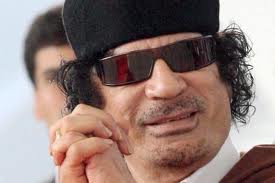
Gaddafi 'agreed to fund Nicolas Sarkozy's 2007 poll campaign'

April 28, 2012

gaddafi

Paris, April 28: Muammar Gaddafi's regime agreed to fund French President Nicolas Sarkozy's 2007 election campaign to the tune of 50 million euros, a news website reported Saturday, publishing what it said was documentary evidence.

The 2006 document in Arabic, which website Mediapart said was signed by Gaddafi's foreign intelligence chief Mussa Kussa, referred to an "agreement in principle to support the campaign for the candidate for the presidential elections, Nicolas Sarkozy, for a sum equivalent to 50 million euros."

The left-wing investigative website made similar assertions on March 12, based on testimony by a former doctor of a French arms dealer alleged to have arranged the campaign donation, which Sarkozy slammed as "grotesque."

"If he had financed it, I wasn't very grateful," Sarkozy said sarcastically in a television interview, in an apparent reference to the active role that France played in the Nato campaign that led to the strongman's ouster last year.

The latest report comes as Sarkozy trails Socialist rival Francois Hollande in opinion polls ahead of the run-off second round of presidential elections on May 6.

The green-bordered note published and translated by Mediapart said the agreement followed a meeting on October 6, 2006, attended by Gaddafi's spy chief Abdullah Senussi, the head of Tripoli's African investment fund Bashir Saleh, close Sarkozy associate Brice Hortefeux and arms dealer Ziad Takieddine.

A lawyer for Takieddine denied to Mediapart that her client was present but said, "he believes this document is credible, given the date and the persons named."

The latest report by Mediapart, a respected source seen as opposed to Sarkozy's right-wing government, strengthens long-running allegations that French political camps have benefited financially from kickbacks on arms deals with foreign regimes. Gaddafi's son Seif al-Islam last year claimed that Libya financed Sarkozy's campaign, after Paris abandoned its improving ties with Libya and threw its weight behind the rebellion that eventually deposed and killed the dictator.

"Sarkozy must first give back the money he took from Libya to finance his electoral campaign. We funded it and we have all the details and are ready to reveal everything," Seif told the Euronews network.

When asked about Seif's comments during the March 12 interview on France's TF1 television, Sarkozy replied: "I am sorry to see you in the role of a spokeswoman for Gaddafi's son, frankly I've known you in better roles."

"It's grotesque and I am sorry that I am being interrogated about declarations of Gaddafi or his son on an important channel like TF1," Sarkozy said.

"When one quotes Mr. Gaddafi, who is dead, his son, who has blood on his hands, that is a regime of dictators, assassins, whose credibility is zero... frankly, I think we have sunk low enough in the political debate."

The report published by Mediapart in March, which also referred to "BH" -- understood to be Hortefeux, who later became Sarkozy's interior minister -- was written by private operative Jean-Charles Brisard.

Takieddine is already under investigation for his alleged role in the funding of Edouard Balladur's failed 1995 presidential campaign for which Sarkozy was spokesman.

Investigators suspect Balladur's camp collected kickbacks on a deal to sell submarines to Pakistan and that a Karachi bombing that killed 11 French engineers was carried out by Pakistani agents in revenge after promised bribes went unpaid.

Sarkozy has always denied any wrongdoing in the 1995 campaign finance arrangements.


Comments

Add new comment

  • Coastaldigest.com reserves the right to delete or block any comments.
  • Coastaldigset.com is not responsible for its readers’ comments.
  • Comments that are abusive, incendiary or irrelevant are strictly prohibited.
  • Please use a genuine email ID and provide your name to avoid reject.
Agencies
August 7,2020

Moscow, Aug 7: Russia will register its first vaccine against the coronavirus on August 12, Deputy Health Minister Oleg Gridnev said on Friday.

The vaccine has been developed jointly by the Gamaleya Research Institute and the Russian Defence Ministry.

"The vaccine developed by the Gamaleya centre will be registered on August 12. At the moment, the last, third, stage is underway. The trials are extremely important. We have to understand that the vaccine must be safe. Medical professionals and senior citizens will be the first to get vaccinated," Gridnev told reporters at the opening of a cancer centre building in the city of Ufa.

According to the minister, the effectiveness of the vaccine will be judged when the population immunity has formed.

Clinical trials of the vaccine began on June 18 and included 38 volunteers. All of the participants developed immunity. 

The first group was discharged on July 15 and the second group on July 20.

Comments

Add new comment

  • Coastaldigest.com reserves the right to delete or block any comments.
  • Coastaldigset.com is not responsible for its readers’ comments.
  • Comments that are abusive, incendiary or irrelevant are strictly prohibited.
  • Please use a genuine email ID and provide your name to avoid reject.
Agencies
August 7,2020

Russia boasts that it's about to become the first country to approve a Covid-19 vaccine, with mass vaccinations planned as early as October using shots that are yet to complete clinical trials -- and scientists worldwide are sounding the alarm that the headlong rush could backfire.

Moscow sees a Sputnik-like propaganda victory, recalling the Soviet Union's launch of the world's first satellite in 1957.

But the experimental Covid-19 shots began first-in-human testing on a few dozen people less than two months ago, and there's no published scientific evidence yet backing Russia's late entry to the global vaccine race, much less explaining why it should be considered a front-runner.

“I'm worried that Russia is cutting corners so that the vaccine that will come out may be not just ineffective, but also unsafe,” said Lawrence Gostin, a global public health law expert at Georgetown University. “It doesn't work that way... Trials come first. That's really important.”

According to Kirill Dmitriev, head of Russia's Direct Investment Fund that bankrolled the effort, a vaccine developed by the Gamaleya research institute in Moscow may be approved in days, before scientists complete what's called a Phase 3 study.

That final-stage study, usually involving tens of thousands of people, is the only way to prove if an experimental vaccine is safe and really works.

Health Minister Mikhail Murashko said members of “risk groups,” such as medical workers, may be offered the vaccine this month.

He didn't clarify whether they would be part of the Phase 3 study that is said to be completed after the vaccine receives “conditional approval.”

Deputy Prime Minister Tatyana Golikova promised to start “industrial production” in September, and Murashko said mass vaccination may begin as early as October.

Dr Anthony Fauci, the top US infectious disease specialist, questioned the fast-track approach last week.

“I do hope that the Chinese and the Russians are actually testing a vaccine before they are administering the vaccine to anyone, because claims of having a vaccine ready to distribute before you do testing I think is problematic at best," he said.

Questions about this vaccine candidate come after the US, Britain and Canada last month accused Russia of using hackers to steal vaccine research from Western labs.

Delivering a vaccine first is a matter of national prestige for the Kremlin as it tries to assert the image of Russia as a global power capable of competing with the US and China.

The notion of being “the first in the world” dominated state news coverage of the effort, with government officials praising reports of the first-step testing.

In April, President Vladimir Putin ordered state officials to shorten the time of clinical trials for a variety of drugs, including potential coronavirus vaccines.

According to Russia's Association of Clinical Trials Organizations, the order set “an unattainable bar” for scientists who, as a result, "joined in on the mad race, hoping to please those at power.”

The association first raised concern in late May, when professor Alexander Gintsburg, head of the Gamaleya institute, said he and other researchers tried the vaccine on themselves.

The move was a “crude violation of the very foundations of clinical research, Russian law and universally accepted international regulations" the group said in an open letter to the government, urging scientists and health officials to adhere to clinical research standards.

But a month later, the Health Ministry authorized clinical trials of the Gamaleya product, with what appeared to be another ethical issue.

Human studies started June 17 among 76 volunteers. Half were injected with a vaccine in liquid form and the other half with a vaccine that came as soluble powder.

Some in the first half were recruited from the military, which raised concerns that servicemen may have been pressured to participate.

Some experts said their desire to perform well would affect the findings. “It's no coincidence media reports we see about the trials among the military said no one had any side effects, while the (other group) reported some," said Vasily Vlassov, a public health expert with Moscow's Higher School of Economics.

As the trials were declared completed and looming regulatory approval was announced last week, questions arose about the vaccine's safety and effectiveness.

Government assurances the drug produced the desired immune response and caused no significant side effects were hardly convincing without published scientific data describing the findings.

The World Health Organization said all vaccine candidates should go through full stages of testing before being rolled out.

“There are established practices and there are guidelines out,” WHO spokesman Christian Lindmeier said Tuesday.

“Between finding or having a clue of maybe having a vaccine that works, and having gone through all the stages, is a big difference.”

Offering an unsafe compound to medical workers on the front lines of the outbreak could make things worse, Georgetown's Gostin said, adding: “What if the vaccine started killing them or making them very ill?”

Vaccines that are not properly tested can cause harm in many ways — from a negative impact on health to creating a false sense of security or undermining trust in vaccinations, said Thomas Bollyky, director of the global health program at the Council on Foreign Relations. 

Comments

Add new comment

  • Coastaldigest.com reserves the right to delete or block any comments.
  • Coastaldigset.com is not responsible for its readers’ comments.
  • Comments that are abusive, incendiary or irrelevant are strictly prohibited.
  • Please use a genuine email ID and provide your name to avoid reject.
Agencies
March 8,2020

Panic gripped big tech firms like Facebook and Twitter which decided to close their offices from Seattle to London as more employees tested positive for the new coronavirus.

Facebook shut its three London offices till Monday after an employee was diagnosed with COVID-19.

The social networking giant told nearly 3,000 employees in London to work from home after an employee, who is based in Singapore but visited the London offices between February 24-26, was diagnosed with the new coronavirus, Sky News reported on Friday.

"An employee based in our Singapore office who has been diagnosed with COVID-19 visited our London offices on February 24-26.

"We are therefore closing our London offices until Monday for deep cleaning and employees are working from home until then," the company said in a statement.

There have been 163 cases of coronavirus so far in the UK.

Earlier, Facebook recommended all its Bay Area employees in the US to work from home. The latest precautions come after San Francisco announced its first two coronavirus cases on Thursday.

Facebook has also shut its Seattle office until Monday after one of its contractors was confirmed to be infected with the virus. The infected contractor last visited the Facebook office on February 21. King County health officials said all Facebook sites should work from home until March 31.

Twitter shut its Seattle office for a 'deep clean' after an employee developed COVID-19 like symptoms though final result was still awaited.

"A Seattle-based employee has been advised by doctor about likely COVID-19, though still awaiting the final testing," Twitter said in a tweet on Friday.

"While the employee has not been at a Twitter office for several weeks and hasn't been in contact w/others, we're closing our Seattle office to deep clean," the company added.

According to The Seattle Times, at least 14 people have died due to COVID-19 in Washington State till date.

Amazon, Microsoft, Google and Facebook have advised their employees in Washington State to work from home.

Apple has reportedly suggested its employees at California campuses to work from home as an "extra precaution" while new coronavirus cases spread on the west coast in the US, especially Seattle area.

Apple's flagship developers' conference WWDC 2020 in June is also at the risk of getting cancelled as the Santa Clara public health department has warned against large public gatherings. The event draws nearly 5,000 developers from across the world.

The US death toll from the new coronavirus has climbed to 14, according to Johns Hopkins' tracker, with 329 cases reported across the country.

Comments

Add new comment

  • Coastaldigest.com reserves the right to delete or block any comments.
  • Coastaldigset.com is not responsible for its readers’ comments.
  • Comments that are abusive, incendiary or irrelevant are strictly prohibited.
  • Please use a genuine email ID and provide your name to avoid reject.