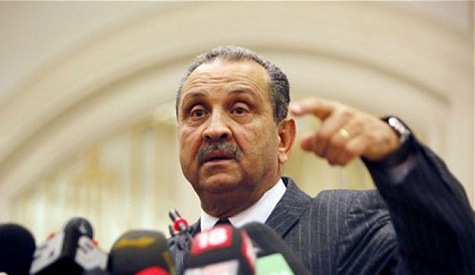
Gadhafi-era oil chief found dead

May 1, 2012

Shukri-Ghanem-Drowned

Vienna, May 1: Libya's former top oil industry official, Shokri Ghanem, has been found floating dead in the River Danube in Austria, police said on Sunday.

Ghanem, 69, had been chairman of Libya's state-owned National Oil Corporation (NOC) before defecting last year several months after opponents of Muammar Gadhafi had risen up against the Libyan leader and begun a rebellion.

As NOC chairman since 2006, Ghanem helped steer Libya's oil policy and held the high-profile job of representing Libya at OPEC meetings, often visiting Vienna for meetings in that role.

No foul pay

“He was found dead in the Danube river at 8:40 am (0640 GMT). There is no suspicion at all of foul play at this stage. The corpse exhibited no signs of violence,” a Vienna police spokesman said.

He said an autopsy would be performed to determine the cause of death. After making a final break with the Gadhafi administration last year, Ghanem first appeared in Rome, saying he had defected because of the “unbearable violence” being used by government forces to try to put down the rebellion.

He was believed to have been living in Europe in exile since then but was still closely associated with Gadhafi's rule by Libya's new leaders and had ruled out returning home.

Comments

Add new comment

  • Coastaldigest.com reserves the right to delete or block any comments.
  • Coastaldigset.com is not responsible for its readers’ comments.
  • Comments that are abusive, incendiary or irrelevant are strictly prohibited.
  • Please use a genuine email ID and provide your name to avoid reject.
News Network
June 9,2020

Washington, Jun 9: The defacement of Mahatma Gandhi's statue by unknown miscreants was a "disgrace", US President Donald Trump has said, days after it was vandalised with graffiti and spray painting during the nationwide protests against the custodial killing of African-American George Floyd.

The statue, which is across the road from the Indian Embassy, was vandalised on the intervening night of June 2 and 3, prompting the Indian embassy to register a complaint with the local law enforcement agencies.

The incident happened during the week of nationwide protests against the custodial killing of Floyd in Minneapolis on May 25.

"It was a disgrace," Trump made the brief comment at the White House on Monday when asked about the incident.

The Indian Embassy here has taken up the matter with the US Department of State for early investigation into the matter, as also with the Metropolitan Police and National Park Service.

It is working with the US Department of State, Metropolitan Police and National Park Service for expeditious restoration of the statue at the park.

The US president and First Lady Melania Trump, during their visit to India in February, had spent considerable time at the Gandhi Ashram in Ahmedabad. Prime Minister Narendra Modi had personally given them a tour of the historic place.

"The First Lady and I have just had a pleasure of visiting Mahatma Gandhi's Ashram, a few miles from here, where he launched the famous Salt March," Trump had said during his address at the Namaste Trump rally at the Motera Stadium in Ahmedabad on February 24. A day later, Trump and the first lady also laid a wreath at Raj Ghat in New Delhi.

Pictures of Trump and the first lady with Gandhi's spinning wheel during their visit to the Sabarmati Ashram in Ahmedabad are seen hanging on the walls of the White House.

Last week, top US lawmakers and the Trump Campaign condemned the vandalisation of the statue.

"Very disappointing," tweeted Kimberly Guilfoyle, advisor to Donald J Trump for President Inc. and National Chair of the Trump Victory Finance Committees.

North Carolina Senator Tom Tillis said, "It's disgraceful to see the defacing of the Gandhi statue" in Washington DC.

"Gandhi was a pioneer of peaceful protesting, demonstrating the great change it can bring. Rioting, looting and vandalising do not bring us together, he said.

Senator Marco Rubio said, "more evidence that violent radicals and run of the mill crazies have hijacked legitimate protests to create anarchy or for their own purposes."

Protests against the custodial killing of Floyd turned violent in the US and prestigious monuments were damaged. In Washington DC, protestors burnt a historic church and damaged monuments like the Lincoln Memorial.

US Ambassador to India Ken Juster apologised for the incident.

"So sorry to see the desecration of the Gandhi statue in Wash, DC. Please accept our sincere apologies," he said.

"Appalled as well by the horrific death of George Floyd and the awful violence and vandalism. We stand against prejudice & discrimination of any type. We will recover and be better," he said in a tweet last week.

One of the few statues of a foreign leader on a federal land in Washington DC, the statue of Gandhi was dedicated by former prime minister Atal Bihari Vajpayee in the presence of the then US president Bill Clinton on September 16, 2000, during his state visit to the US.

Comments

Add new comment

  • Coastaldigest.com reserves the right to delete or block any comments.
  • Coastaldigset.com is not responsible for its readers’ comments.
  • Comments that are abusive, incendiary or irrelevant are strictly prohibited.
  • Please use a genuine email ID and provide your name to avoid reject.
Agencies
August 7,2020

Russia boasts that it's about to become the first country to approve a Covid-19 vaccine, with mass vaccinations planned as early as October using shots that are yet to complete clinical trials -- and scientists worldwide are sounding the alarm that the headlong rush could backfire.

Moscow sees a Sputnik-like propaganda victory, recalling the Soviet Union's launch of the world's first satellite in 1957.

But the experimental Covid-19 shots began first-in-human testing on a few dozen people less than two months ago, and there's no published scientific evidence yet backing Russia's late entry to the global vaccine race, much less explaining why it should be considered a front-runner.

“I'm worried that Russia is cutting corners so that the vaccine that will come out may be not just ineffective, but also unsafe,” said Lawrence Gostin, a global public health law expert at Georgetown University. “It doesn't work that way... Trials come first. That's really important.”

According to Kirill Dmitriev, head of Russia's Direct Investment Fund that bankrolled the effort, a vaccine developed by the Gamaleya research institute in Moscow may be approved in days, before scientists complete what's called a Phase 3 study.

That final-stage study, usually involving tens of thousands of people, is the only way to prove if an experimental vaccine is safe and really works.

Health Minister Mikhail Murashko said members of “risk groups,” such as medical workers, may be offered the vaccine this month.

He didn't clarify whether they would be part of the Phase 3 study that is said to be completed after the vaccine receives “conditional approval.”

Deputy Prime Minister Tatyana Golikova promised to start “industrial production” in September, and Murashko said mass vaccination may begin as early as October.

Dr Anthony Fauci, the top US infectious disease specialist, questioned the fast-track approach last week.

“I do hope that the Chinese and the Russians are actually testing a vaccine before they are administering the vaccine to anyone, because claims of having a vaccine ready to distribute before you do testing I think is problematic at best," he said.

Questions about this vaccine candidate come after the US, Britain and Canada last month accused Russia of using hackers to steal vaccine research from Western labs.

Delivering a vaccine first is a matter of national prestige for the Kremlin as it tries to assert the image of Russia as a global power capable of competing with the US and China.

The notion of being “the first in the world” dominated state news coverage of the effort, with government officials praising reports of the first-step testing.

In April, President Vladimir Putin ordered state officials to shorten the time of clinical trials for a variety of drugs, including potential coronavirus vaccines.

According to Russia's Association of Clinical Trials Organizations, the order set “an unattainable bar” for scientists who, as a result, "joined in on the mad race, hoping to please those at power.”

The association first raised concern in late May, when professor Alexander Gintsburg, head of the Gamaleya institute, said he and other researchers tried the vaccine on themselves.

The move was a “crude violation of the very foundations of clinical research, Russian law and universally accepted international regulations" the group said in an open letter to the government, urging scientists and health officials to adhere to clinical research standards.

But a month later, the Health Ministry authorized clinical trials of the Gamaleya product, with what appeared to be another ethical issue.

Human studies started June 17 among 76 volunteers. Half were injected with a vaccine in liquid form and the other half with a vaccine that came as soluble powder.

Some in the first half were recruited from the military, which raised concerns that servicemen may have been pressured to participate.

Some experts said their desire to perform well would affect the findings. “It's no coincidence media reports we see about the trials among the military said no one had any side effects, while the (other group) reported some," said Vasily Vlassov, a public health expert with Moscow's Higher School of Economics.

As the trials were declared completed and looming regulatory approval was announced last week, questions arose about the vaccine's safety and effectiveness.

Government assurances the drug produced the desired immune response and caused no significant side effects were hardly convincing without published scientific data describing the findings.

The World Health Organization said all vaccine candidates should go through full stages of testing before being rolled out.

“There are established practices and there are guidelines out,” WHO spokesman Christian Lindmeier said Tuesday.

“Between finding or having a clue of maybe having a vaccine that works, and having gone through all the stages, is a big difference.”

Offering an unsafe compound to medical workers on the front lines of the outbreak could make things worse, Georgetown's Gostin said, adding: “What if the vaccine started killing them or making them very ill?”

Vaccines that are not properly tested can cause harm in many ways — from a negative impact on health to creating a false sense of security or undermining trust in vaccinations, said Thomas Bollyky, director of the global health program at the Council on Foreign Relations. 

Comments

Add new comment

  • Coastaldigest.com reserves the right to delete or block any comments.
  • Coastaldigset.com is not responsible for its readers’ comments.
  • Comments that are abusive, incendiary or irrelevant are strictly prohibited.
  • Please use a genuine email ID and provide your name to avoid reject.
News Network
February 16,2020

Munich, Feb 16: Iran's foreign minister said Saturday that US President Donald Trump is receiving bad advice if he believes an American "maximum pressure" campaign against his country will cause the government in Tehran to collapse.

Foreign Minister Mohammad Javad Zarif told a group of top defense officials and diplomats at the Munich Security Conference that the information provided to the president has dissuaded Trump from accepting offers from other leaders to mediate between Washington and Tehran.

"President Trump has been convinced that we are about to collapse so he doesn't want to talk to a collapsing regime," Zarif said.

To support his argument, the Iranian minister cited Trump's decision to pull out unilaterally in 2018 from Iran's nuclear deal with the US and other world powers. Trump said the landmark 2015 accord didn't address Iran's ballistic missile program or regional activities and needed to be renegotiated.

Since then, the Trump administration's re-imposition of US sanctions in a campaign of so-called "maximum pressure" have taken a severe toll on the Iranian economy and sent Iran's currency plunging.

"I believe President Trump, unfortunately, does not have good advisers," Zarif said. "He's been wanting for Iran to collapse since he withdrew from the nuclear deal." Zarif also said the killing of Iranian Gen. Qassem Soleimani in a US drone strike in Iraq on January 3 was a miscalculation by Washington that has galvanized support for Iran instead of increasing pressure on the regime.

The Iran nuclear deal, known as the Joint Comprehensive Plan of Action or JCPOA, promised Iran economic incentives in exchange for curbs on its nuclear program. It was intended to prevent Tehran from developing a nuclear bomb, which Iran insists it does not want to do.

Since the US withdrawal, the deal's other signatories - Germany, France, Britain, Russia and China - have unsuccessfully struggled to come up with ways to offset the effects of the new American sanctions.

Washington has pressured the other countries - so far without success - to abandon the deal entirely US Secretary of State Mike Pompeo said at the Munich Security Conference earlier Saturday that while there may be disagreements on what to do with the JCPOA, "when I talk to my counterparts here in Europe, everybody gets it."

"Everyone understands that these are folks who continue to build out their nuclear program," Pompeo said. "So there's a common understanding about the threat; we have tactical differences on how to proceed."

In recent months, Iran has steadily violated the limitations the deal placed on the amount of enriched uranium and heavy water it can stockpile, the number and type of centrifuges it can operate, and the purity of the uranium it enriches.

Iranian officials insist the moves are intended only to put pressure on the countries that remain part of the deal to provide economic help to Iran and that all the measures taken are fully reversible.

Zarif rejected Trump's suggestion of negotiating a new deal, saying the one negotiated during the Obama administration was the only vehicle for talks on Iran's nuclear program.

"There is no point in talking over something you already talked about. You don't buy a horse twice," he said.

"It's not about opening talks with the United States. It's about bringing the United States to the negotiating table that's already there," Zarif said.

Comments

Add new comment

  • Coastaldigest.com reserves the right to delete or block any comments.
  • Coastaldigset.com is not responsible for its readers’ comments.
  • Comments that are abusive, incendiary or irrelevant are strictly prohibited.
  • Please use a genuine email ID and provide your name to avoid reject.