


GCC, Turkey blast UN inaction in Syria

October 14, 2016

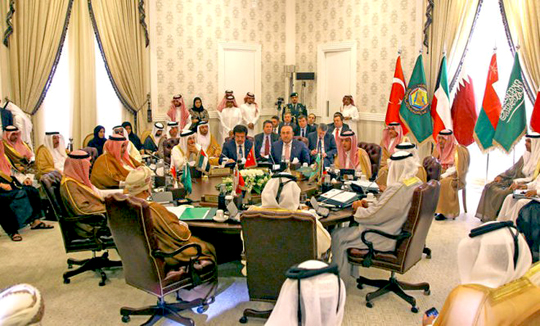
Riyadh, Oct 14: Foreign ministers of Gulf Cooperation Council states and Turkey on Thursday called for urgent intervention of the UN in Syria to stop the killing of innocent people.
GCC

They strongly advocated the need for the speedy implementation of the UNSC resolution, calling for the unimpeded and timely delivery of humanitarian assistance to all Syrian cities.

The GCC and Turkish ministers met in Riyadh within the framework of the GCC-Turkey Strategic Dialogue.

On the sidelines of the meeting, Custodian of the Two Holy Mosques King Salman received Turkish Foreign Minister Mevlut Cavusoglu, and Economy Minister Nihat Zeybekci, and held talks with them on bilateral and regional issues.

The Turkish ministers later attended the ministerial meeting at the GCC General Secretariat.

In a major development, the GCC foreign ministers designated the network led by US-based cult leader Fethullah Gulen as a terrorist organization. The ministers also condemned “indiscriminate” airstrikes on Syria’s Aleppo and expressed “deep regrets” at the inability of the UN and the international community to stop the raids.

They expressed concerns over the large-scale offensive coordinated by Russian and Syrian warplanes, which have ruthlessly attacked rebel-controlled Aleppo.

Addressing a joint press conference with Cavusoglu after the GCC-Turkey ministerial meeting, Foreign Minister Adel Al-Jubeir called on “Iran and Iraq to refrain from promoting sectarianism in the region.”

A joint communique issued by the GCC General Secretariat after the meeting stressed “the need to dry up funding to terrorism, as well as their commitment to combat radical ideology of the terrorist groups.”

The statement also supported the French initiative and international efforts aimed at “settling the Palestinian issue and establishing the independent sovereign state of Palestine with East Jerusalem as its capital.”

On the urgent need to restore peace and security in the region, the communique underlined the importance of making the Middle East, including the Gulf region, a WMD-free zone, including nuclear weapons.

“The ministers emphasized the right of countries of the region to use nuclear energy for peaceful purposes, and ensure that Iran sign all nuclear safety treaties,” it added.

Strategic Dialogue

The GCC and Turkish foreign ministers, who met here at the GCC General Secretariat within the framework of the “GCC-Turkey Strategic Dialogue,” also reaffirmed “their complete rejection of the use of Iraqi territory as a safe haven for terrorist groups to carry out terror attacks including smuggling of weapons and explosives.”

The ministers expressed grave concern about “Iraq’s move to involve sectarian militia forces, which perpetrated revenge attacks, mass killings and abuses against the local populations of the liberated areas, in the imminent Mosul operation, which might compromise the sustainable success of the operation and trigger sectarian conflict.”

Al-Jubeir urged Iran not to meddle in the affairs of Arab countries.

The GCC ministers called on Iran to respond positively to the efforts of the UAE to resolve the issue of the three islands — Greater Tunb, Lesser Tunb, and Abu Musa — through negotiations or recourse to the International Court of Justice.

The ministers condemned the attack on the UAE civilian vessel Swift near the Bab Al-Mandab Strait while it was on a regular trip transporting humanitarian aid and evacuating injured civilians for treatment in the UAE. They described the incident as a terrorist act threatening international navigation in the Bab Al-Mandab Strait, as it contravenes all international navigation laws and undermines international and regional efforts to deliver humanitarian aid to Yemen.

Referring to the bloodbath in Syria, the ministers condemned the escalation of military operations in Aleppo by the regime and its supporters through indiscriminate air raids against the civilian population and infrastructure. The ministers called on the international community to condemn such crimes against the people of Aleppo, and against civilians across the country. They also expressed their deep regret for “the inability of the UN Security Council to make decision to stop the air campaign and the bombing of civilians in Aleppo.”

The ministers also expressed their rejection of the Justice Against Sponsors of Terrorism (JASTA) law, affirming that “it is inconsistent with the principles of international law, particularly against the principle of equal sovereignty among countries provided for in the UN charter.” They expressed hope that the legislation would be reconsidered as it would have an “adverse impact on the relations between countries including the US.”

Referring to the deplorable situation in Yemen, the ministers reaffirmed that the formation of the so-called political council in Yemen between the Houthis and Ali Abdullah Saleh’s supporters, and the formation of the so-called national salvation government constitute violations of Yemen’s internationally recognized constitutional legitimacy and impede reaching a political agreement.

Comments

Add new comment

  • Coastaldigest.com reserves the right to delete or block any comments.
  • Coastaldigset.com is not responsible for its readers’ comments.
  • Comments that are abusive, incendiary or irrelevant are strictly prohibited.
  • Please use a genuine email ID and provide your name to avoid reject.
News Network
March 11,2020

Riyadh, Mar 11: Energy titan Saudi Aramco said Tuesday it will boost crude oil supplies to 12.3 million barrels per day in April, flooding markets as it escalates a price war with Russia.

Riyadh had already slashed its price for April delivery after Russia refused its proposal that producer alliance OPEC+ orchestrate a co-ordinated cut of 1.5 million barrels per day.

The production cut had been mooted to shore up global oil prices, which have gone into meltdown as the deadly new coronavirus casts a pall over the world economy, but now price cuts and rising output indicate an unravelling of OPEC+ co-operation.

"Saudi Aramco announces that it will provide its customers with 12.3 million barrels per day of crude oil in April," the company said in a statement to the Saudi stock exchange.

Saudi Arabia, the world's biggest crude exporter has been pumping some 9.8 million bpd so its announcement on Tuesday means it will be adding at least 2.5 million bpd from April.

"The Company has agreed with its customers to provide them with such volumes starting 1 April 2020. The Company expects that this will have a positive, long-term financial effect," the statement said.

Saudi Arabia says it has an output capacity of 12 million bpd but it is not known for how long it can sustain such levels.

The kingdom also has millions of barrels of crude stored in strategic reserves to be used when needed and is expected to use it to provide the extra supply to the global market.

"Production above 12 million bpd shows the Saudis have something to prove," director of Britain-based RS Energy Bill Farren-Price said.

"This is a grab for market share. The taps are open and the prices have been cut sharply," Farren-Price told AFP.

In a quick response, Russian Energy Minister Alexander Novak said Moscow could boost production in the short term "by 200,00-300,000 bpd, with a potential of 500,000 bpd in the near future".

But he stressed that Moscow was in favour of extending a December agreement that had seen OPEC and Russia agree to cut production by 500,000 barrels per day in 2020, lowering output from October 2018 levels by 1.7 million barrels per day.

The events of recent days have signalled a disintegration of collaboration between OPEC and Russia.

Russia is a non-OPEC member and the world's second-biggest oil producer, but Moscow and other non-members have in recent years co-operated with the oil cartel in an arrangement known as OPEC+.

The Saudi price cuts over the weekend, which were the first salvo in the price war, sent oil prices crashing -- registering the single biggest one-day loss in three decades on Monday.

Saudi Arabia draws around 70 per cent of its revenues from oil, and the revenues are key to ambitious reform programmes launched by Crown Prince Mohammed bin Salman.

Comments

Add new comment

  • Coastaldigest.com reserves the right to delete or block any comments.
  • Coastaldigset.com is not responsible for its readers’ comments.
  • Comments that are abusive, incendiary or irrelevant are strictly prohibited.
  • Please use a genuine email ID and provide your name to avoid reject.
News Network
January 6,2020

Dubai/Washington, Jan 6: Tens of thousands of Iranians thronged the streets of Tehran on Monday for the funeral of Quds Force commander Qassim Suleimani who was killed in a US air strike last week and his daughter said his death would bring a "dark day" for the United States.

"Crazy Trump, don't think that everything is over with my father's martyrdom," Zeinab Suleimani said in her address broadcast on state television after US President Donald Trump ordered Friday's strike that killed the top Iranian general.

Iran has promised to avenge the killing of Qassim Suleimani, the architect of Iran's drive to extend its influence across the region and a national hero among many Iranians, even many of those who did not consider themselves devoted supporters of the Islamic Republic's clerical rulers.

The scale of the crowds in Tehran shown on television mirrored the masses that gathered in 1989 for the funeral of the founder of the Islamic Republic, Ayatollah Ruhollah Khomeini.

In response to Iran's warnings, Trump has threatened to hit 52 Iranian sites, including cultural targets, if Tehran attacks Americans or US assets, deepening a crisis that has heightened fears of a major Middle East conflagration.

The coffins of the Iranian general and Iraqi militia leader Abu Mahdi al-Muhandis, who was also killed in Friday's attack on Baghdad airport, were passed across the heads of mourners massed in central Tehran, many of them chanting "Death to America".

One of the Islamic Republic's major regional goals, namely to drive US forces out of neighbouring Iraq, came a step closer on Sunday when the Iraqi parliament backed a recommendation by the prime minister for all foreign troops to be ordered out.

"Despite the internal and external difficulties that we might face, it remains best for Iraq on principle and practically," said Iraqi caretaker Prime Minister Adel Abdul Mahdi, who resigned in November amid anti-government protests.

Iraq's rival Shi'ite leaders, including ones opposed to Iranian influence, have united since Friday's attack in calling for the expulsion of US troops.

Esmail Qaani, the new head of the Quds Force, the Revolutionary Guards' unit in charge of activities abroad, said Iran would continue Suleimani's path and said "the only compensation for us would be to remove America from the region."

ALLIES AT FUNERAL

Prayers at Suleimani's funeral in Tehran, which will later move to his southern home city of Kerman, were led by Iran's Supreme Leader Ayatollah Ali Khamenei. Suleimani was widely seen as the second most powerful figure in Iran behind Khamenei.

The funeral was attended by some of Iran's allies in the region, including Ismail Haniyeh, the leader of Palestinian group Hamas who said: "I declare that the martyred commander Suleimani is a martyr of Jerusalem."

Adding to tensions, Iran said it was taking another step back from commitments under a 2015 nuclear deal with six major powers, a pact from which the United States withdrew in 2018.

Washington has since imposed tough sanctions on Iran, describing its policy as "maximum pressure" and saying it wanted to drive down Iranian oil exports - the main source of government revenues - to zero.

Talking to reporters aboard Air Force One on the way to Washington from Florida on Sunday, Trump stood by his remarks to include cultural sites on his list of potential targets, despite drawing criticism from US politicians.

"They're allowed to kill our people. They're allowed to torture and maim our people. They're allowed to use roadside bombs and blow up our people. And we're not allowed to touch their cultural sites? It doesn't work that way," Trump said.

Democratic critics of the Republican president have said Trump was reckless in authorizing the strike, and some said his comments about targeting cultural sites amounted to threats to commit war crimes. Many asked why Soleimani, long seen as a threat by US authorities, had to be killed now.

Republicans in the US Congress have generally backed Trump's move.

Trump also threatened sanctions against Iraq and said that if US troops were required to leave the country, Iraq's government would have to pay Washington for the cost of a "very extraordinarily expensive" air base there.

He said if Iraq asked US forces to leave on an unfriendly basis, "we will charge them sanctions like they've never seen before ever. It'll make Iranian sanctions look somewhat tame."

Comments

Add new comment

  • Coastaldigest.com reserves the right to delete or block any comments.
  • Coastaldigset.com is not responsible for its readers’ comments.
  • Comments that are abusive, incendiary or irrelevant are strictly prohibited.
  • Please use a genuine email ID and provide your name to avoid reject.
Agencies
May 31,2020

Riyadh, May 31: Over 90,000 mosques in Saudi Arabia reopened their doors to worshippers on Sunday morning after over a two-month closure as part of an ease in the curfew restrictions to prevent the spread of the novel coronavirus.

The worshipers were allowed to enter the mosques, except the mosques in Makkah, from Fajr prayers today morning (Shawwal 8) with a limit of 40 per cent capacity.

The reopening of mosques was be undertaken in accordance with the guidance of Minister of Islamic Affairs, Dr Abdullatif Al Asheikh, and in line with advice issued by the Senior Council of Ulemas.

The ministry has embarked on a vigorous media campaign to urge all worshippers to abide by preventive measures for their own safety to curb the spread of Covid-19.Among the instructions are doing ablution at home, hand-washing and using sanitisers before going out to the mosque and after coming back home.

On Saturday, the Custodian of the Two Holy Mosques King Salman has approved opening the Prophet's Mosque in Madinah in stages to the public.

The elderly and those with chronic diseases are advised to perform their prayers at home. Reading and reciting the Holy Quran online is advised, too, from one's own mobile phone or at least reading from a privately owned copy of the Holy Quran.

Bringing one's prayer mat to perform prayers in mosques is highly recommended as well as keeping a two-metre distance between one another prayer.

Accompanying children under the age of 15 to the mosques is prohibited. Putting on a face mask and avoiding shaking hands and other contact is also recommended.

Meanwhile, the ministry managed, during the closure of mosques, to undertaking a massive cleaning, sanitising and maintenance drive in all mosques Kingdom-wide, according to world-class standards and best known practices. This included sanitising over 10 million mosques, 43 million copies of several sizes and volumes of the Quran, more than 600,000 Holy Quran cupboards, in addition to repairing and maintaining about 176,000

water closets, annexed to mosques.


Comments

Add new comment

  • Coastaldigest.com reserves the right to delete or block any comments.
  • Coastaldigset.com is not responsible for its readers’ comments.
  • Comments that are abusive, incendiary or irrelevant are strictly prohibited.
  • Please use a genuine email ID and provide your name to avoid reject.