


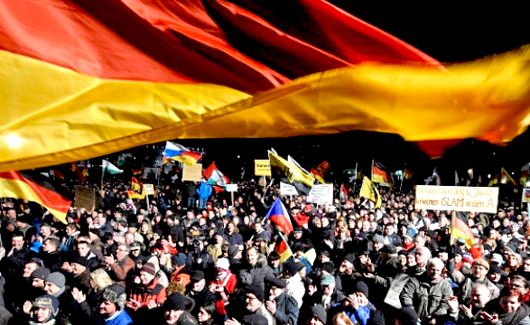
Germany bans anti-Islamic rally over terror threat

January 19, 2015

Anti-Islamic rally

Berlin, Jan 19: German authorities have banned a rally by the anti-Islamic PEGIDA movement in the eastern city of Dresden today, saying they have "concrete" information that Islamist militants plan to attack the weekly demonstrations.

The federal and state police agencies had received information that radical Islamists were planning to mix with demonstrators and attack one of the leaders of the right¬wing Patriotic Europeans Against Islamisation of the West (PEGIDA), which has been organising the Dresden rallies since September.

"In our assessment of the situation, we believe that there is a concrete threat of a terror attack," Dresden's police commissioner Dieter Kroll said yesterday.

Informations received by the authorities indicated that one of the PEGIDA leaders and the people around him were being targeted for a terror attack, Kroll said in a statement.

Kroll, however, said there were no specific information about the suspected terrorists or the nature of the attacks they were planning.

The anti¬Islam rally in Dresden to protest against the "Islamisation of Germany" and the government's asylum policy have been drawing a number of supporters in spite of appeals to the public by Chancellor Angela Merkel and other leaders to stay away from it.

Police estimated that a record number of over 25,000 people attended the rally last Monday and its organisers were expecting a much bigger crowd today.

According to police, the suspected attackers have been asked in a message in Arabic sent from a Twitter account to "mix with the demonstrators to carry out an attack on one of the organisers of the PEGIDA demonstrations."

Besides the anti¬Islam demonstration, a counter¬rally planned by opponents of PEGIDA in Dresden today also has been banned.

Germany's intelligence agencies have received warnings from their partner services abroad that Islamist militants were planning attacks on the central railway stations in Berlin and in Dresden as well as on the PEGIDA demonstrations.

Their warnings were based on information gained by intercepting telephone and e¬mail communications between suspected radical Islamists known to the authorities and international terror networks, media reports earlier said.

The latest terror warnings come close on the heels of the arrests of two Turkish men during a raid at eleven houses in different parts of Berlin on Friday.

The Turks were charged with planning a major terror attack in Syria, supporting Islamic State terror group by recruiting fighters, and organising and financing their travel to Syria.

The state prosecutor in Berlin said it has no information that the two men were planning any terror attacks in Germany nor they were linked to the terror attacks in Paris, which killed 17 people in three days.

Comments

Add new comment

  • Coastaldigest.com reserves the right to delete or block any comments.
  • Coastaldigset.com is not responsible for its readers’ comments.
  • Comments that are abusive, incendiary or irrelevant are strictly prohibited.
  • Please use a genuine email ID and provide your name to avoid reject.
Agencies
July 1,2020

The ILO has warned that if another Covid-19 wave hits in the second half of 2020, there would be global working-hour loss of 11.9 percent - equivalent to the loss of 340 million full-time jobs.

According to the 5th edition of International Labour Organisation (ILO) Monitor: Covid-19 and the world of work, the recovery in the global labour market for the rest of the year will be uncertain and incomplete.

The report said that there was a 14 percent drop in global working hours during the second quarter of 2020, equivalent to the loss of 400 million full-time jobs.

The number of working hours lost across the world in the first half of 2020 was significantly worse than previously estimated. The highly uncertain recovery in the second half of the year will not be enough to go back to pre-pandemic levels even in the best scenario, the agency warned.

The baseline model – which assumes a rebound in economic activity in line with existing forecasts, the lifting of workplace restrictions and a recovery in consumption and investment – projects a decrease in working hours of 4.9 percent (equivalent to 140 million full-time jobs) compared to last quarter of 2019.

It says that in the pessimistic scenario, the situation in the second half of 2020 would remain almost as challenging as in the second quarter.

“Even if one assumes better-tailored policy responses – thanks to the lessons learned throughout the first half of the year – there would still be a global working-hour loss of 11.9 per cent at the end of 2020, or 340 million full-time jobs, relative to the fourth quarter of 2019,” it said.

The pessimistic scenario assumes a second pandemic wave and the return of restrictions that would significantly slow recovery. The optimistic scenario assumes that workers’ activities resume quickly, significantly boosting aggregate demand and job creation. With this exceptionally fast recovery, the global loss of working hours would fall to 1.2 per cent (34 million full-time jobs).

The agency said that under the three possible scenarios for recovery in the next six months, “none” sees the global job situation in better shape than it was before lockdown measures began.

“This is why we talk of an uncertain but incomplete recovery even in the best of scenarios for the second half of this year. So there is not going to be a simple or quick recovery,” ILO Director-General Guy Ryder said.

The new figures reflect the worsening situation in many regions over the past weeks, especially in developing economies. Regionally, working time losses for the second quarter were: Americas (18.3 percent), Europe and Central Asia (13.9 percent), Asia and the Pacific (13.5 percent), Arab States (13.2 percent), and Africa (12.1 percent).

The vast majority of the world’s workers (93 per cent) continue to live in countries with some sort of workplace closures, with the Americas experiencing the greatest restrictions.

During the first quarter of the year, an estimated 5.4 percent of global working hours (equivalent to 155 million full-time jobs) were lost relative to the fourth quarter of 2019. Working- hour losses for the second quarter of 2020 relative to the last quarter of 2019 are estimated to reach 14 per cent worldwide (equivalent to 400 million full-time jobs), with the largest reduction (18.3 per cent) occurring in the Americas.

The ILO Monitor also found that women workers have been disproportionately affected by the pandemic, creating a risk that some of the modest progress on gender equality made in recent decades will be lost, and that work-related gender inequality will be exacerbated.

The severe impact of Covid-19 on women workers relates to their over-representation in some of the economic sectors worst affected by the crisis, such as accommodation, food, sales and manufacturing.

Globally, almost 510 million or 40 percent of all employed women work in the four most affected sectors, compared to 36.6 percent of men, it said.

The report said that women also dominate in the domestic work and health and social care work sectors, where they are at greater risk of losing their income and of infection and transmission and are also less likely to have social protection.

The pre-pandemic unequal distribution of unpaid care work has also worsened during the crisis, exacerbated by the closure of schools and care services.

Even as countries have adopted policy measures with unprecedented speed and scope, the ILO Monitor highlights some key challenges ahead, including finding the right balance and sequencing of health, economic and social and policy interventions to produce optimal sustainable labour market outcomes; implementing and sustaining policy interventions at the necessary scale when resources are likely to be increasingly constrained and protecting and promoting the conditions of vulnerable, disadvantaged and hard-hit groups to make labour markets fairer and more equitable.

“The decisions we adopt now will echo in the years to come and beyond 2030. Although countries are at different stages of the pandemic and a lot has been done, we need to redouble our efforts if we want to come out of this crisis in a better shape than when it started,” Ryder said. 

Comments

Add new comment

  • Coastaldigest.com reserves the right to delete or block any comments.
  • Coastaldigset.com is not responsible for its readers’ comments.
  • Comments that are abusive, incendiary or irrelevant are strictly prohibited.
  • Please use a genuine email ID and provide your name to avoid reject.
News Network
February 14,2020

London, Feb 14: Five years ago Britain’s new finance minister Rishi Sunak wasn’t even a member of parliament and now he is running the world's fifth largest economy.

The 39-year-old former Goldman Sachs banker was appointed in dramatic fashion on Thursday when incumbent Sajid Javid unexpectedly quit — in a row over advisers — during what Downing Street had cast as a routine ministerial reshuffle.

Sunak is married to the daughter of Infosys co-founder NR Narayana Murthy, and was hand-picked to take over an ultra-safe seat in northern England, previously represented by former Conservative Party leader William Hague. The Murthy family was not reachable for comment.

In July, when he was promoted chief secretary to the Treasury, Murthy had said: “Our advice to our children, including Rishi, has been to work hard, be honest, and do good for society…We wish him well.”

After Thursday’s announcement, Sunak said: “Delighted to be appointed... Lots to get on with.”

Tipped for Promotion

As Boris Johnson moves to increase control of the finance ministry, one of the youngest chancellors in history will face a prime minister who wants to increase government spending on everything from infrastructure and police to health and education.

Sunak, seen as a rising star in the ruling Conservative Party since he entered Parliament in 2015, had been tipped for promotion to a senior post in the ministerial rejig as Johnson put together his post-Brexit cabinet.

But, despite an already rapid ascent through the ranks of government, few expected the Oxford University Politics, Philosophy and Economics graduate to ascend to one of the highest offices in the land.

Sunak had been serving as Javid’s deputy in the finance ministry since Johnson promoted him upon taking office in July 2019. Prior to that he had served as a junior housing minister.

“From working in my mum’s tiny chemist shop to my experience building large businesses, I have seen first-hand how politicians should support free enterprise and innovation to ensure our future prosperity,” Sunak says on his website.

Smooth and loyal

Seen as a smooth media performer and ultra-loyal member of the Conservative Party, Sunak has been used by the government to present and defend their policies in television interviews — a sign of trust from Johnson, who has a fraught relationship with Britain’s media.

Sunak takes control at a critical juncture for Britain’s $2.7 trillion economy. He will have to steer the economy through the turbulence of leaving the European Union and the forging of new trade links that will define Britain’s new relationship with the world.

However, the power struggle that forced his predecessor Javid to quit hints at a more diminished role for what is the second most powerful position in the government — with Johnson’s office wanting to centralise control and minimise dissent.

Sunak is one of the three ministers of Indian origin in Johnson’s cabinet, the other two being Priti Patel and Alok Sharma. Patel remains the interior minister after the cabinet reshuffle while Sharma, a former minister for international development, was appointed the new minister for business. Sunak’s father was a doctor and his mother ran a chemist shop. Before entering politics he worked for Goldman Sachs and a hedge fund, then co-founded an investment firm. He also has an MBA from Stanford University.

Comments

Add new comment

  • Coastaldigest.com reserves the right to delete or block any comments.
  • Coastaldigset.com is not responsible for its readers’ comments.
  • Comments that are abusive, incendiary or irrelevant are strictly prohibited.
  • Please use a genuine email ID and provide your name to avoid reject.
News Network
April 16,2020

Brussels/Amsterdam, Apr 16: As the novel coronavirus continues to wreak havoc in the western world since its outbreak in Wuhan last December, researchers believe that the Chinese leadership is trying to absolve President Xi Jinping by using a section of the western media to influence public opinion globally.

"There are clear indications that China is conducting activities in a persistent and systematic manner to influence public opinion-making, academia, think tanks and political decision-making among the member states of the Belt and Road Initiative (BRI) in general and western capital cities in particular," Siegfried O Wolf, Director of Research at Brussels-based think tank South Asia Democratic Front, said.

Some western media say some Chinese officials were secretly aware that they were facing a pandemic from the new coronavirus but allowed Wuhan to host a mass banquet for tens of thousands of people and millions began their annual trip home for the Lunar New Year celebrations.

The pandemic has since then affected 210 countries and territories around the world. Over 2 million people have been declared positive in which over 134,000 lost their lives.

"The frequency and extra-ordinary large scale of Chinese sponsored events in European political hubs, like in Brussels, and the subsequent media coverage can be seen as evidence for Beijing's public diplomacy efforts. However, the rising skepticism within the EU regarding Xi Jinping's development projects and the emerging questioning of Chinese sources funding Free Universities, like the one in Berlin, shows that this strategy produced mixed results so far," Wolf said.

He added, "However, one must also state that these efforts helped China to gain certain leverage among many non-Chinese media, western as well as non-western ones. Today, we can observe that China's political leadership tries to instrumentalise this influence for a major image campaign to distract from the fact that it carries the initial responsibility for the dramatic spread of COVID-19 by holding back key information."

Wolf also said that the current internal dynamics in China, like the shirking of responsibilities by the local authorities, are most-likely part of a twofold strategy. Firstly, there is the strategic component - namely, to reaffirm to the general public that the Communist Party of China is still in full control of the situation. The second strategic pillar is one of 'whitewashing'.

"Concretely, Beijing's obvious aim is to distract the domestic and international attention from the real, but hidden causes of the Coronavirus outbreak and its potential reputational and political consequences for Xi Jinping and his BRI," he stated.

Yoana Barakova, a Research Analyst at European Foundation for South Asian Studies (EFSAS), an Amsterdam-based think-tank, said, "The death of Dr. Li Wenliang, one of the very few medical professionals who tried to warn the world in December 2019 about the looming threat, sparked widespread condemnation around the international community in early February. Yet, little did he know that his legacy would continue much later after his demise, with the emboldened Chinese government trying to cover up its missteps through hardcore censorship after being exposed for undermining and underestimating the initial danger."

The researchers believe that the deterioration in press freedom under Jinping's regime has become more evident in recent days, with local authorities trying to control the state narrative by cosmetically placing media's focus on government's superficial attempts to tackle the crisis.

Comments

Add new comment

  • Coastaldigest.com reserves the right to delete or block any comments.
  • Coastaldigset.com is not responsible for its readers’ comments.
  • Comments that are abusive, incendiary or irrelevant are strictly prohibited.
  • Please use a genuine email ID and provide your name to avoid reject.