



In Germany, a few Muslim refugees convert to Christianity

December 10, 2016

Berlin, Dec 10: Clad in white at a Berlin church, asylum seekers Saeed, Veronica, Farida and Matin were just about to become Christians on a recent Sunday.chrs
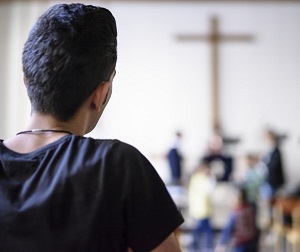
"Do you believe from the bottom of your heart that Jesus Christ is your Lord and saviour, and will you follow him every day of your life?" Pastor Matthias Linke asked them. "If so, say yes."

All four replied with a frank "Ja", to the enthusiastic applause of the faithful at the Free Evangelical Church, and were plunged head-to-toe into a baptism basin.

"I am very, very happy, I feel... how to say?", said 20-year-old Iran native Matin right after his baptism, placing his hand on his chest.

Muslim refugees have recently been taking the same step throughout Germany, where nearly 900,000 asylum seekers arrived in 2015.

Church leaders have confirmed a notable, though not huge, trend upward, but have not provided statistics.

"In our diocese, there are several groups of refugees who are preparing for baptism, and there are more and more requests," said Felix Goldinger, a Catholic priest in Speyer, southwestern Germany.

Many come from Iran and Afghanistan, some from Syria or Eritrea, he said.

"I am currently handling a group of 20 people but I do not know how many will go through until baptism," he said.

Over the course of their preparations, which last nearly a year in Goldinger's diocese, potential converts are encouraged to weigh their own motivations.

"During this period, it is important that they examine their original religion, Islam, and the reasons why they want to change it," he said.
"We are obviously pleased that people want to be baptised, but it is very important for us that they are sure of their decision."

Goldinger said that "many people recall what they have experienced in their country", including "terrorist acts committed in the name of religion. They see Christianity as a religion of love and respect for life."

In Iran, said Linke, many had been in contact with unrecognised churches in the Islamic republic, where conversion is prohibited, and then had to flee.

Other refugees met Christians on their journey to Europe.

This was the case for Saeed, a 31-year-old aeronautical engineer who spent four months in Turkey with a Christian and then became interested in his religion. Like fellow new convert Veronica, Saeed is from Afghanistan.

Reading the Bible "helped in times of trouble," he says.

It was in Greece, recalled Matin, that he first came in touch with the Christian faith. After he arrived in Germany, he approached the Free Evangelical Church through his German friends.

His sister Farida followed him and they began preparations -- in German and Farsi -- for baptism.

Farida said she "was looking for a church" and wanted to choose her religion "in complete freedom".

"This is a very important reason to become a Christian," said Linke.

Among refugees who adopt Germany's dominant religion, he said, "there is a strong desire to decide for themselves, in a free and personal way, the direction of their lives".

Churches concede that some conversions are motivated by a desire to integrate into German society, or even by the belief that they will increase their chances of gaining political asylum.

Countries that send Muslim converts to Christianity back to their homelands put them potentially at great risk.

Apostasy or blasphemy can be punished with jail or death sentences in some Muslim countries, among them Iran, Mauritania, Saudi Arabia and Afghanistan.

For jihadist groups such as the Islamic State, conversion is also a punishable sin.

"There are refugees who think that if they convert, it will be easier for them to stay here, but it is not systematic," Goldinger said.

"Do they change religion in order to be able to stay in Germany? This is an important issue for the authorities," said Linke, who is often consulted by the state Office for Migration and Refugees.

"I have no guarantees, I can only ask them: 'do you really believe with all your heart?' After their baptism, most of them live as Christians and come to church," he added.

Outside their new community, the converts nonetheless usually try to remain discreet.

"They may face difficult situations in refugee homes, where the majority are Muslims," said Thomas Klammt, in charge of migration issues at the Union of Free German Evangelical Churches.

"They may also be afraid for their families left behind in their country of origin."

Matin said he stays in contact with relatives back home -- especially his mother, who had "accepted" his willingness to convert.

"She calls me every Sunday to ask if I have been to mass," he said, laughing.

Comments

shaji
 - 
Sunday, 11 Dec 2016

Christian missionaries are luring these deserted people to change their religion. This is their tactics being practiced in many poor countries.

Rashid
 - 
Sunday, 11 Dec 2016

One , who really applied muslim or community connected muslim , never select other religion... Allah considers eligible to 'jannah' , whether he dies as 'muslim' ... that is why muslim always prays to die as muslims...

Mohammad.n
 - 
Saturday, 10 Dec 2016

Failed in Allah's test

Add new comment

  • Coastaldigest.com reserves the right to delete or block any comments.
  • Coastaldigset.com is not responsible for its readers’ comments.
  • Comments that are abusive, incendiary or irrelevant are strictly prohibited.
  • Please use a genuine email ID and provide your name to avoid reject.
Agencies
March 14,2020

San Francisco, Mar 14: Microsoft on friday announced that co-founder Bill Gates has left its board of directors to devote more time to philanthropy.

The 64-year-old stopped being involved in day-to-day operations at the firm more than a decade ago, turning his attention to the foundation he launched with his wife, Melinda.

Gates served as chairman of Microsoft's board of directors until early in 2014 and has now stepped away entirely, according to the Redmond-based technology giant.

“It's been a tremendous honor and privilege to have worked with and learned from Bill over the years,” Microsoft chief executive and company veteran Satya Nadella said in a release.

Nadella said Microsoft would continue to benefit from Gates' “technical passion and advice” in his continuing role as a technical advisor.
“I am grateful for Bill's friendship and look forward to continuing to work alongside him,” he added.

Gates left his CEO position in 2000, handing the company reins to Steve Ballmer to devote more time to his charitable foundation.

He gave up the role of chairman at the same time Nadella became Microsoft's third CEO in 2014.

Regularly listed among the world's richest people, William H. Gates was a geeky-looking young man when he and Paul Allen co-founded Microsoft in 1975.

Gates went on to turn his attention from software to fighting disease and other humanitarian challenges with his wife, under the auspices of the Bill and Melinda Gates Foundation.

Comments

Add new comment

  • Coastaldigest.com reserves the right to delete or block any comments.
  • Coastaldigset.com is not responsible for its readers’ comments.
  • Comments that are abusive, incendiary or irrelevant are strictly prohibited.
  • Please use a genuine email ID and provide your name to avoid reject.
News Network
February 17,2020

Feb 17: Chinese authorities on Monday reported a slight upturn in new virus cases and 105 more deaths for a total of 1,770 since the outbreak began two months ago.

The 2,048 new cases followed three days of declines but was up by just 39 cases from the previous day’s figure. Another 10,844 people have recovered from COVID-19, a disease caused by the new coronavirus, and have been discharged from hospitals, according to Monday’s figures.

The update followed the publication late Saturday in China’s official media of a recent speech by President Xi Jinping in which he indicated for the first time that he had led the response to the outbreak from early in the crisis. While the reports were an apparent attempt to demonstrate the Communist Party leadership acted decisively from the start, it also opened Xi up to criticism over why the public was not alerted sooner.

In his speech, Xi said he gave instructions on fighting the virus on Jan. 7 and ordered the shutdown of the most-affected cities that began on Jan. 23.

The disclosure of his speech indicates top leaders knew about the outbreak’s potential severity at least two weeks before such dangers were made known to the public. It was not until late January that officials said the virus can spread between humans and public alarm began to rise.

New cases in other countries are raising growing concerns about containment of the virus.

Taiwan on Sunday reported its first death from COVID-19, the fifth fatality outside of mainland China. Taiwan’s Central News Agency, citing health minister Chen Shih-chung, said the man who died was in his 60s and had not traveled overseas recently and had no known contact with virus patients.

Japanese Prime Minister Shinzo Abe convened an experts meeting to discuss containment measures in his country, where more than a dozen cases have emerged in the past few days without any obvious link to China.

“The situation surrounding this virus is changing by the minute,” Abe said.

Japanese Health Minister Katsunobu Kato said the country is “entering into a phase that is different from before,” requiring new steps to stop the spread of the virus.

Japan now has 413 confirmed cases, including 355 from a quarantined cruise ship, and one death from the virus. Its total is the highest number of cases among about two dozen countries outside of China where the illness has spread.

Hundreds of Americans from the cruise ship took charter flights home, as Japan announced another 70 infections had been confirmed on the Diamond Princess. Canada, Hong Kong and Italy were planning similar flights.

The 300 or so Americans flying on U.S.-government chartered aircraft back to the U.S. will face another 14-day quarantine at Travis Air Force Base in California and Lackland Air Force Base in Texas. The U.S. Embassy said the departure was offered because people on the ship were at a high risk of exposure to the virus. People with symptoms were banned from the flights.

About 255 Canadians and 330 Hong Kong residents are on board the ship or undergoing treatment in Japanese hospitals. There are also 35 Italians, of which 25 are crew members, including the captain.

In China’s Hubei province, where the outbreak began in December, all vehicle traffic will be banned in another containment measure. It expands a vehicle ban in the provincial capital, Wuhan, where public transportation, trains and planes have been halted for weeks.

Exceptions were being made for vehicles involved in epidemic prevention and transporting daily necessities.

Hubei has built new hospitals with thousands of patient beds and China has sent thousands of military medical personnel to staff the new facilities and help the overburdened health care system.

Last Thursday, Hubei changed how it recognized COVID-19 cases, accepting a doctor’s diagnosis rather than waiting for confirmed laboratory test results, in order to treat patients faster. The tally spiked by more than 15,000 cases under the new method.

Comments

Add new comment

  • Coastaldigest.com reserves the right to delete or block any comments.
  • Coastaldigset.com is not responsible for its readers’ comments.
  • Comments that are abusive, incendiary or irrelevant are strictly prohibited.
  • Please use a genuine email ID and provide your name to avoid reject.
Agencies
January 11,2020

Washington, Jan 11: US President Donald Trump has signed an executive order imposing another set of crippling sanctions against Iran, targeting several of its top leaders, military commanders, and its infrastructure industry, according to a statement from the White House on Friday.

Trump said the executive order authorises the imposition of sanctions against any individual or entity operating in the construction, manufacturing, textiles, or mining sectors of the Iranian economy or anyone assisting those who engage in this sanctioned business.

The sanctions are the latest in a series of retaliatory measures between the two nations.

Iran's powerful military commander Qasem Soleimani was killed last Friday in US drone strikes, ordered by President Trump, bringing the entire Gulf region close to a full-blown conflict.

Regional tensions remained high after Iran on Wednesday fired missiles at two bases in Iraq used by US forces.

"Today, I am holding the Iranian regime responsible for attacks against United States personnel and interests by denying it substantial revenue that may be used to fund and support its nuclear program, missile development, terrorism and terrorist proxy networks, and malign regional influence," said Trump on Friday, after signing the executive order.

"This order will have a major impact on the Iranian economy, authorising powerful secondary sanctions on foreign financial institutions.

"The Iranian regime has threatened United States military service members, diplomats, and civilians, as well as the citizens and interests of our allies and partners, through military force and proxy groups. The United States will continue to counter the Iranian regime's destructive and destabilising behaviour," the president said.

Trump said the economic sanctions will remain till the Iranian regime changes its behaviour.

Earlier at a White House news conference, Treasury Secretary Steven Mnuchin, along with cabinet colleague Secretary of State Mike Pompeo, said the US will continue its economic and diplomatic sanctions on Iran till Tehran announces it will not pursue the nuclear weapons program and stop its destabilising behaviour in the region.

The eight senior Iranian regime officials against whom sanctions have been issued include Ali Shamkhani, the Secretary of Iran's Supreme National Security Council, Mohammad Reza Ashtiani, the Deputy Chief of Staff of Iranian armed forces, and Gholamreza Soleimani, the head of the Basij militia of the Islamic Revolutionary Guards Corps (IRGC).

The sanction on the Iranian officials would mean denial of visa to the US and seizure of assets, among others.

In addition, the treasury designated 17 Iranian metals producers and mining companies, a network of three China-and Seychelles-based entities, and a vessel involved in the purchase, sale, and transfer of Iranian metals products, as well as in the provision of critical metals production components to Iranian metal producers.

"The United States is targeting senior Iranian officials for their involvement and complicity in Tuesday's ballistic missile strikes," Mnuchin said.

"We are also designating Iran's largest metals manufacturers, and imposing sanctions on new sectors of the Iranian economy including construction, manufacturing, and mining. These sanctions will continue until the regime stops the funding of global terrorism and commits to never having nuclear weapons," he added.

Pompeo told reporters that Iran was planning "broad, large-scale attacks" against American interests in the Middle East, including embassies.

The latest round of sanctions are aimed at striking at the heart of Iran's internal security apparatus, he said.

"The president has been very clear: we will continue to apply economic sanctions until Iran stops its terrorist activities and commits that it will never have nuclear weapons," Mnuchin said.

Comments

Add new comment

  • Coastaldigest.com reserves the right to delete or block any comments.
  • Coastaldigset.com is not responsible for its readers’ comments.
  • Comments that are abusive, incendiary or irrelevant are strictly prohibited.
  • Please use a genuine email ID and provide your name to avoid reject.