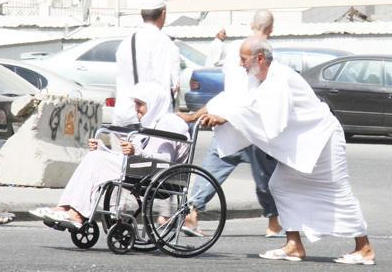
Go for Ramadan Umrah once ‘to make it easy for others’

July 13, 2014

Ramadan UmrahJeddah, Jul 13: A high-ranking official at the Haj Ministry has advised Saudis and expats to perform Umrah only once during Ramadan to give others a chance to do it with ease. Civil Defense has sent text messages to Saudis and expats urging them not to perform Umrah more than once.

Hussein Al-Sharif, undersecretary at the Haj Ministry, said efforts to reduce the number of pilgrims are only temporary until Grand Mosque expansion projects are complete.

“We are trying to put a cap on the number of pilgrims in their own interest and safety pending construction efforts, especially since there are many elderly pilgrims and children.”

Grand Mufti Abdulaziz Al-Asheikh, head of the grand scholars committee, had openly supported the decision to reduce the number of Umrah visitors and pilgrims during the peak Ramadan and Haj seasons.

A number of Shariah specialists have also supported the decision, saying it would benefit Grand Mosque and Prophet Mosque visitors.

Makkah has become a large workshop, with cranes dotting the landscape as expansion efforts go ahead.

Once complete, the area for circumambulation will accommodate 130,000 worshippers as opposed to the previous 30,000 limit.

Comments

Add new comment

  • Coastaldigest.com reserves the right to delete or block any comments.
  • Coastaldigset.com is not responsible for its readers’ comments.
  • Comments that are abusive, incendiary or irrelevant are strictly prohibited.
  • Please use a genuine email ID and provide your name to avoid reject.
Agencies
May 26,2020

Riyadh, May 26: The authorities in Saudi Arabia have decided to ease some restrictions put in place over coronavirus fears, allowing movement and resumption of some economic and commercial activities, Saudi Press Agency reported early Tuesday citing an official source at the Interior Ministry.

The move also allows restarting of domestic flights, opening of mosques, restaurants and cafes and work attendance, however, the temporary suspension of Umrah pilgrimage remains in force.

The easing of restrictions will be carried out in a phased manner, with the first phase beginning on Thursday (May 28) and ending on May 30.

In the first phase, the movement within and between all regions of the Kingdom in private cars will be allowed from 6 a.m. to 3 p.m. except in Makkah. Economic and commercial activities will resume in retail and wholesale shops and malls but beauty salons, barber shops, sports clubs, health clubs, entertainment centers and cinemas will continue to remain shut due to social distancing concerns.

In the second phase, which begins on May 31 and ends on June 20, the movement is allowed from 6 a.m. and 8 p.m. in all areas of the Kingdom, except in Makkah. All congregational prayers, including Friday prayers, will resume in all mosques across the Kingdom except in Makkah.

The suspension of workplace attendance will end, allowing all employees in ministries, government entities and private sector companies to return to working from their offices provided that they follow strict precautionary guidelines.

The suspension on travel between regions in the Kingdom using various transport methods will no longer be in place. Airlines will be allowed to operate domestic flights if they adhere to precautionary measures set by the civil aviation authority and the Ministry of Health. The suspension of international flights, will, however, continue until further notice.

Restaurants and cafes serving food and beverages can reopen, however, beauty salons, barber shops, sports clubs, health clubs, entertainment centers and cinemas will be barred from reopening in the second phase. The ban on social gatherings of more than fifty people, such as weddings and funerals will also continue to remain in force.

In the third phase commencing on June 21, the Kingdom will return to "normal" conditions as it was before the coronavirus lockdown measures were implemented.

Meanwhile in Makkah, the first phase measures will be implemented between May 31 to June 20 and the second phase will begin on May 21. Friday prayers and all congregational prayers will continue to be held in the Grand Mosque, only to be attended by Imams and the employees.

Comments

Mohammed Sarfraz
 - 
Tuesday, 26 May 2020

I think second phase is May 31 to June 20. Must be a typo. 

Add new comment

  • Coastaldigest.com reserves the right to delete or block any comments.
  • Coastaldigset.com is not responsible for its readers’ comments.
  • Comments that are abusive, incendiary or irrelevant are strictly prohibited.
  • Please use a genuine email ID and provide your name to avoid reject.
News Network
June 30,2020

Dubai, June 30: The United Arab Emirates is all set to reopen mosques and other places of worship at 30 per cent capacity from July 1.

However, Friday prayers will remain suspended in the country, said Saif Al Dhaheri, Spokesperson for the National Crisis & Emergency Management Authority (NCEMA) during a virtual press briefing on Monday.

The official said certain mosques in industrial areas, labor residential areas, shopping malls and public parks will remain closed until further notice.

He said health authorities already conducted Covid-19 tests for Imams and workers serving at the mosque to ensure health and safety of the worshippers.

Al Dhaheri also spelt out guidelines that worship centres have to follow to welcome worshippers.

A distance of three metres should be observed between each worshippers and no handshakes are allowed. Worshippers will have to perform ablutions at home. People should bring their own personal copies of Holy Quran or read from digital copies. It is also mandatory for all worshippers to download and activate contract tracing app AlHosn.

"We urge the public to cooperate by following precautionary measures including social distancing. Children under 12 years old, the elderly as well as individuals with chronic diseases should avoid going to mosques," said the official.

The UAE first announced the suspension of public prayers in all places of worship on March 16, which was extended until further notice on April 9.

As Khaleej Times reported, places of worship had been preparing to reopen since the last few weeks by sanitizing parking lots and outdoor areas, entrances, main prayer halls and ablution areas.

The spokesperson also announced that the Private and commercial boat trips and water sports will be allowed to operate at reduced capacity of 50 per cent but by following precautionary measures.

The total number of recovered cases of Coronavirus (Covid-19) in the UAE has reached 37,076 with 665 cases recovered today after receiving treatment. Since the beginning of June, UAE has had a daily recovery average of 660 cases, said Dr. Amna Al Shamsi, Spokesperson for the UAE government.

Guidelines

1. Maintain a distance of 3 metres between worshippers.

2. No handshakes allowed.

3. Ablutions must be performed at home.

4. To read the Holy Quran, worshippers must bring their own copies.

5. All worshippers must download and activate contact tracing app AlHosn

6. People in vulnerable categories like those with chronic diseases and the elderly must not visit the mosques.

Comments

Add new comment

  • Coastaldigest.com reserves the right to delete or block any comments.
  • Coastaldigset.com is not responsible for its readers’ comments.
  • Comments that are abusive, incendiary or irrelevant are strictly prohibited.
  • Please use a genuine email ID and provide your name to avoid reject.
KT
May 18,2020

May 18: As the UAE authorities have asked all residents to avoid gatherings, it is clear that - for the first time - it's going to be a #StayHome Eid. But experts say that although it will be different, the celebration will be just as meaningful.

It is important to remember that the Eid prayer can be performed at home either individually or with family members under the sane roof, said Dr Mohammed Eyada Ayoub Alkobaisi, a Grand Mufti with the Islamic Affairs and Charitable Activities Department in Dubai.

Dr Alkobaisi said this prayer is a highly recommended Sunnah or practice urged by the Prophet Muhammad (Peace be upon him).

"Eid Prayer must be performed openly, unless we are prevented for an acceptable reason, such as fear for self, wellbeing, property, etc." Under the current circumstances, prayers can be offered from home, he said.

But what the faithful will likely miss is listening to the khutbah or the sermon of Eid with a crowd. The sight of people pouring out into the streets and coming together for prayer and worship would not be unfolding this time.

Dr Sheikh Mohamed Ashmawy, an Islamic researcher, said that in this time of Covid, doing away with several Eid traditions would be necessary for everyone's safety.

"The ban is is line with the ongoing preventive measures to curb the spread of Covid-19," he said.

However, it doesn't mean people can't celebrate and exchange heartfelt greetings, he added.

"We can greet each other remotely on the phone or via social media networks."

Islamic researcher Sheikh Mohamed Wasfi said audio-visual smart apps have made communication much easier, even bringing people closer than before.

"Of course, families and friends wish to hug, shake hands and see each other personally, but this will be a big risk these days," he said.

Sheikh Asadullah Del Mohamed, an imam, reminded that banquets, parties and visits are discouraged to avoid crowds and gathering.

Recently, 30 people from two families tested positive for the virus after breaking social distancing rules and holding a gathering.

Faithful's sentiments

Ibrahim Abdelkader, an Egyptian auditor, said that while it would be sad to spend Eid Al Fitr at home, he understood that it is for everyone's safety.

"Better to stay home than be sorry," said Ahmad Jamil, a Syrian resident.

Rashid Saeed, an Emirati national, said people are advised to just check on each other by phone or video and voice call apps.

"While Eid prayers is banned in congregation, it's not acceptable at all for some people to carelessly gather and exchange visits," he said.

Abdullah Al Saleh, an Emirati national, said he and all his relatives used to gather for breakfast after the Eid prayer - but this time, they are ready to do it in their own homes.

Mohamed Ibrahim, another Emirati, said he would surely miss seeing his kids happily prancing around with their new clothes and enjoying the outdoors like every year.

"But, I agree as it is for their health, safety and wellbeing," he said.

THINGS TO REMEMBER IN CELEBRATING EID THIS YEAR

>Perform the Eid prayer at home, individually or with family members living with you

>Exchange greetings with loved ones and friends via phone calls or online

>No hugs

>No handshakes

>No gatherings

>No visits to other homes

Comments

Add new comment

  • Coastaldigest.com reserves the right to delete or block any comments.
  • Coastaldigset.com is not responsible for its readers’ comments.
  • Comments that are abusive, incendiary or irrelevant are strictly prohibited.
  • Please use a genuine email ID and provide your name to avoid reject.