Goldman Sachs sees worst India recession with 45% second quarter slump

News Network
May 18, 2020

May 18: Goldman Sachs expects India will experience its deepest recession ever after a poor run of data underscored the damaging economic impact of lockdowns in the world’s second-most populous nation.

Gross domestic product will contract by an annualized 45% in the second quarter from the prior three months, compared with Goldman’s previous forecast of a 20% slump. A stronger rebound of 20% is now seen for the third quarter, while projections for the fourth quarter and first of next year are unchanged at 14% and 6.5%.

Those estimates imply that real GDP will fall by 5% in the 2021 fiscal year, which would be deeper than any other recession India has ever experienced, Goldman economists Prachi Mishra and Andrew Tilton wrote in a note dated May 17.

India’s government has extended its nationwide lockdown until May 31, while further easing restrictions in certain sectors to boost economic activity, as coronavirus cases escalate across the country. The announcement followed Finance Minister Nirmala Sitharaman’s fifth briefing in as many days, in which she outlined details of the country’s $265 billion virus rescue package, which is equivalent to 10% of India’s GDP.

 “There have been a series of structural reform announcements across several sectors over the past few days,” the Goldman economists wrote. “These reforms are more medium-term in nature, and we, therefore, do not expect these to have an immediate impact on reviving growth. We will continue to monitor their implementation to gauge their effect on the medium-term outlook.”

Infections are surging across the South Asian nation of 1.3 billion people, with more than 91,300 infections, including 2,897 deaths as of Sunday, according to data from Johns Hopkins University.

Comments

Add new comment

  • Coastaldigest.com reserves the right to delete or block any comments.
  • Coastaldigset.com is not responsible for its readers’ comments.
  • Comments that are abusive, incendiary or irrelevant are strictly prohibited.
  • Please use a genuine email ID and provide your name to avoid reject.
News Network
February 14,2020

New Delhi, Feb 14: AAP convenor Arvind Kejriwal has invited Prime Minister Narendra Modi to his swearing-in ceremony scheduled to take place at the Ramlila Maidan on February 16, senior party leader Gopal Rai said on Friday.

Rai, the convenor of the Aam Aadmi Party's Delhi unit, said a letter was sent to the prime minister on Friday morning.

All seven Delhi MPs and eight newly-elected BJP MLAs have also been invited for the oath-taking ceremony, Rai told news agency.

No chief minister or political leaders from other states will be part of the event as it will be a "Delhi-specific" ceremony, Rai had said on Thursday.

Kejriwal, through front-page advertisements in newspapers, has urged Delhiites to attend his oath-taking ceremony as he is set to become the chief minister of Delhi for the third consecutive term.

Kejriwal will take oath as Delhi Chief minister along with his cabinet at Ramlila Maidan at 10 am on Sunday.

Comments

Add new comment

  • Coastaldigest.com reserves the right to delete or block any comments.
  • Coastaldigset.com is not responsible for its readers’ comments.
  • Comments that are abusive, incendiary or irrelevant are strictly prohibited.
  • Please use a genuine email ID and provide your name to avoid reject.
coastaldigest.com news network
August 8,2020

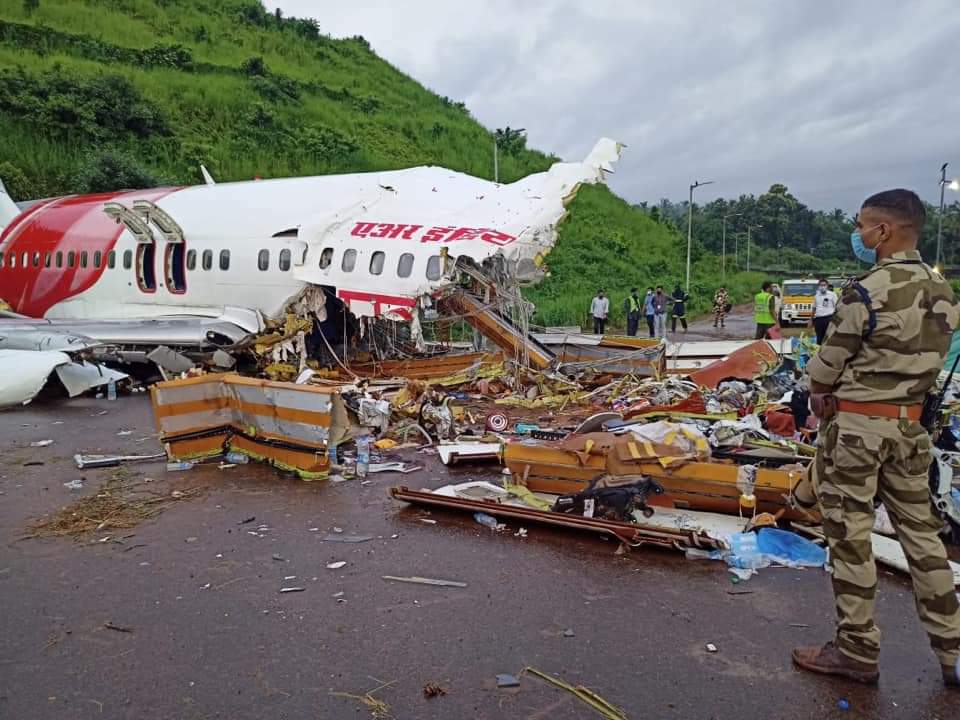
Kozhikode, Aug 8: A tailwind or crosswind could be the reason for the Air India Express flight mishap at Kozhikode international airport in Kerala, according to some aviation experts. 

Team of DGCA and AIE already reached the spot. With the death of the captain and co-pilot in the mishap, the investigation would be focusing mainly on the voice recorders and other technical aspects.

It is learnt that the ill-fated aircraft, IX 1344 with 190 onboard including crew, was initially planning to land on runway-28 of the airport. But later the pilot opted runway-10 which is toward the other direction. Pilots would be taking the decisions on the basis of inputs from ATC.

The questions now doing the rounds are what made the pilot opt runway-10 and whether the tabletop runway lacked adequate safety parameters.

An aviation expert, who didn't want to be quoted, said that Capt Deepak Sathe, who was commandeering the aircraft, was a well-experienced pilot and was also familiar with the terrains. Hence the chances of any error from his part was very unlikely. Hence a fair in-depth probe was required to find the exact cause.

Though the Kozhikode airport has an Instrument Landing System, it was of category-I for which pilot's visibility is very crucial toward a touchdown. Since it is a tabletop airport and rough weather prevailing in the region, the chances of tailwind was also high, said sources.

There had been safety concerns about the airport over quite some time. In 2011 aviation safety consultant captain Mohan Ranganathan reportedly gave a report citing the safety issues, especially the buffer zones at the end of the runway.

However, an AAI officer said that rectification steps were already done by last year by widening the Runway End Safety Area (RESA) from 90 metre to 240 metre. However, the length of the runway had to be reduced to 2,700 metre from 2,850. The AAI was also constantly pressing for increasing the runway length to 3,150 metres. But that was getting delayed due to land acquisition issues pending with the state government.

stm88 info live rtp slot

slot auto scatter hitam

Comments

Add new comment

  • Coastaldigest.com reserves the right to delete or block any comments.
  • Coastaldigset.com is not responsible for its readers’ comments.
  • Comments that are abusive, incendiary or irrelevant are strictly prohibited.
  • Please use a genuine email ID and provide your name to avoid reject.
Agencies
June 15,2020

New Delhi, Jun 15: Average temperature of India experienced a rise of 0.7 degree Celsius, along with decline in rainfall, significant increase in frequency of very severe cyclonic storms and droughts in over a decade due to human activities, the Ministry of Earth Sciences in its research report said.

The contentions were made in a report issued by the ministry on the impact of climate change. It will be published by Union Minister Harsh Vardhan on June 19.

According to the report, "Since the middle of the twentieth century, India witnessed rise in temperature; decrease in monsoon; rise in extreme temperature and rainfall, droughts, and sea levels; and increase intensity of severe cyclones.

The report, prepared by researchers of the Centre for Climate Change Research, a cell under The Ministry's Indian Institute of Tropical Meteorology, Pune, further stated that there is compelling scientific evidence that human activities have influenced these changes in regional climate.

India's average temperature has risen by around 0.7 degrees Celsius during 1901-2018, it said, adding that the rise is largely on account of GHG-induced warming and partially offset by forcing due to anthropogenic aerosols.

It states that the average temperature over India is projected to rise by 4.4 degrees Celsius, while the intensity of heat waves is likely to increase by 3-4 times by the end of the century.

In the 30-year period between 1986 and 2015, temperatures of the warmest day and the coldest night of the year have risen by about 0.63 degrees Celsius and 0.4 degree Celsius.

According to the report, by the end of the century, the temperatures of the warmest day and the coldest night are projected to rise by approximately 4.7 degrees Celsius and 5.5 degrees Celsius, respectively.

Alarmingly, sea surface temperature of the tropical Indian Ocean has also risen by one degrees Celsius on average during 1951-2015.

"The frequency of very severe cyclonic storms during the post-monsoon season has increased significantly (+1 event per decade) during the last two decades (2000-2018)," it added.

This came in the backdrop of Cyclone 'Amphan' and 'Nisarga' which made landfalls on May 20 and June 3 and killed several people, flattened villages, and destroyed farms.

"This is the first-ever climate change assessment report for India. This report will be very useful for policy makers, researchers, social scientists, economists, and students," said M. Rajeevan, secretary, the Ministry of Earth Sciences.

Besides this, the report also highlighted various other unnerving data on climate change in the country. Both the frequency and extent of droughts have increased significantly during 1951-2016.

The overall decrease of seasonal "summer monsoon rainfall" during the last 6-7 decades has led to an increased propensity for droughts over India.

"In particular, areas over central India, southwest coast, southern peninsula and north-eastern India have experienced more than 2 droughts per decade, on average, during this period. The area affected by drought has also increased by 1.3 per cent per decade over the same period."

The Hindu Kush Himalayas (HKH) also experienced a temperature rise of about 1.3 degree Celsius during 1951-2014.

Several areas of the Himalayas have experienced a declining trend in snowfall and also retreat of glaciers in recent decades. By the end of the twenty-first century, its annual mean surface temperature is projected to increase by about 5.2 degree Celsius.

The summer monsoon precipitation from June to September over India has also declined by around 6 per cent from 1951 to 2015, with notable decreases over the Indo-Gangetic Plains and the Western Ghats, the report further states.


Comments

Add new comment

  • Coastaldigest.com reserves the right to delete or block any comments.
  • Coastaldigset.com is not responsible for its readers’ comments.
  • Comments that are abusive, incendiary or irrelevant are strictly prohibited.
  • Please use a genuine email ID and provide your name to avoid reject.