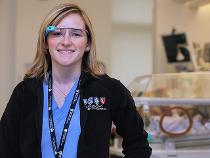
Google Glass is helping scientists to study brain disease

November 25, 2016

Moscow, Nov 25: Using Google Glass, Siberian scientists are developing a prototype of a model to study an individual's proneness to certain brain diseases at an early stage, media reported.

glassThe scientists are using Google Glass to study how people react to virtual reality and analysed the participants' movements in virtual reality, rbth.com reported on Thursday.

"They evaluated the condition of the muscles, the brain and the vestibular system. There is a difference between the vestibular system's reaction in healthy people and that in sick people," said Ivan Tolmachev, one of the model's developers.

The test requires the person to be aware of what is happening around and follow the doctor's instructions.

The scientists are thinking of conducting the test on children who are five and older in order to understand if they are already prone to brain disease, noted the report.

Scientists from Tomsk Polytechnic University and the Siberian State Medical University are together working on this prototype and the project will need $64,000 to make the model marketable.

Comments

Add new comment

  • Coastaldigest.com reserves the right to delete or block any comments.
  • Coastaldigset.com is not responsible for its readers’ comments.
  • Comments that are abusive, incendiary or irrelevant are strictly prohibited.
  • Please use a genuine email ID and provide your name to avoid reject.
Agencies
June 11,2020

The World Health Organisation (WHO) Director-General Tedros Adhanom Ghebreyesus said that more research needs to be done to better understand the extent to which COVID-19 is being spread by people who don't show symptoms.

"Since early February, we have said that asymptomatic people can transmit COVID-19, but that we need more research to establish the extent of asymptomatic transmission," the WHO chief said at a virtual press conference from Geneva on Wednesday, Xinhua news agency reported.

"That research is ongoing, and we're seeing more and more research being done," he added.

Saying that the world has been achieving a lot in knowing the new virus, the WHO chief told reporters that "there's still a lot we don't

"WHO's advice will continue to evolve as new information becomes available," he said.

Tedros stressed that the most critical way to stop transmission is to find, isolate and test people with symptoms, and trace and quarantine their contacts.

"Many countries have succeeded in suppressing transmission and controlling the virus doing exactly this," Tedros said.

Meanwhile, Michael Ryan, executive director of WHO Health Emergencies Program, said Wednesday that the COVID-19 pandemic is still evolving.

"If we look at the numbers... this pandemic is still evolving. It is growing in many parts of the world," he said. "We have deep concerns that health systems of some countries are struggling, under a huge strain and require our support, our help and our solidarity."

He said "each and every country has a different combination of risks and opportunities, and it's really down to national authorities to carefully consider where they are in the pandemic."

In Europe, the risk issue now are about travels and the opening of the schools, around risk management, mass gathering, surveillance and contact tracing, said the WHO official.

In Southeast Asian countries, where to a great extent transmissions have been under control, governments are more concerned about the re-emergence of clusters, while in South America, the issue of PPE for health workers has not gone away, said Ryan.

As regards Africa, Ryan said the death rates have been very low in the past week, but the health system can be overwhelmed, as it would have to cope with other diseases such as malaria.

Comments

Add new comment

  • Coastaldigest.com reserves the right to delete or block any comments.
  • Coastaldigset.com is not responsible for its readers’ comments.
  • Comments that are abusive, incendiary or irrelevant are strictly prohibited.
  • Please use a genuine email ID and provide your name to avoid reject.
Agencies
July 14,2020

UN, Jul 14: There will be no return to the "old normal" for the foreseeable future as a result of the ongoing COVID-19 pandemic, and too many countries were still headed in the wrong direction, the chief of the World Health Organization (WHO) warned.

"The virus remains public enemy number one, but the actions of many governments and people do not reflect this," Xinhua news agency quoted WHO Director-General Tedros Adhanom Ghebreyesus at as saying a regular briefing on Monday.

He noted that mixed messages from leaders are undermining trust, which is the most critical ingredient of any response, while the only aim of the virus is to find people to infect.

Things are going to "get worse and worse and worse", he warned, unless governments communicate clearly with their citizens and roll out a comprehensive strategy focused on suppressing transmission and saving lives, while populations follow the basic public health principles of physical distancing, hand washing, wearing masks, coughing etiquette and staying home when sick.

COVID-19 has been gaining its momentum lately.

According to Tedros, Sunday saw a record of 230,000 cases reported to WHO, of which almost 80% were from just 10 countries and about half from just two countries.

"But it does not have to be this way," he said, asking every single leader, government and individual "to do their bit to break the chains of COVID-19 transmission and end the collective suffering".

To control the disease and get on with people's lives, Tedros said, three things are required. The first is to focus on reducing mortality and suppressing transmission; the second is to focus on an empowered, engaged community that takes individual behaviour measures in the interest of each other.

And the third is a strong government leadership and coordination of comprehensive strategies that are communicated clearly and consistently.

"We weren't prepared collectively, but we must use all the tools we have to bring this pandemic under control. And we need to do it right now," he added.

At the WHO briefing on Monday, health experts also said there was evidence to suggest that children under the age of 10 were only very mildly affected by Covid-19, while those over 10 seemed to suffer similar mild symptoms to young adults.

To what extent children can transmit the virus, while it appears to be low, remains unknown.

On Tuesday, the number of global coronavirus cases cross the 13 million mark, according to the Johns Hopkins University.

The total number of cases currently stood at 13,070,097, while the fatalities rose to 572,411, the University's Center for Systems Science and Engineering (CSSE) revealed in its latest update.

The US accounted for the world's highest number of infections and fatalities at 3,363,056 and 135,605, respectively, according to the CSSE.

Brazil came in the second place with 1,884,967 infections and 72,833 deaths.

Comments

Add new comment

  • Coastaldigest.com reserves the right to delete or block any comments.
  • Coastaldigset.com is not responsible for its readers’ comments.
  • Comments that are abusive, incendiary or irrelevant are strictly prohibited.
  • Please use a genuine email ID and provide your name to avoid reject.
Agencies
June 17,2020

Leading physicians are celebrating a small dose of good news that arrived Tuesday about dexamethasone, a cheap and widely used steroid shown to be able to save lives among COVID-19 patients, but also cautioning against releasing study results by press release during a global health emergency, like in the case of the latest dexamethasone study by University of Oxford.

"It will be great news if dexamethasone, a cheap steroid, really does cut deaths by one-third in ventilated patients with COVID19, but after all the retractions and walk backs, it is unacceptable to tout study results by press release without releasing the paper", Atul Gawande, surgeon and CEO of Haven Healthcare, tweeted.

"Bottom line is, good news," Dr. Fauci, America's foremost infectious diseases expert told a US newswire on Tuesday, soon after the dexamethasone results were announced in the UK.

Fauci, who has long championed the therapeutics-first view said that dexamethasone is a "significant improvement" in the available therapeutic options currently available.

On Medical Twitter and Facebook, doctors broadly agree that dexamethasone use aligns well with the way COVID19 attacks the body's immune system. Fauci said the results in the Oxford study make "perfect sense" in that context.

"We should see the number of people who actually survive go up, if the study holds up," virologist and epidemiologist Dr. Joseph Fair told a television network.

Global coronavirus cases crossed 8 million on Tuesday. In the US, Texas and Florida are facing a new wave of cases after lifting lockdown orders earlier than medical experts recommended. Amidst the relentless graph upwards, the dexamethasone study results injected hope for better survival rates among those most seriously ill.

World Health Organization chief scientist Soumya Swaminathan welcomed the results from the randomised control trial.

Dr Eugene Gu, Founder and CEO of CoolQuit tweeted that he is "genuinely impressed" with the UK dexamethasone trial. This may be a "game changer", he wrote.

"There's no conflict of interest as dexamethasone is a generic steroid. The mechanism of action makes sense because steroids can reduce cytokine storms and overactive immune systems that makes COVID-19 so deadly. The number needed to treat is 8 ventilated patients which is great."

The Oxford study found that dexamethasone reduced deaths by 35 percent in patients who needed treatment with breathing machines and by 20 percent in those only needing supplemental oxygen. Dexamethasone was one of 5 drugs studied in a large clinical trial in the United Kingdom named RECOVERY, short for Randomised Evaluation of COVID-19 Therapy.

Peter Horby, chief investigator of the University of Oxford clinical trial, said dexamethasone is the first drug to be shown to improve survival in COVID-19. Details of the study have not been released. The trial organisers said they made their announcement via a news release because of "the public health importance of these results." According to Horby's public comments, there was a lot of initial resistance to studying steroids.

During the study, 2,104 patients were randomly selected to be given 6 milligrams of dexamethasone once a day (either by mouth or by intravenous injection) for 10 days. That group was compared with 4,321 patients who received the usual care alone.

Researchers estimated that dexamethasone would prevent one death for every eight patients treated while on ventilators and one for every 25 patients on extra oxygen alone.

UK experts have called the study results a breakthrough in the fight against the virus. The researchers have promised they would publish the results soon.

Comments

Add new comment

  • Coastaldigest.com reserves the right to delete or block any comments.
  • Coastaldigset.com is not responsible for its readers’ comments.
  • Comments that are abusive, incendiary or irrelevant are strictly prohibited.
  • Please use a genuine email ID and provide your name to avoid reject.