


Govt plans to declare 100 yoga parks across the country

May 25, 2017

New Delhi, May 25: As it gears up for Mega Yoga Day celebrations, the government has plans to declare a hundred parks especially dedicated for yoga activities across the country to promote this traditional practice.yoga
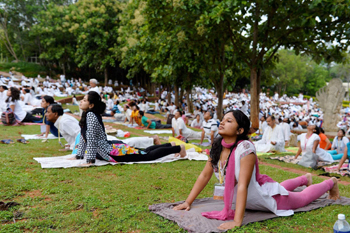
Uttar Pradesh capital Lucknow will host the main event of the International Day of Yoga (IDY) on June 21 this year where Prime Minister Narendra Modi will participate.

Around 150 countries are expected to participate in the mega event, with Indian Missions in those nations coordinating the activities. IDY will be observed at some of the major landmarks like the Eiffel Tower in Paris, the Trafalgar Square in London and the Central Park in New York among others.

"It would be no exaggeration to say that the world has acknowledged the supremacy of India in the field of yoga. Last two years, the IDY was celebrated across the globe with an active participation of more than 190 countries," Minister of State for AYUSH Shripad Yesso Naik said.

The Prime Minister’s Award for outstanding contribution to promotion and development of Yoga at the national and international level will be given to individuals or organisations who have made a significant impact on the society for a sustained period of time by way of promotion and development of Yoga, Naik said.

A screening committee chaired by AYUSH secretary has been constituted to recommend the names and the jury headed by Cabinet Secretary will finalise the four winners, two in each category.

The ministry is also planning to have 100 Yoga parks across the country which will be managed by Yoga or other organisations voluntarily.

The prime minister, senior ministers, Uttar Pradesh chief minister and yoga gurus along with nearly 51,000 people are expected to take part in the event.

In Delhi, seven main events are being planned in different places in association with NDMC, DDA and Yoga organisations.

Apart from this, yoga events will be held in different parts of the country as well as main cities like Paris, London and New York across the globe.

The Ministry on its official website has requested the people visiting the web page related to IDY to take a pledge to make yoga an integral part of their daily life.

The first IDY celebration was organised at Rajpath in New Delhi on June 21, 2015, in which representatives of 191 countries had participated. Last year, the main function was in Chandigarh.

The United Nations General Assembly, heeding to a call by Prime Minister Modi, had made a declaration in December 2014 to observe June 21 every year as IDY.

Comments

Add new comment

  • Coastaldigest.com reserves the right to delete or block any comments.
  • Coastaldigset.com is not responsible for its readers’ comments.
  • Comments that are abusive, incendiary or irrelevant are strictly prohibited.
  • Please use a genuine email ID and provide your name to avoid reject.
Agencies
February 11,2020

Using smartphone for long hours every day may do you more harm than you can probably think of. Researchers have found that spending a lot of time with the device and on social media may lead to mental distress and suicidality among adolescents.

The findings, published in the journal CMAJ (Canadian Medical Association Journal) contains guidance for physicians, parents and teachers on how to help teenagers manage smartphone and social media use for a healthy balance between sleep, academic work, social activity, interpersonal relationships and online activity.

"Physicians, teachers and families need to work together with youth to decrease possible harmful effects of smartphones and social media on their relationships, sense of self, sleep, academic performance, and emotional well-being," said lead author of the study Elia Abi-Jaoude from Toronto Western Hospital in Canada.

This review of evidence, led by the Hospital for Sick Children (SickKids), focuses on smartphone use and does not consider online gaming.

"For adolescents today, who have not known a world without social media, digital interactions are the norm, and the potential benefits of online access to productive mental health information -- including media literacy, creativity, self-expression, sense of belonging and civic engagement -- as well as low barriers to resources such as crisis lines and Internet-based talking therapies cannot be discounted," the authors wrote.

The researchers recommend that doctors should ask teenagers to reduce social media use rather than eradicate it completely and encourage parents to be part of the conversations.

Parents should discuss appropriate smartphone use with teenagers to determine together how to reduce risks and set boundaries.

A recent poll from the US indicates that 54 per cent of teenagers think they spend too much time on their smartphones and about half said they were cutting back on usage.

"Encouragingly, youth are increasingly recognising the negative impact of social media on their lives and starting to take steps to mitigate it," the authors wrote.

Comments

Add new comment

  • Coastaldigest.com reserves the right to delete or block any comments.
  • Coastaldigset.com is not responsible for its readers’ comments.
  • Comments that are abusive, incendiary or irrelevant are strictly prohibited.
  • Please use a genuine email ID and provide your name to avoid reject.
Agencies
April 21,2020

The Lockdown is not a cure but a critical strategy to prevent the geographical spread of COVID-19.

While pandemics at this level involves actual life threatening situations for individual's or significant others in one's immediate circle, it envisages a marked disruption in routine life. Even after the pandemic has been contained and will come to pass; it's aftermath will leave a trailblazer which demands planning and implementation of a post pandemic reconstruction of society with potentially traumatic experiences varying in intensity, multiplicity and duration.

Degree of Trauma

It would do well for each one of us to realise that the pandemic is "potentially traumatic", since not everyone will experience COVID -19 as a traumatic event in their lives. Yet, there will be those who may develop post pandemic stress reactions, depression and related dysfunction and pathological reactions while still other exhibit healthy reactions to the same set of circumstances.

"Psychological reactions to the pandemic can be distilled into four distinct prototypical patterns, namely, Resilience, Recovery, Chronic and Delayed patterns which may vary in intensity, multiplicity, and duration. Resilient individual have an ability to bounce back from adversity and experience modest or little disruption in normal functioning and are able to maintain a relatively stable, healthy levels of psychological functioning even after enduring the pandemic. Recovery pattern is characterised by relatively rapid reduction in symptoms and return to normal functioning whereas chronic pattern is characterised by symptoms and dysfunction of a long duration," says Pune-based military psychologist Lt Col Dr Samir Rawat.

Challenges at the Individual and Community Levels

From a psychological perspective, post pandemic reconstruction would entail catering to the problems, concerns and needs of those adversely impacted by the COVID -19 with stress symptoms typically characterised by individual's experiencing an overwhelming trauma of the pandemic (for example, recurring nightmares/ breaking into a cold sweat, flashback of stressful events, increasing irritability, low frustration tolerance or emotional numbing).

It could also manifest in depressive symptoms which may result in lack of interest or diminished pleasure in activities and things which you earlier liked to do, feelings of worthlessness or even survivor guilt in case of a loss of a loved one due to COVID-19, fleeting thoughts of death and suicidal ideation. Physical symptoms, on the other hand could be a decrease in appetite, weight and sleep problems, inability to focus and lack of concentration.

Undoubtedly, the pandemic will cause a financial loss of varying magnitude to many, especially the marginalised and economically disadvantaged strata of daily wage earners; it will also lead to loss of jobs (already beginning to show), homelessness, occupational difficulties and new challenges in interpersonal relations at work and on the home front, besides physical health problems and psychological barriers with new norms of accepted social behaviour (social distancing, handshakes, an obsession for cleanliness to name a few).

Emotional battles

Many factors may influence whether individuals come out stronger and more resilient or surrender to the pandemic. Emotion Regulation is one such long term critical factor that can play an important role in contributing to varying degrees of adaptation with negative or positive outcomes. While we know that primary emotions are fear, anger, disgust, joy, anticipation, acceptance, sadness and surprise, other basic emotions include wonder, love, desire, joy, hatred, sadness, attachment, disgust, rage and even expectancy .

To be able to regulate these emotions and avoid negativity , especially on social media platforms is likely to increase efforts in emotion regulation which involves initiating, increasing or maintaining an emotional response.

This means by regulating or on the other hand by stopping, decreasing or avoiding an emotional response, that is, by down-regulating, depending on the individual's objectives and goals or his /her ability to regulate emotions in the valued and given direction.

"One of the best ways to regulate emotions is through cognitive restructuring wherein we change the way we think; after all it is not the event but the interpretation of the event which is perceived as stressful and finding meaning promotes resilience and reduces risk and vulnerability to stress," advises Dr Rawat.

Adding, "Clearly, we need to have a psychological plan to prevent, mitigate and minimise negative outcomes by post pandemic reconstruction of society at an individual and community level all over the country; this has to be integrated by all leaders across verticals in diverse domains."

Comments

Add new comment

  • Coastaldigest.com reserves the right to delete or block any comments.
  • Coastaldigset.com is not responsible for its readers’ comments.
  • Comments that are abusive, incendiary or irrelevant are strictly prohibited.
  • Please use a genuine email ID and provide your name to avoid reject.
Agencies
June 27,2020

After admitting that the world may have a COVID-19 vaccine within one year or even a few months earlier, the World Health Organisation (WHO) on Friday said that UK-based AstraZeneca is leading the vaccine race while US-based pharmaceutical major Moderna is not far behind.

WHO Chief Scientist Soumya Swaminathan stated that the AstraZeneca's coronavirus vaccine candidate is the most advanced vaccine currently in terms of development.

"I think AstraZeneca certainly has a more global scope at the moment in terms of where they are doing and planning their vaccine trials," she told the media.

AstraZeneca's Covid-19 vaccine candidate developed by researchers from the Oxford University will likely provide protection against the disease for one year, the British drug maker's CEO told Belgian radio station Bel RTL this month.

The Oxford University last month announced the start of a Phase II/III UK trial of the vaccine, named AZD1222 (formerly known as ChAdOx1 nCoV-19), in about 10,000 adult volunteers. Other late-stage trials are due to begin in a number of countries.

Last week, Swaminathan had said that nearly 2 billion doses of the COVID-19 vaccine would be ready by the end of next year.

Addressing the media from Geneva, she said that "at the moment, we do not have a proven vaccine but if we are lucky, there will be one or two successful candidates before the end of this year" and 2 billion doses by the end of next year.

Scientists predict that the world may have a COVID-19 vaccine within one year or even a few months earlier, said the Director-General of the World Health Organization even as he underlined the importance of global cooperation to develop, manufacture and distribute the vaccines.

However, making the vaccine available and distributing it to all will be a challenge and will require political will, WHO chief Tedros Adhanom Ghebreyesus said on Thursday during a meeting with the European Parliament's Committee for Environment, Public Health and Food Safety.

One option would be to give the vaccine only to those who are most vulnerable to the virus.

There are currently over 100 COVID-19 vaccine candidates in various stages of development.

Comments

Add new comment

  • Coastaldigest.com reserves the right to delete or block any comments.
  • Coastaldigset.com is not responsible for its readers’ comments.
  • Comments that are abusive, incendiary or irrelevant are strictly prohibited.
  • Please use a genuine email ID and provide your name to avoid reject.