


Govt plans to declare 100 yoga parks across the country

May 25, 2017

New Delhi, May 25: As it gears up for Mega Yoga Day celebrations, the government has plans to declare a hundred parks especially dedicated for yoga activities across the country to promote this traditional practice.yoga
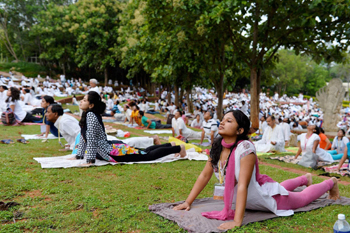
Uttar Pradesh capital Lucknow will host the main event of the International Day of Yoga (IDY) on June 21 this year where Prime Minister Narendra Modi will participate.

Around 150 countries are expected to participate in the mega event, with Indian Missions in those nations coordinating the activities. IDY will be observed at some of the major landmarks like the Eiffel Tower in Paris, the Trafalgar Square in London and the Central Park in New York among others.

"It would be no exaggeration to say that the world has acknowledged the supremacy of India in the field of yoga. Last two years, the IDY was celebrated across the globe with an active participation of more than 190 countries," Minister of State for AYUSH Shripad Yesso Naik said.

The Prime Minister’s Award for outstanding contribution to promotion and development of Yoga at the national and international level will be given to individuals or organisations who have made a significant impact on the society for a sustained period of time by way of promotion and development of Yoga, Naik said.

A screening committee chaired by AYUSH secretary has been constituted to recommend the names and the jury headed by Cabinet Secretary will finalise the four winners, two in each category.

The ministry is also planning to have 100 Yoga parks across the country which will be managed by Yoga or other organisations voluntarily.

The prime minister, senior ministers, Uttar Pradesh chief minister and yoga gurus along with nearly 51,000 people are expected to take part in the event.

In Delhi, seven main events are being planned in different places in association with NDMC, DDA and Yoga organisations.

Apart from this, yoga events will be held in different parts of the country as well as main cities like Paris, London and New York across the globe.

The Ministry on its official website has requested the people visiting the web page related to IDY to take a pledge to make yoga an integral part of their daily life.

The first IDY celebration was organised at Rajpath in New Delhi on June 21, 2015, in which representatives of 191 countries had participated. Last year, the main function was in Chandigarh.

The United Nations General Assembly, heeding to a call by Prime Minister Modi, had made a declaration in December 2014 to observe June 21 every year as IDY.

Comments

Add new comment

  • Coastaldigest.com reserves the right to delete or block any comments.
  • Coastaldigset.com is not responsible for its readers’ comments.
  • Comments that are abusive, incendiary or irrelevant are strictly prohibited.
  • Please use a genuine email ID and provide your name to avoid reject.
News Network
June 20,2020

Washington, Jun 20: Pregnant and postpartum women are usually at a high risk of depression and anxiety - one in seven women struggle with symptoms in the perinatal period and the coronavirus pandemic is exacerbating those struggles according to a recent study.

The study was published in Frontiers in Global Women's Health, which found that the likelihood of maternal depression and anxiety has substantially increased during the health crisis.

"The social and physical isolation measures that are critically needed to reduce the spread of the virus are taking a toll on the physical and mental health of many of us," said Dr. Margie Davenport of the University of Alberta, Canada, who co-authored the study.

For new moms, those stresses come with side effects.

"We know that experiencing depression and anxiety during pregnancy and the postpartum period can have detrimental effects on the mental and physical health of both mother and baby that can persist for years," said Davenport.

Such effects can include premature delivery, reduced mother-infant bonding, and developmental delays in infants.

The study surveyed 900 women - 520 of whom were pregnant and 380 of whom had given birth in the past year - and asked about their depression and anxiety symptoms before and during the pandemic.

Before the pandemic began, 29 percent of those women experienced moderate to high anxiety symptoms, and 15 percent experienced depressive symptoms. During the pandemic, those numbers increased - 72 percent experienced anxiety and 41percent experienced depression.

Because lockdown measures have affected daily routines and access to gyms, researchers also asked women whether their exercise habits had changed. Of the women surveyed, 64 percent reduced their physical activity since the pandemic began, while 15 percent increased and 21 percent experienced no change.

Exercise is a known way to ease depression symptoms, so limited physical activity may result in an uptick in depressive symptoms. Indeed, the study found that women who engaged in at least 150 minutes of moderate physical activity a week had significantly lower symptoms of depression and anxiety.

The findings are somewhat limited given the fact that researchers could not survey women before the pandemic began (since they could not know a pandemic would occur). The women surveyed could only offer their pre-pandemic symptoms in hindsight.

Also, while the researchers asked women about their symptoms using validated measures, only mental health care professionals can validly diagnose an individual with depression or anxiety.

The study was specifically interested in the impact of COVID-19 on new moms, but Davenport says maternal mental health is a critical issue no matter the time.

"Even when we are not in a global pandemic, many pregnant and postpartum women frequently feel isolated whether due to being hospitalized, not having family or friends around or other reasons," she said.

"It is critical to increase awareness of the impact of social (and physical) isolation on the mental health of pregnant and postpartum women," Davenport added.

Increased awareness makes diagnosis and treatment - the ultimate goal - more likely.

Comments

Add new comment

  • Coastaldigest.com reserves the right to delete or block any comments.
  • Coastaldigset.com is not responsible for its readers’ comments.
  • Comments that are abusive, incendiary or irrelevant are strictly prohibited.
  • Please use a genuine email ID and provide your name to avoid reject.
Agencies
February 10,2020

Washington D.C, Feb 10: Children's vulnerability towards depression, anxiety, impulsive behaviour, and poor cognitive performance could be determined by considering the hours of sleep they manage to get.

Sleep states are active processes that support the reorganisation of brain circuitry. This makes sleep especially important for children, whose brains are developing and reorganising rapidly.

In a study by researchers from the University of Warwick -- recently published in the journal Molecular Psychiatry -- cases of 11,000 children aged between 9 and 11 years from the Adolescent Brain Cognitive Development dataset were analyzed to find out the relationship between sleep duration and brain structure.

The study was carried out by researchers Professor Jianfeng Feng, Professor Edmund Rolls, Dr. Wei Cheng and colleagues from the University of Warwick's Department of Computer Science and Fudan University.

Measures of depression, anxiety, impulsive behaviour and poor cognitive performance in the children were associated with shorter sleep duration. Moreover, the depressive problems were associated with short sleep duration one year later.

The reduced brain volume of areas such as orbitofrontal cortex, prefrontal, and temporal cortex, precuneus, and supramarginal gyrus was found to be associated with the shorter sleep duration.

Professor Jianfeng Feng, from the University of Warwick's Department of Computer Science, comments: "The recommended amount of sleep for children 6 to 12 years of age is 9-12 hours. However, sleep disturbances are common among children and adolescents around the world due to the increasing demand on their time from school, increased screen time use, and sports and social activities."

A previous study showed that about 60 per cent of adolescents in the United States receive less than eight hours of sleep on school nights.

Professor Jianfeng Feng further added: "Our findings showed that the total score for behavior problems in children with less than 7 hours sleep was 53 per cent higher on average and the cognitive total score was 7.8 per cent lower on average than for children with 9-11 hours of sleep. It highlights the importance of enough sleep in both cognition and mental health in children."

Professor Edmund Rolls from the University of Warwick's Department of Computer Science also commented: "These are important associations that have been identified between sleep duration in children, brain structure, and cognitive and mental health measures, but further research is needed to discover the underlying reasons for these relationships."

Comments

Add new comment

  • Coastaldigest.com reserves the right to delete or block any comments.
  • Coastaldigset.com is not responsible for its readers’ comments.
  • Comments that are abusive, incendiary or irrelevant are strictly prohibited.
  • Please use a genuine email ID and provide your name to avoid reject.
Agencies
February 4,2020

Despite tremendous advances in treatment of congenital heart disease (CHD), a new global study shows that the chances for a child to survive a CHD diagnosis is significantly less in low-income countries.

The research revealed that nearly 12 million people are currently living with CHD globally, 18.7 per cent more than in 1990.

The findings, published in The Lancet, is drawn from the first comprehensive study of congenital heart disease across 195 countries, prepared using data from the Global Burden of Diseases, Injuries and Risk Factors Study 2017 (GBD).

"Previous congenital heart estimates came from few data sources, were geographically narrow and did not evaluate CHD throughout the life course," said the study authors from Children's National Hospital in the US.

This is the first time the GBD study data was used along with all available data sources and previous publications - making it the most comprehensive study on the congenital heart disease burden to date.

The study found a 34.5 per cent decline in deaths from congenital disease between 1990 to 2017. Nearly 70 per cent of deaths caused by CHD in 2017 (180,624) were in infants less than one year old.

Most CHD deaths occurred in countries within the low and low-middle socio-demographic index (SDI) quintiles.

Mortality rates get lower as a country's Socio-demographic Index (SDI) rises, the study said.

According to the researchers, birth prevalence of CHD was not related to a country's socio-demographic status, but overall prevalence was much lower in the poorest countries of the world.

This is because children in these countries do not have access to life saving surgical services, they added.

"In high income countries like the United States, we diagnose some heart conditions prenatally during the 20-week ultrasound," said Gerard Martin from Children's National Hospital who contributed to the study.

"For children born in middle- and low-income countries, these data draw stark attention to what we as cardiologists already knew from our own work in these countries -- the lack of diagnostic and treatment tools leads to lower survival rates for children born with CHD," said researcher Craig Sable.

"The UN has prioritised reduction of premature deaths from heart disease, but to meet the target of 'ending preventable deaths of newborns and children under 5 years of age,' health policy makers will need to develop specific accountability measures that address barriers and improve access to care and treatment," the authors wrote.

Comments

Add new comment

  • Coastaldigest.com reserves the right to delete or block any comments.
  • Coastaldigset.com is not responsible for its readers’ comments.
  • Comments that are abusive, incendiary or irrelevant are strictly prohibited.
  • Please use a genuine email ID and provide your name to avoid reject.