


Govt rejects demand for PM's reply on demonetisation debate

November 17, 2016

New Delhi, Nov 17: Government today rejected the demand for Prime Minister Narendra Modi's response on the debate on demonetisation and accused the opposition of using it as an excuse to scuttle discussion on the issue in Parliament.
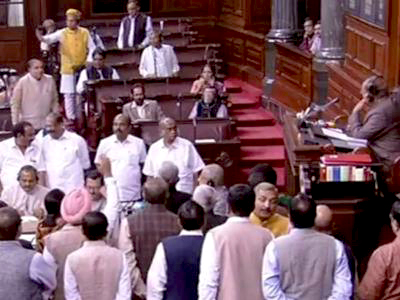
GovtInformation and Broadcasting Minister M Venkaiah Naidu told reporters after Parliament was adjourned for the day, amid protests by opposition demanding Modi's presence, that the reply to the debate would be given by the minister concerned or any other person on behalf of the government as per the rules of the House and precedents.

The opposition disrupted the Rajya Sabha, stalling midway the discussion on demonetisation that started yesterday.

A united opposition's relentless demand for a debate on demonetisation under a rule which entails voting forced the adjournment of the Lok Sabha also for the day as the government refused to accept it.

"Half way through, they realised that by raising such a debate it is going negative on them and boomeranging. Now I am afraid, are they trying to find a way out to come out of this and then stall the debate on one pretext or the other," Naidu said.

Dubbing the uproar by Congress and other opposition parties as an "excuse" to stall a debate, Naidu alleged that there is no rationale, whatsoever, behind it.

The Minister said things will happen as per the rules and procedures of the House and urged that the debate should go on.

"I feel that those who started the debate are now understanding that it is going negative, that is why they are finding excuse for not allowing the discussion.

"They are speaking in double tone and in different voices. They are not coming out openly either for or against. They are in dilemma and that dilemma will continue," he said.

Naidu said the entire country is watching as to who are with the hoarders and with the people with black money and who are with the government and the Prime Minister, who has "taken such a revolutionary step. They have to make a choice".

"Let the discussion take place. Then who will reply in the government. It could be the concerned Minister. The solution will come through the government as per traditions and rules," he said.

Naidu said government is addressing the problems faced by people on demonetisation and any suggestion, if worth considering, will be take up positively.

"Government is open to ideas to improve the system. But if somebody is trying to question this and attribute motives, then people are there to finally come to an assessment and decide. Let every party decide are they in favour of this move or against it, for which they have no answer directly," the minister said.

Comments

c.m bin
 - 
Thursday, 17 Nov 2016

cancel this PM. see korea and build the nation.

Add new comment

  • Coastaldigest.com reserves the right to delete or block any comments.
  • Coastaldigset.com is not responsible for its readers’ comments.
  • Comments that are abusive, incendiary or irrelevant are strictly prohibited.
  • Please use a genuine email ID and provide your name to avoid reject.
News Network
June 30,2020

New Delhi, Jun 30: Short video making app TikTok, one of the 59 apps banned by the Central government on Tuesday, has said that it complies with all data privacy and security requirements under the Indian law and has not shared any information of its users in India with any foreign government, including the Chinese Government.

Taking to microblogging site Twitter, Tiktok India posted the statement issued by Nikhil Gandhi, Head of TikTok, India.

"The Government of India has issued an interim order for the blocking of 59 apps, including TikTok and we are in the process of complying with it. We have been invited to meet with concerned government stakeholders for an opportunity to respond and submit clarifications. TikTok continues to comply with all data privacy and security requirements under Indian law and has not shared any information of our users in India with any foreign government, including the Chinese Government," reads the statement.

"Further, if we are requested to in the future we would not do so. We place the highest importance on user privacy and integrity. TikTok has democratized the internet by making it available in 14 Indian languages, with hundreds of millions of users, artists, story-tellers, educators and performers depending on it for their livelihood, many of whom are first-time internet users," the statement further reads.

Amid border tensions with China in Eastern Ladakh, the Centre had on Monday banned 59 mobile apps including Tik Tok, UC Browser and other Chinese apps "prejudicial to sovereignty and integrity and defence" of the country.

A senior official at the IT ministry said the prime reason to block the apps under section 69 A of Information Technology Act is to stop the violation and threat to the security of the state and public order and to plug the data leaks.

"Almost all of them have some preferential Chinese interest. Few are from countries like Singapore. However, the majority have parent companies which are Chinese," the official said.

This move will safeguard the interests of crores of Indian mobile and internet users. This decision is a targeted move to ensure safety and sovereignty of Indian cyberspace, Ministry of Information Technology said.

Comments

Angry Indian
 - 
Tuesday, 30 Jun 2020

war is fought man to man face to face...how china killed how soldier,

and we indian banning there app...what a joke

now bakth will say 56 inch chest modi is hero...


in our counrty we have 100% fool leaders and 80% foolish citizen...we will never develop..


Add new comment

  • Coastaldigest.com reserves the right to delete or block any comments.
  • Coastaldigset.com is not responsible for its readers’ comments.
  • Comments that are abusive, incendiary or irrelevant are strictly prohibited.
  • Please use a genuine email ID and provide your name to avoid reject.
Agencies
March 22,2020

New Delhi, Mar 22: The exercise to update the National Population Register (NPR) and the first phase of the Census 2021, scheduled to begin from April 1, are likely to be deferred for an indefinite period due to Coronavirus pandemic, officials said.

A formal order on this effect is expected within a day or two.

Discussions are going on at the highest level of the government and in all probability, the NPR and house listing phase of the Census work will be deferred till the threat of the Coronavirus is over, a home ministry official said.

The exercise to update NPR and the housing listing phase of the Census is scheduled to be carried out across the country from April 1 to September 30.

Last week, the home ministry had said the preparation for the Census 2021 and updation of the NPR were at its peak and they will begin from April 1.

The ministry said this after a conference of the Directors of the Census Operations on status of preparatory work around Census 2021 and NPR updation.

There has been opposition from several state governments to the NPR and some of the assemblies even adopted resolutions expressing reservations on the exercise.

The states which have been opposing the NPR include Kerala, West Bengal, Punjab, Rajasthan, Chhattisgarh and Bihar.

However, most of them also said they will cooperate with the house listing phase of the Census.

The objective of the NPR is to create a comprehensive identity database of every usual resident in the country.

The database would contain demographic as well as biometric particulars, they said.

The notification for the house listing census and NPR exercise came recently amid furore over the contentious Citizenship Amendment Act (CAA).

The home ministry officials said most of the states have notified provisions related to the NPR.

The NPR is a register of usual residents of the country. It is being prepared at the local (village/sub-town), subdistrict, district, state and national levels under provisions of the Citizenship Act, 1955 and the Citizenship (Registration of Citizens and Issue of National Identity Cards) Rules, 2003.

The data for NPR was last collected in 2010 along with the house listing phase of the Census 2011. Updating of this data was done during 2015 by conducting door to door survey.

While updating the register in 2015, the government has asked details like Aadhaar and their mobile number.

This time, the information related to their driving licence and voter ID card may also be gathered, the officials said, adding that PAN card details will not be collected as part of this exercise.

Though information regarding the place of birth of parents will be sought, it is up to the residents whether to respond the question as it is voluntary.

For the purposes of the NPR, a 'resident' is defined as a person who has lived in a local area for the past six months or more, or a person who intends to reside in that area for the next six months.

The law compulsorily seeks to register every citizen of India and issue a national identity card.

The demographic details of every individual are required for every usual resident: name, relationship to head of household, father's name, mother's name, spouse's name (if married), sex, date of birth, marital status, place of birth, nationality (as declared), present address of usual residence, duration of stay at present address, permanent residential address, occupation, educational qualification.

The Union Cabinet has approved Rs 3,941.35 crore for the NPR exercise.

Comments

Add new comment

  • Coastaldigest.com reserves the right to delete or block any comments.
  • Coastaldigset.com is not responsible for its readers’ comments.
  • Comments that are abusive, incendiary or irrelevant are strictly prohibited.
  • Please use a genuine email ID and provide your name to avoid reject.
Agencies
June 15,2020

New Delhi, Jun 15: Average temperature of India experienced a rise of 0.7 degree Celsius, along with decline in rainfall, significant increase in frequency of very severe cyclonic storms and droughts in over a decade due to human activities, the Ministry of Earth Sciences in its research report said.

The contentions were made in a report issued by the ministry on the impact of climate change. It will be published by Union Minister Harsh Vardhan on June 19.

According to the report, "Since the middle of the twentieth century, India witnessed rise in temperature; decrease in monsoon; rise in extreme temperature and rainfall, droughts, and sea levels; and increase intensity of severe cyclones.

The report, prepared by researchers of the Centre for Climate Change Research, a cell under The Ministry's Indian Institute of Tropical Meteorology, Pune, further stated that there is compelling scientific evidence that human activities have influenced these changes in regional climate.

India's average temperature has risen by around 0.7 degrees Celsius during 1901-2018, it said, adding that the rise is largely on account of GHG-induced warming and partially offset by forcing due to anthropogenic aerosols.

It states that the average temperature over India is projected to rise by 4.4 degrees Celsius, while the intensity of heat waves is likely to increase by 3-4 times by the end of the century.

In the 30-year period between 1986 and 2015, temperatures of the warmest day and the coldest night of the year have risen by about 0.63 degrees Celsius and 0.4 degree Celsius.

According to the report, by the end of the century, the temperatures of the warmest day and the coldest night are projected to rise by approximately 4.7 degrees Celsius and 5.5 degrees Celsius, respectively.

Alarmingly, sea surface temperature of the tropical Indian Ocean has also risen by one degrees Celsius on average during 1951-2015.

"The frequency of very severe cyclonic storms during the post-monsoon season has increased significantly (+1 event per decade) during the last two decades (2000-2018)," it added.

This came in the backdrop of Cyclone 'Amphan' and 'Nisarga' which made landfalls on May 20 and June 3 and killed several people, flattened villages, and destroyed farms.

"This is the first-ever climate change assessment report for India. This report will be very useful for policy makers, researchers, social scientists, economists, and students," said M. Rajeevan, secretary, the Ministry of Earth Sciences.

Besides this, the report also highlighted various other unnerving data on climate change in the country. Both the frequency and extent of droughts have increased significantly during 1951-2016.

The overall decrease of seasonal "summer monsoon rainfall" during the last 6-7 decades has led to an increased propensity for droughts over India.

"In particular, areas over central India, southwest coast, southern peninsula and north-eastern India have experienced more than 2 droughts per decade, on average, during this period. The area affected by drought has also increased by 1.3 per cent per decade over the same period."

The Hindu Kush Himalayas (HKH) also experienced a temperature rise of about 1.3 degree Celsius during 1951-2014.

Several areas of the Himalayas have experienced a declining trend in snowfall and also retreat of glaciers in recent decades. By the end of the twenty-first century, its annual mean surface temperature is projected to increase by about 5.2 degree Celsius.

The summer monsoon precipitation from June to September over India has also declined by around 6 per cent from 1951 to 2015, with notable decreases over the Indo-Gangetic Plains and the Western Ghats, the report further states.

Comments

Add new comment

  • Coastaldigest.com reserves the right to delete or block any comments.
  • Coastaldigset.com is not responsible for its readers’ comments.
  • Comments that are abusive, incendiary or irrelevant are strictly prohibited.
  • Please use a genuine email ID and provide your name to avoid reject.