



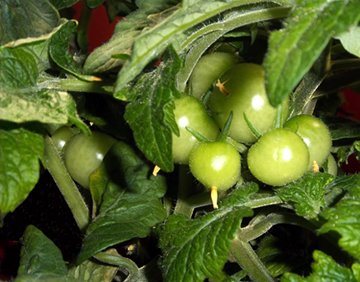
Green tomatoes may help build bigger, stronger muscles

April 10, 2014

cherry-tomatoes1Washington, Apr 10: Want to grow bigger, stronger muscles like Arnold Schwarzenegger? Eat green tomatoes!

A natural compound in green tomatoes stimulates muscle growth, improves muscle strength and endurance, protects against muscle wasting, a new study claims.

Using a screening method, University of Iowa scientists discovered that tomatidine, a compound from green tomatoes, is potent for building muscle and protecting against muscle atrophy.

Muscle atrophy, or wasting, is caused by ageing and a variety of illnesses and injuries, including cancer, heart failure, and orthopedic injuries, to name a few.

It makes people weak and fatigued, impairs physical activity and quality of life, and predisposes people to falls and fractures.

“Muscle atrophy causes many problems for people, their families, and the health care system in general,” said Christopher Adams, associate professor of internal medicine and molecular physiology and biophysics.

Stronger_musclesIn a new study, Adams searched for a small molecule compound that might be used to treat muscle atrophy.

He zeroed in on tomatidine using a systems biology tool called the Connectivity Map.

Adams discovered that tomatidine generates changes in gene expression that are essentially opposite to the changes that occur in muscle cells when people are affected by muscle atrophy.

After identifying tomatidine, Adams and his team tested its effects on skeletal muscle. They first discovered that tomatidine stimulates growth of cultured muscle cells from humans.

“That result was important because we are looking for something that can help people,” said Adams.

They found that healthy mice supplemented with tomatidine grew bigger muscles, became stronger and could exercise longer. And, most importantly, they found that tomatidine prevented and treated muscle atrophy.

Interestingly, although mice fed tomatidine had larger muscles, their overall body weight did not change due to a corresponding loss of fat, suggesting that the compound may also have potential for treating obesity.

The study was published in the Journal of Biological Chemistry.

Comments

Add new comment

  • Coastaldigest.com reserves the right to delete or block any comments.
  • Coastaldigset.com is not responsible for its readers’ comments.
  • Comments that are abusive, incendiary or irrelevant are strictly prohibited.
  • Please use a genuine email ID and provide your name to avoid reject.
Agencies
July 25,2020

The COVID-19 pandemic and the subsequent lockdown saw many people turning chefs overnight, but those who could not turned to online delivery of food. And not just any food, as per a new report, Indians "craved the most for Biryani" during the lockdown.

The "StatEATistics report: The Quarantine Edition" from food delivery platform Swiggy found that Indians ordered biryani over "5.5 lakh times" from their favourite restaurants.

The new normal might have opened a pandora's box of behavioral changes, but some old habits die hard like the love for Biryani, which took the top spot for overall orders. It was followed by butter naan and masala dosa at 3,35,185 and 3,31,423, respectively.

Biryani has topped the list of most ordered dishes for the fourth year in a row, the food delivery platform noted.

Indians didn't forget to indulge their sweet tooth in the uncertain months of lockdown. Their favourite comfort food during the lockdown period was the moist and decadent Choco Lava cake, ordered around 1,29,000 times.

"The humble Gulab Jamun (84,558) and chic Butterscotch Mousse cake (27,317) followed suit," said the report derived from Swiggy's order analysis in the past few months across cities that it is present in.

Also, as birthday parties moved to video calls, and virtual cake cutting sessions, according to the food delivery platform, it delivered nearly "1,20,000 cakes" to complete these celebrations.

According to the report, on average, "65,000 meal orders" were placed by 8 pm each day to make sure food arrived in time for dinner.

"It was the busiest hour for Swiggy delivery partners and restaurants. On average, they (customers) chose to tip Rs.23.65, with one particularly generous customer tipping Rs. 2500!," it added.

For those who only relied on home-made food during the quarantine, Swiggy delivered a whooping 323 million kgs of onions and 56 million kgs of bananas through its grocery section and hence ensured that its consumers were all stocked up.

That said, it also took care of the 'quick-fix meal' tribe -- consumers who resort to the evergreen college hacks of living on instant noodles.

"Around 3,50,000 packets of this ideal easy to cook meal were ordered during the lockdown," it said.

In all, Swiggy delivered 40 million orders across food, groceries, medicines and other household items during India's lockdowns. It also delivered over 73,000 bottles of sanitizers and hand wash along with 47,000 face masks as the definition of essentials' changed during these uncertain times.

Comments

Add new comment

  • Coastaldigest.com reserves the right to delete or block any comments.
  • Coastaldigset.com is not responsible for its readers’ comments.
  • Comments that are abusive, incendiary or irrelevant are strictly prohibited.
  • Please use a genuine email ID and provide your name to avoid reject.
Agencies
May 30,2020

Drinking coffee may help reduce the risk of certain digestive disorders, including gallstone disease and pancreatitis, a new study has suggested.

The study from the Institute for Scientific Information on Coffee (ISIC) also highlighted other beneficial effects that coffee consumption may have on the process of digestion, including supporting gut microflora and promoting gut motility.

"Data indicates benefits against common digestive complaints such as constipation, as well as a potential reduction in the risk of more serious conditions like chronic liver diseases," said study author Carlo La Vecchia from the University of Milan in Italy.

Gallstone disease is a common digestive disorder, caused by the accumulation of gallstones in the gallbladder or bile duct, which affects approximately 10-15 per cent of the adult population.

While the mechanism by which coffee may protect against gallstone disease is not yet known, it has been observed that the risk for the condition declines with increasing daily consumption of coffee, the researchers said.

Caffeine is thought to play a role in these associations, as the same effect is not observed with decaffeinated coffee.

A common question among consumers and focus area for research is whether coffee is associated with heartburn or gastro-oesophageal reflux disease (GORD).

While a small number of studies have suggested an association between coffee drinking and GORD, the majority of studies reviewed suggest that coffee is not a major trigger of these conditions.

The report also reviewed a growing area of health and nutrition research, namely: the effect of coffee on the gut microflora (microorganism populations).

Recent studies suggest that populations of the beneficial gut bacteria Bifidobacterium spp, increase after drinking coffee.

The findings showed the dietary fibre and polyphenols found in coffee, support the healthy growth of microflora populations.

Additional research findings highlighted that coffee consumption is thought to stimulate digestion by encouraging the release of gastric acid, bile and pancreatic secretions.

Coffee is one of the most widely researched components of the diet, and its effect on digestion remains a growing area of research, the researchers noted.

Comments

Add new comment

  • Coastaldigest.com reserves the right to delete or block any comments.
  • Coastaldigset.com is not responsible for its readers’ comments.
  • Comments that are abusive, incendiary or irrelevant are strictly prohibited.
  • Please use a genuine email ID and provide your name to avoid reject.
Agencies
April 4,2020

Washington D.C., Apr 4: While consuming a high-diet salt can result in high blood pressure, a recent study has revealed a link between salt-rich diet and weaker immune system.

The study was conducted under the leadership of the University Hospital Bonn, and the results were published in the journal Science Translational Medicine.

The research was conducted on mice that were fed a high-salt diet. Later, they were found to suffer from much more severe bacterial infections.

Human volunteers who consumed an additional six grams of salt per day also showed pronounced immune deficiencies.

The World Health Organization (WHO) has recommended a maximum amount of five grams of salt a day.

It corresponds approximately to one level teaspoon. In reality, however, many Germans exceed this limit considerably. 

Figures from the Robert Koch Institute suggest that on average men consume ten, and women more than eight grams a day.

This means that we reach for the salt shaker much more than is good for us. After all, sodium chloride, which is its chemical name, raises blood pressure and thereby increases the risk of heart attack or stroke.

"We have now been able to prove for the first time that excessive salt intake also significantly weakens an important arm of the immune system," said Prof. Dr. Christian Kurts from the Institute of Experimental Immunology at the University of Bonn.

This finding is unexpected, as some studies point in the opposite direction. For example, infections with certain skin parasites in laboratory animals heal significantly faster if these consume a high-salt diet.

The study also sheds light on the fact that the skin serves as a salt reservoir.

"Our results show that this generalization is not accurate," emphasized Katarzyna Jobin, lead author of the study.

The body keeps the salt concentration in the blood and in the various organs largely constant. Otherwise important biological processes would be impaired. The only major exception is the skin which functions as a salt reservoir of the body. This is why the additional intake of sodium chloride works so well for some skin diseases.

However, other parts of the body are not exposed to the additional salt consumed with food. Instead, it is filtered out by the kidneys and excreted in the urine.

"We examined volunteers who consumed six grams of salt in addition to their daily intake," said Prof. Kurts. This is roughly the amount contained in two fast-food meals, i.e. two burgers and two portions of French fries.

After one week, from the results, it showed that the immune cells coped much worse with bacteria after the test subjects had started to eat a high-salt diet.

In human volunteers, excessive salt intake also resulted in increased glucocorticoid levels.

Comments

Add new comment

  • Coastaldigest.com reserves the right to delete or block any comments.
  • Coastaldigset.com is not responsible for its readers’ comments.
  • Comments that are abusive, incendiary or irrelevant are strictly prohibited.
  • Please use a genuine email ID and provide your name to avoid reject.