



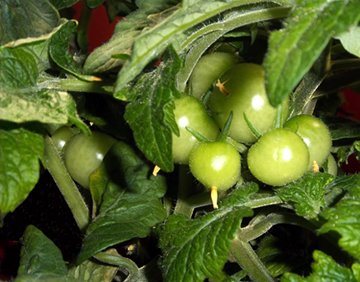
Green tomatoes may help build bigger, stronger muscles

April 10, 2014

cherry-tomatoes1Washington, Apr 10: Want to grow bigger, stronger muscles like Arnold Schwarzenegger? Eat green tomatoes!

A natural compound in green tomatoes stimulates muscle growth, improves muscle strength and endurance, protects against muscle wasting, a new study claims.

Using a screening method, University of Iowa scientists discovered that tomatidine, a compound from green tomatoes, is potent for building muscle and protecting against muscle atrophy.

Muscle atrophy, or wasting, is caused by ageing and a variety of illnesses and injuries, including cancer, heart failure, and orthopedic injuries, to name a few.

It makes people weak and fatigued, impairs physical activity and quality of life, and predisposes people to falls and fractures.

“Muscle atrophy causes many problems for people, their families, and the health care system in general,” said Christopher Adams, associate professor of internal medicine and molecular physiology and biophysics.

Stronger_musclesIn a new study, Adams searched for a small molecule compound that might be used to treat muscle atrophy.

He zeroed in on tomatidine using a systems biology tool called the Connectivity Map.

Adams discovered that tomatidine generates changes in gene expression that are essentially opposite to the changes that occur in muscle cells when people are affected by muscle atrophy.

After identifying tomatidine, Adams and his team tested its effects on skeletal muscle. They first discovered that tomatidine stimulates growth of cultured muscle cells from humans.

“That result was important because we are looking for something that can help people,” said Adams.

They found that healthy mice supplemented with tomatidine grew bigger muscles, became stronger and could exercise longer. And, most importantly, they found that tomatidine prevented and treated muscle atrophy.

Interestingly, although mice fed tomatidine had larger muscles, their overall body weight did not change due to a corresponding loss of fat, suggesting that the compound may also have potential for treating obesity.

The study was published in the Journal of Biological Chemistry.

Comments

Add new comment

  • Coastaldigest.com reserves the right to delete or block any comments.
  • Coastaldigset.com is not responsible for its readers’ comments.
  • Comments that are abusive, incendiary or irrelevant are strictly prohibited.
  • Please use a genuine email ID and provide your name to avoid reject.
Agencies
March 27,2020

New Delhi, Mar 27: The Centre has restricted sale and distribution of "hydroxychloroquine" declaring it as an essential drug to treat the COVID-19 patients and meet the requirements of emergency arising due to the pandemic.

The Ministry of Health and Family Welfare on Thursday made the announcement making it clear that the order "shall come into force on the date of its publication in the official Gazette".

In the order, the government declared that the Central government is "satisfied that the drug hydroxychloroquine is essential to meet the requirements of emergency arising due to pandemic COVID-19 and in the public interest, it is necessary and expedient to regulate and restrict the sale and distribution of the drug 'hydroxychloroquine' and preparation based thereon for preventing their misuse".

"Now, therefore, in exercise of the powers conferred by Section 26B of the Drugs and Cosmetics Act, 1940 (23 of 1940), the Central government hereby directs that sale by retail of any preparation containing the drug Hydroxychloroquine shall be in accordance with the conditions for sale of drugs specified in Schedule H1 to the Drugs and Cosmetics Rules, 1945."

The order came at a time when the novel coronavirus claimed 16 lives and infected over 600 people across India.

The announcement regarding ban of sale and distribution of the drug was made by the government earlier but it issued an official Gazette notification on Thursday signalling that hydroxychloroquine -- an anti-Malaria drug -- will work as a medicine for treating coronavirus infected patients as well.

Recently, the national task force for COVID-19 constituted by Indian Council for Medical Research (ICMR) has recommended hydroxy-chloroquine as a preventive medication.

Comments

Add new comment

  • Coastaldigest.com reserves the right to delete or block any comments.
  • Coastaldigset.com is not responsible for its readers’ comments.
  • Comments that are abusive, incendiary or irrelevant are strictly prohibited.
  • Please use a genuine email ID and provide your name to avoid reject.
Agencies
June 11,2020

The World Health Organisation (WHO) Director-General Tedros Adhanom Ghebreyesus said that more research needs to be done to better understand the extent to which COVID-19 is being spread by people who don't show symptoms.

"Since early February, we have said that asymptomatic people can transmit COVID-19, but that we need more research to establish the extent of asymptomatic transmission," the WHO chief said at a virtual press conference from Geneva on Wednesday, Xinhua news agency reported.

"That research is ongoing, and we're seeing more and more research being done," he added.

Saying that the world has been achieving a lot in knowing the new virus, the WHO chief told reporters that "there's still a lot we don't

"WHO's advice will continue to evolve as new information becomes available," he said.

Tedros stressed that the most critical way to stop transmission is to find, isolate and test people with symptoms, and trace and quarantine their contacts.

"Many countries have succeeded in suppressing transmission and controlling the virus doing exactly this," Tedros said.

Meanwhile, Michael Ryan, executive director of WHO Health Emergencies Program, said Wednesday that the COVID-19 pandemic is still evolving.

"If we look at the numbers... this pandemic is still evolving. It is growing in many parts of the world," he said. "We have deep concerns that health systems of some countries are struggling, under a huge strain and require our support, our help and our solidarity."

He said "each and every country has a different combination of risks and opportunities, and it's really down to national authorities to carefully consider where they are in the pandemic."

In Europe, the risk issue now are about travels and the opening of the schools, around risk management, mass gathering, surveillance and contact tracing, said the WHO official.

In Southeast Asian countries, where to a great extent transmissions have been under control, governments are more concerned about the re-emergence of clusters, while in South America, the issue of PPE for health workers has not gone away, said Ryan.

As regards Africa, Ryan said the death rates have been very low in the past week, but the health system can be overwhelmed, as it would have to cope with other diseases such as malaria.

Comments

Add new comment

  • Coastaldigest.com reserves the right to delete or block any comments.
  • Coastaldigset.com is not responsible for its readers’ comments.
  • Comments that are abusive, incendiary or irrelevant are strictly prohibited.
  • Please use a genuine email ID and provide your name to avoid reject.
Agencies
June 23,2020

The record levels of new daily COVID-19 cases are due to the fact that the pandemic is peaking in a number of big countries at the same time and reflect a change in the virus' global activity, the World Health Organisation said.

At a media briefing on Monday, WHO's emergencies chief Dr Michael Ryan said that the numbers are increasing because the epidemic is developing in a number of populous countries at the same time.

Some countries have attributed their increased caseload to more testing, including India and the US But Ryan dismissed that explanation.

We do not believe this is a testing phenomenon, he said, noting that numerous countries have also noted marked increases in hospital admissions and deaths neither of which cannot be explained by increased testing.

There definitely is a shift in that the virus is now very well established, Ryan said. The epidemic is now peaking or moving towards a peak in a number of large countries.

He added the situation was definitely accelerating in a number of countries, including the US and others in South Asia, the Middle East and Africa.

Comments

Add new comment

  • Coastaldigest.com reserves the right to delete or block any comments.
  • Coastaldigset.com is not responsible for its readers’ comments.
  • Comments that are abusive, incendiary or irrelevant are strictly prohibited.
  • Please use a genuine email ID and provide your name to avoid reject.