



Gujarat snooping scandal reaches the Supreme Court

November 19, 2013

New Delhi, Nov 19: The Gujarat snooping controversy today reached the Supreme Court with a suspended IAS officer Pradeep Sharma urging it to take cognisance of audio tapes aired by news portals saying it contains proof of how the state government had tried to frame him in "frivolous" cases.
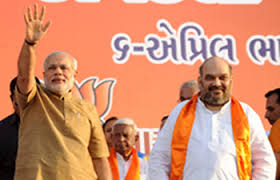
snooping

A bench headed by Chief Justice P Sathasivam asked Sharma to file an affidavit after the Gujarat government counsel submitted that no oral arguments should be allowed to be made till something is placed on record.

At the outset, advocate Prashant Bhushan, appearing for Sharma, submitted that an important development has taken place (referring to audio tapes) since the last hearing and the case needs to be heard urgently.

The bench, also comprising justices Ranjana Prakash Desai and Ranjajan Gogoi, then asked Sharma to file affidavit and posted the case for hearing in the first week of December.

Two investigative portals, Cobrapost and Gulail, had claimed on November 15 that Amit Shah, the former home minister of Gujarat and Modi's close aide, had ordered illegal surveillance of a woman at the behest of one "saheb" and they had released taped conversation between Shah and an IPS officer to back up their claim.

Sharma, a 1984 batch IAS officer, is facing five criminal cases including a case for alleged irregularity in land allotment to private firms in Kutch district in 2008.

In his petition, he had made some references to the personal life of Modi but the court on on May 12, 2011 had directed him to remove those portions, which was accepted.

Sharma, who last served as Bhavnagar Municipal Commissioner, was arrested on January 6, 2010 in a case involving alleged irregularities in Kutch earthquake rehabilitation.

The IAS officer in his petition, however, alleged that he is being targeted by Modi government because his younger brother Kuldip Sharma, a senior IPS officer in the state, has "unmasked" many misdeeds of Modi since Godhra riots. Sharma sought that probe in these cases be handed over to CBI.

"The petitioner happens to be the brother of Kuldip Sharma who has unmasked many misdeeds of Narendra Modi and Amit Shah, the ex-Home Minister, since the 2002 Godhra riots.

"The two siblings have been very close to each other right from childhood and share very strong fraternal bonds. In order to cause prejudice to Kuldip Sharma, the petitioner has been victimised by Chief Minister Narendra Modi and Amit Shah," the petition said.

Comments

Add new comment

  • Coastaldigest.com reserves the right to delete or block any comments.
  • Coastaldigset.com is not responsible for its readers’ comments.
  • Comments that are abusive, incendiary or irrelevant are strictly prohibited.
  • Please use a genuine email ID and provide your name to avoid reject.
News Network
June 17,2020

New Delhi, Jun 17: Police Surender Jeet Kaur, Assistant Commissioner of Delhi Police Surender Jeet Kaur, has held herself responsible for the death of her husband Charan Jeet Singh, who succumbed to Covid at a hospital in Delhi.

“My husband didn’t step out of the house when the lockdown started, but I went out daily because of my job… I will never be able to forgive myself,” Kaur on Tuesday, a day after losing her husband.

54-year-old Singh, a resident of Lajpat Nagar and a businessman, is survived by his wife and their 26-year-old son who lives in Canada.

Kaur, 57, ACP (Crimes Against Women) in the South-East district of the Delhi Police, is also ACP (Covid Cell) of the district. On May 20, five days after Kaur tested positive for the virus, her husband Singh tested positive, followed by the ACP’s 80-year-old father on May 24.

All of them had symptoms and while Kaur and Singh were admitted to Indraprastha Apollo hospital, her father was admitted to Max hospital in Saket. On May 26, Kaur returned home after recovering from the virus.

Kaur said, “I last spoke to my husband on May 22 night, when we were both admitted in the hospital in different wards. The doctor called me and said that my husband needs to be put on ventilator support. I had a video call with my husband. He was breathless and told me that his oxygen level was dropping. He showed me the monitor, the doctors in the room, and then said he was having trouble speaking and that he would send me WhatsApp messages.”

A day after he passed away, Kaur recalled the messages that Singh sent her just before being put on ventilator support. “He started sending me details of our finances, accounts… I told him to stop and asked him why he was telling me all this. He said I needed to know… Maybe he feared he wouldn’t come back. I prayed every day, at temples, mosques, churches and gurdwaras for him. I am devastated that he’s gone. We were to move to Canada to live with our son in 2023 after my retirement. We had so many plans.”

Kaur’s brother Maninder Ahluwalia said the hospital tried plasma therapy but Singh didn’t respond to the treatment. “He had diabetes and high BP, but those were always under control. We were hopeful,” he said.

The couple’s son joined on video call from Canada to watch his father’s last journey from the ambulance to the entrance of the crematorium. “My son couldn’t attend his father’s last rites because there are no flights… It’s so unfortunate,” said Kaur.

Friends and family remember Singh as a “jolly, disciplined and brave man”, while Kaur said he was the “perfect partner”. She said, “When I was an SHO-rank officer, I would work for 36 hours straight some days, and he would handle the house and our son who was growing up. I would miss family functions and important occasions but he would always go and make up for my absence. I was able to do this job for decades because of his support.”

On Tuesday afternoon, Singh was cremated in the presence of close family and members of the police fraternity. “The DCP and the Joint CP called me daily to enquire about my husband, other police officers too. I am grateful for their support. They didn’t let me feel alone for a single day,” said Kaur.

Comments

Add new comment

  • Coastaldigest.com reserves the right to delete or block any comments.
  • Coastaldigset.com is not responsible for its readers’ comments.
  • Comments that are abusive, incendiary or irrelevant are strictly prohibited.
  • Please use a genuine email ID and provide your name to avoid reject.
News Network
May 24,2020

New Delhi, May 24: The Indian economy is likely to slip into recession in the third quarter of this fiscal as loss in income and jobs and cautiousness among consumers will delay recovery in consumer demand even after the pandemic, says a report.

According to Dun & Bradstreet's latest Economic Observer, the country's economic recovery will depend on the efficacy and duration of implementation of the government's stimulus package.

"The multiplier effect of the stimulus measures on the economy will depend on three key aspects i.e. the time taken for effecting the withdrawal of the lockdown, the efficacy of implementation and duration of execution of the measures announced," Dun & Bradstreet India Chief Economist Arun Singh said.

The report noted that the government's larger-than-expected stimulus package is likely to re-start economic activities.

Besides, measures taken by the Reserve Bank of India like reducing the repo rate by a further 40 basis points to 4 per cent, extending the moratorium period by three months and facilitating working capital financing will also help stimulate the momentum.

Singh said while the measures announced by the government are "positive", most of them have been directed towards strengthening the supply side of the economy, and "it is to be noted that supply needs to be matched with demand", he said.

Besides, "in the absence of cash-in-hand benefits under the government's stimulus package, demand for goods and services is expected to remain depressed", he added.

He further said the loss in income and employment opportunities, and cautiousness among consumers, will lead to a delayed recovery in consumer demand, even after the pandemic. As debt and bad loan levels increase, the banking sector might face challenges.

The report further noted that even as the monetary stimulus is expected to inject liquidity and stimulate demand for a wider section of the economy, the channelisation of funds from the financial institutions will be subjected to several constraints.

The foremost concern being increase in risk averseness, as the balance sheets of firms, households, and banks/NBFCs have weakened considerably and low demand for funds by firms as production activities have been on a standstill during the lockdown period, Singh said.

India has been under lockdown since March 25 to contain the spread of the coronavirus, resulting in supply disruptions and demand compression.

Prime Minister Narendra Modi imposed a nationwide lockdown to control the spread of coronavirus on March 25. It has been extended thrice, with some relaxations. The fourth phase of the lockdown is set to expire on May 31. 

Comments

Add new comment

  • Coastaldigest.com reserves the right to delete or block any comments.
  • Coastaldigset.com is not responsible for its readers’ comments.
  • Comments that are abusive, incendiary or irrelevant are strictly prohibited.
  • Please use a genuine email ID and provide your name to avoid reject.
News Network
June 11,2020

Washington, Jun 11: Observing that historically India has been a tolerant, respectful country for all religions, a top Trump administration official has said the US is "very concerned" about what is happening in India over religious freedom.

The comments by Samuel Brownback, Ambassador-At-Large for International Religious Freedom, came hours after the release of the "2019 International Religious Freedom Report" on Wednesday.

Mandated by the US Congress, the report documenting major instances of violation of religious freedom across the world was released by Secretary of State Mike Pompeo at the State Department.

India has previously rejected the US religious freedom report, saying it sees no locus standi for a foreign government to pronounce on the state of its citizens' constitutionally protected rights.

"We do remain very concerned about what's taking place in India. It's historically just been a very tolerant, respectful country of religions, of all religions," Mr Brownback said during a phone call with foreign journalists on Wednesday.

The trend lines have been troubling in India because it is such a religious subcontinent and seeing a lot more communal violence, Mr Brownback said. "We're seeing a lot more difficulty. I think really they need to have a - I would hope they would have an - interfaith dialogue starting to get developed at a very high level in India, and then also deal with the specific issues that we identified as well," he said.

"It really needs a lot more effort on this topic in India, and my concern is, too, that if those efforts are not put forward, you're going to see a growth in violence and increased difficulty within the society writ large," said the top American diplomat.

Responding to a question, Mr Brownback said he hoped minority faiths are not blamed for the COVID-19 spread and that they would have access to healthcare amid the crisis.

Prime Minister Narendra Modi has criticised any form of discrimination, saying the COVID-19 pandemic affects everyone equally. "COVID-19 does not see race, religion, colour, caste, creed, language or border before striking. Our response and conduct thereafter should attach primacy to unity and brotherhood," PM Modi said in a post on LinkedIn in February.

The government, while previously rejecting the US religious freedom report, had said: "India is proud of its secular credentials, its status as the largest democracy and a pluralistic society with a longstanding commitment to tolerance and inclusion".

"The Indian Constitution guarantees fundamental rights to all its citizens, including its minority communities… We see no locus standi for a foreign entity/government to pronounce on the state of our citizens' constitutionally protected rights," the Foreign Ministry said in June last year.

According to the Home Ministry, 7,484 incidents of communal violence took place between 2008 and 2017, in which more than 1,100 people were killed.

Comments

Add new comment

  • Coastaldigest.com reserves the right to delete or block any comments.
  • Coastaldigset.com is not responsible for its readers’ comments.
  • Comments that are abusive, incendiary or irrelevant are strictly prohibited.
  • Please use a genuine email ID and provide your name to avoid reject.