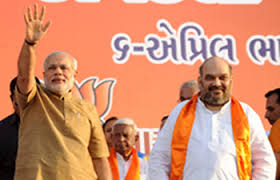
Gujarat snooping scandal reaches the Supreme Court

November 19, 2013

New Delhi, Nov 19: The Gujarat snooping controversy today reached the Supreme Court with a suspended IAS officer Pradeep Sharma urging it to take cognisance of audio tapes aired by news portals saying it contains proof of how the state government had tried to frame him in "frivolous" cases.

snooping

A bench headed by Chief Justice P Sathasivam asked Sharma to file an affidavit after the Gujarat government counsel submitted that no oral arguments should be allowed to be made till something is placed on record.

At the outset, advocate Prashant Bhushan, appearing for Sharma, submitted that an important development has taken place (referring to audio tapes) since the last hearing and the case needs to be heard urgently.

The bench, also comprising justices Ranjana Prakash Desai and Ranjajan Gogoi, then asked Sharma to file affidavit and posted the case for hearing in the first week of December.

Two investigative portals, Cobrapost and Gulail, had claimed on November 15 that Amit Shah, the former home minister of Gujarat and Modi's close aide, had ordered illegal surveillance of a woman at the behest of one "saheb" and they had released taped conversation between Shah and an IPS officer to back up their claim.

Sharma, a 1984 batch IAS officer, is facing five criminal cases including a case for alleged irregularity in land allotment to private firms in Kutch district in 2008.

In his petition, he had made some references to the personal life of Modi but the court on on May 12, 2011 had directed him to remove those portions, which was accepted.

Sharma, who last served as Bhavnagar Municipal Commissioner, was arrested on January 6, 2010 in a case involving alleged irregularities in Kutch earthquake rehabilitation.

The IAS officer in his petition, however, alleged that he is being targeted by Modi government because his younger brother Kuldip Sharma, a senior IPS officer in the state, has "unmasked" many misdeeds of Modi since Godhra riots. Sharma sought that probe in these cases be handed over to CBI.

"The petitioner happens to be the brother of Kuldip Sharma who has unmasked many misdeeds of Narendra Modi and Amit Shah, the ex-Home Minister, since the 2002 Godhra riots.

"The two siblings have been very close to each other right from childhood and share very strong fraternal bonds. In order to cause prejudice to Kuldip Sharma, the petitioner has been victimised by Chief Minister Narendra Modi and Amit Shah," the petition said.

Comments

Add new comment

  • Coastaldigest.com reserves the right to delete or block any comments.
  • Coastaldigset.com is not responsible for its readers’ comments.
  • Comments that are abusive, incendiary or irrelevant are strictly prohibited.
  • Please use a genuine email ID and provide your name to avoid reject.
News Network
January 1,2020

Jan 1: The ban on the practice of instant triple talaq, making it a penal offence and the increase in the strength of Supreme Court judges were two of the major achievements of the law ministry in 2019.

In July, Parliament gave its nod to The Muslim Women (Protection of Rights on Marriage) Bill, 2019. The new law makes talaq-e-biddat or any other similar form of talaq having the effect of instantaneous and irrevocable divorce pronounced by a Muslim husband void and illegal.

It makes it illegal to pronounce talaq three times in spoken, written or through SMS or WhatsApp or any other electronic chat in one sitting.

According to the new law, any Muslim who pronounces the illegal form of talaq upon his wife shall be punished with imprisonment for a term which may extend to three years, and shall also be liable to fine.

During the year, four new judges were appointed to the Supreme Court in September, taking its strength to 34, the highest-ever.

However, vacancies in high courts and lower courts are on the rise and convincing state governments and the 25 high courts to come on board to create an all-India judicial service to recruit judges for the subordinate courts tops the agenda of the Law Ministry in 2020.

Besides creating a consensus on setting up the All-India Judicial Services, the ministry will also have to focus on filling up vacancies in the high court. On an average, the vacancies stood at 400 throughout this year.

With more than 5,000 positions of judicial officers in district and subordinate courts lying vacant, the Law Ministry has pitched for setting up all-India judicial services.

The sanctioned strength of the judicial officers in district and subordinate courts was 22,644. The number of judicial officers in position and vacant posts is 17,509 and 5,135, respectively.

The government has proposed that while states and high courts can recruit judicial officers, the Union Public Service Commission (UPSC) can hold pan-India entrance tests.

The ministry has made it clear that such services would not encroach on the powers of the states.

As of now, the selection and appointment of judges in subordinate courts is the responsibility of the high courts and state governments concerned.

The Narendra Modi government has given a fresh push to the long-pending proposal to set up the new service to have a separate cadre for the lower judiciary in the country.

But there is a divergence of opinion among state governments and respective high courts on the constitution of the All India Judicial Service (AIJS).

One of the problems cited is that since several states have used powers under Code of Criminal Procedure (CrPC) and Code of Civil Procedure (CPC) to declare that the local language would be used in lower courts even for writing orders, a person say selected from Tamil Nadu may find it difficult to hold proceedings in states like Uttar Pradesh and Bihar.

The other point of opposition is that an all India service may hamper the career progression of state judicial services officers.

Another key issue the ministry has to handle in 2020 is vacancies in the 25 high courts.

Throughout 2019, on an average, the high courts faced a shortage of 400 judges.

According to Law Ministry data, as on September 1, the high courts had 414 vacant positions as compared to the sanctioned strength of 1,079 judges. The figure was 409 in August and 403 in July, as per the data.

A three-member Supreme Court collegium recommends the names of candidates for appointment as high court judges. In case of appointments to the Supreme Court, the collegium consists of five top judges of the top court.

High court collegiums shortlist candidates for their respective high courts and send the names to the law ministry.

The ministry, along with background check reports by the Intelligence Bureau, forwards it to the Supreme Court collegium for a final call.

The government has maintained that appointment of judges in the high courts is a "continuous collaborative process" between the Executive and the Judiciary, as it requires consultation and approval from various Constitutional authorities.

Vacancies keep arising on account of retirement, resignation or elevation of judges and increase in judges' strength. In June last year, the vacancy position stood at 399, while it was 396 in May.

In April, 399 posts of judges were vacant, while the figure was 394 in March. The vacancy position in February stood at 400 and in January, it was 392, according to the data collated by the Department of Justice.

Over 43 lakh cases are pending in the 25 high courts.

Another priority would be the finalisation of the memorandum of the procedure to guide the appointment and transfer of the Supreme Court and high court judges. The issue had now been pending for over two years now with the SC collegium and the government failing to reach a consensus.

Successive governments have also been working on making India a hub of international arbitration. It has taken several steps to change laws dealing with commercial disputes.


Comments

Add new comment

  • Coastaldigest.com reserves the right to delete or block any comments.
  • Coastaldigset.com is not responsible for its readers’ comments.
  • Comments that are abusive, incendiary or irrelevant are strictly prohibited.
  • Please use a genuine email ID and provide your name to avoid reject.
Agencies
March 15,2020

New Delhi, Mar 15: Dozens of Hindu activists held a cow urine party in New Delhi on Saturday to protect themselves from the new coronavirus, as countries around the world struggle to control the deadly pandemic.

Members and supporters of the All India Hindu Mahasabha staged fire rituals and drank from earthen cups to fight the Covid-19 virus at the gathering in New Delhi dubbed a "gaumutra (cow urine) party".

"Whoever drinks cow urine will be cured and protected," Hari Shankar Kumar, a volunteer at the event, said as he served the remedy in brown clay cups.

Governments and scientists have said no medicine or vaccine is available to protect or cure people of the infection that has killed more than 5,400 people and infected nearly 150,000 across six continents.

Two people have died in India while more than 80 have fallen ill, and the government has ordered the closure of some land routes into the country and cancelled all visas to stop the spread of the virus in the world's second most populous country.

Members draped in saffron clothes chanted Hindu hymns at the fire ritual as devotees sang paeans for the sacred animal.

"We have gathered here and prayed for world peace and we will make an offering to the corona (virus) to calm it," Chakrapani Maharaj, the group's leader, told reporters before gulping down a cup of urine.

He then offered a glass to a devil-shaped caricature of the virus to "pacify" it.

He urged people to adopt the "tried and tested" practice of drinking cow urine to ward off diseases, and desist from killing animals and eating meat.

"The coronavirus is also a bacteria and cow urine is effective against all forms of bacteria that harm us," claimed Om Prakash, a participant from the neighbouring state of Uttar Pradesh.

One legislator from the BJP last week suggested use of the urine as well as cow dung can cure the coronavirus.

Comments

PK
 - 
Sunday, 15 Mar 2020

A Waste is a Waste.... God has created a system in our body and animals to throw out the excess wastage from our body... Guys please stay away from drinking the wastage and putting the wastage inside the body again . U will be a loser health wise and mentally. 


Cows will surely think by seeing these people that human beings are stupid to drink our wastage... Drink its milk which is beneficial drink that God has given us.


Fairman
 - 
Sunday, 15 Mar 2020

If your faith is scientific, simply go to Corona infected patients and cure it.


If you are successful, Not only India the whole world will be Hindus. 


If you cant, you will never do it with cow urine or any other urine. People will losse faith on your type of Hinduism.


Kumaran
 - 
Sunday, 15 Mar 2020

wrost of worst human being..

when you worship the devil, the god will make you to dring urine, shit etc..and root in helll forver


Hindu regilion was very pure before now it become very ugly by so called hindu protector.


Add new comment

  • Coastaldigest.com reserves the right to delete or block any comments.
  • Coastaldigset.com is not responsible for its readers’ comments.
  • Comments that are abusive, incendiary or irrelevant are strictly prohibited.
  • Please use a genuine email ID and provide your name to avoid reject.
News Network
January 30,2020

New Delhi, Jan 30: In a major shift of strategy ahead of the Delhi assembly polls, the Bharatiya Janata Party (BJP) has decided to rope in its senior leaders for massive public rallies.

Its star campaigners like Prime Minister Narendra Modi, Union Home Minister Amit Shah, BJP chief JP Nadda, Uttar Pradesh Chief Minister Yogi Adityanath, and other union ministers would now be addressing massive public rallies in addition to ongoing neighbourhood meetings.

"The big rallies would begin from February 1. While 'Nukkad' meetings will take place till the last day of campaigning, there would be big rallies of the top leadership of the party, " informed a senior party leader.

Sources said the BJP has changed its strategy after the success of its grassroots contact programme as the party wants to consolidate its gains.

"As part of the reworked strategy the BJP has asked its various Mandals to organise public meetings of 10,000-15,000 people in each assembly segment to reach out to the masses," sources added.

While there are two planned for Prime Minister Modi, two have been planned for JDU chief and Bihar Chief Minister Nitish Kumar along with Nadda and Amit Shah. Yogi Aadityanath too would be addressing 12 rallies.

The party is leaving no stone unturned to secure massive gains, which it feels can be converted to victory in the forthcoming polls.

Party sources feel that the relentless campaigning under the guidance of Amit Shah and Nadda has ensured that the morale of party cadre is at an all-time high.

"The neighbourhood meetings have ensured that we have been able to make the people of Delhi aware of the lack of work under the Arvind Kejriwal led Aam Aadmi Party government. They have also been apprised about the anti-national views of the opponents and we think that this is expected to turn the polls into our favour," sources added.

Delhi is scheduled for assembly polls on February 8 and the results for the 70 constituencies will be declared on February 11.

As part of the new strategy, senior leaders like JP Nadda, Amit Shah, Uttar Pradesh chief minister Yogi Adityanath, ministers like Rajnath Singh and Smriti Irani would be holding public rallies in various parts of the city. Several other chief ministers from various BJP ruled states are also expected to be roped in for the campaign.

The strategy for reach out to the masses is an attempt at weakening the hold of AAP on Delhi. With positive feedback coming after the success of the neighbourhood meetings in the past week, the BJP is now looking to increase its potential reach with polls just days away.

Till now the party had deployed 70 union ministers to hold at least one public meeting and one 'padayatra' each as part of the campaign.

Comments

Add new comment

  • Coastaldigest.com reserves the right to delete or block any comments.
  • Coastaldigset.com is not responsible for its readers’ comments.
  • Comments that are abusive, incendiary or irrelevant are strictly prohibited.
  • Please use a genuine email ID and provide your name to avoid reject.