



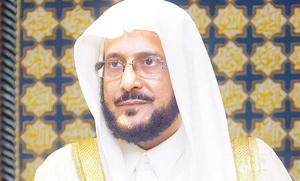
Haia chief for shorter prayer break

January 1, 2014
Jeddah, Jan 1: The Commission for the Promotion of Virtue and the Prevention of Vice (Haia) is considering shortening the time shops close for prayer, the Haia chief has said. haia

The period would be limited to just enough time for ablution and the actual time needed to complete a prayer, said Sheikh Abdullateef Al-Asheikh in the interview broadcast on an Arabic channel on Monday. “We would need the legislature to pass the proposed policy,” he said.

The Haia staff would do random inspections in malls to make sure people follow the new policy. He said Haia members would not chase people to pray.

“It is acceptable to perform prayers in a mall or shop in a group if the mosque is far away,” he said.

Shops across Saudi Arabia are required to close from the time of the call to prayer until the prayer is finished, which could take up to 30 minutes.

During the 35-minute TV program, Al-Asheikh toured a Riyadh shopping mall and interacted with shoppers and shopkeepers to get first-hand experience from people on the performance of his organization.

The chief said he would like his organization to do its job as envisaged by Custodian of the Two Holy Mosques King Abdullah “with moderate and tolerant views, and avoiding hurting the feelings of the public.”

Al-Asheikh took office two years ago with a mission to improve the image of the Haia and clear away decades of public distrust and contempt.

He has revamped the Haia's administrative and field operations to regain public trust. “It was an uphill task and resistance to change was expected,” he said.

Many of the old guard lost their privileges “as I stopped accepting donations to the Haia from private businesses,” he said.

Al-Asheikh said there were staff members who wanted the Haia to take an extremist view to serve their personal interests and ideological beliefs. “I will continue with the most moderate and tolerant view to lead this organization," he said.

He said he was not bothered by foreign media calling the organization the religious police.

“We look at a set of principles to follow within the teachings of Islamic Shariah. Let them call us whatever they want,” he said. The Haia has a mission to respect people, protect them, and keep women safe from harassment, he said.

The foreign media has tried to depict the Haia as a monster “but every country has rules and systems on which it operates. The Haia doesn’t block social movement as long as it doesn’t contradict our religion and culture,” he said.

Al-Asheikh said he upheld his promise to reform the organization. “I was once on an unannounced visit to a mall and found a Haia member not displaying his badge. I asked him to leave the mall immediately,” he said.

Shoppers in the mall asked him to employ more friendly Haia members. “We feel safe with them around us,” one woman shopper told Al-Asheikh.

During his tour of the mall, he stepped into an all-female shop, but to his surprise found a salesman. “We completely support women working in women-related shops, but in a case like this, we'll give them a chance to bring in a saleswoman,” he said.

In another women’s shop, he interacted with a saleswoman who said she appreciated the Haia’s mission and the professional treatment and respect of her shop-owner.

He reiterated that the Haia staff members are not allowed to check people’s cell phones unless they suspect of being involved in harassment, drinking alcohol or drug dealing.

Comments

Add new comment

  • Coastaldigest.com reserves the right to delete or block any comments.
  • Coastaldigset.com is not responsible for its readers’ comments.
  • Comments that are abusive, incendiary or irrelevant are strictly prohibited.
  • Please use a genuine email ID and provide your name to avoid reject.
News Network
May 11,2020

May 11: Saudi Arabia will triple its value-added tax rate and suspend a cost of living allowance for state workers, it said on Monday, seeking to shield finances hit by low oil prices and a slump in demand for its lifeline export worsened by the new coronavirus.

Historic oil output cuts agreed by Riyadh and other major producers have given only limited support to prices after they sank on oversupply caused by a war for petroleum market share between the kingdom and its fellow oil titan Russia.

Saudi Arabia, the world's largest oil exporter, is also being hit hard by measures to fight the new coronavirus, which are likely to curb the pace and scale of economic reforms launched by Crown Prince Mohammed bin Salman.

"The cost of living allowance will be suspended as of June 1, and the value added tax will be increased to 15% from 5% as of July 1," Finance Minister Mohammed al-Jadaan said in a statement reported by the state news agency. "These measures are painful but necessary to maintain financial and economic stability over the medium to long term...and to overcome the unprecedented coronavirus crisis with the least damage possible."

The austerity measures come after the kingdom posted a $9 billion budget deficit in the first quarter.

The minister said non-oil revenues were affected by the suspension and decline in economic activity, while spending had risen due to unplanned strains on the healthcare sector and the initiatives taken to support the economy.

"All these challenges have cut state revenues, pressured public finances to a level that is hard to deal with going forward without affecting the overall economy in the medium to long term, which requires more spending cuts and measures to support non-oil revenues stability," he added.

The government has cancelled and put on hold some operating and capital expenditures for some government agencies, and cut allocations for some reform initiatives and projects worth a total 100 billion riyals ($26.6 billion), the statement said.

Central bank foreign reserves fell in March at their fastest rate in at least 20 years and to their lowest since 2011, while oil revenues in the first three months of the year fell 24% from a year earlier to $34 billion, pulling total revenues down 22%.

"The reforms are positive from a fiscal side as greater adjustment is essential. However, the tripling of VAT is unlikely to help that much in 2020 revenue wise with the expected fall in consumption," said Monica Malik, chief economist at Abu Dhabi Commercial Bank.

She said she kept unchanged her deficit forecast of 16.3% of GDP for this year, which already factors in a greater than previously announced spending cut.

About 1.5 million Saudis are employed in the government sector, according to official figures released in December.

In 2018, Saudi Arabia's King Salman ordered a monthly payment of 1,000 riyals ($267) to every state employee to compensate them for the rising living costs after the government hiked domestic gas prices and introduced value-added tax.

DIFFICULT TIMES

A committee has been formed to study all financial benefits paid to public sector employees and contractors, and will submit recommendations within 30 days, the statement said.

In late 2015, when oil prices fell from record highs, the kingdom slashed lavish bonuses, overtime payments and other benefits once considered routine perks in the public sector.

In a country without elections and with political legitimacy resting partly on distribution of oil revenue, the ability of citizens to adapt to such reforms is crucial for stability.

"Tripling the VAT will test the limits of the balance between revenues and consumption as the economy dives into a deep recession. The move will impact consumption and could also lower the expected revenues," said John Sfakianakis, a Gulf expert at the University of Cambridge.

"These are pro-austerity and pro-revenue moves rather than pro-growth ones," he said.

Hasnain Malik, head of equity strategy at Tellimer, said the VAT rise could bring about $24-$26.5 billion in additional non-oil fiscal revenue. The rise would hit consumer spending further but was a needed step towards fiscal sustainability, he said.

Comments

Add new comment

  • Coastaldigest.com reserves the right to delete or block any comments.
  • Coastaldigset.com is not responsible for its readers’ comments.
  • Comments that are abusive, incendiary or irrelevant are strictly prohibited.
  • Please use a genuine email ID and provide your name to avoid reject.
News Network
January 12,2020

Tehran, Jan 12: Iranian police dispersed students chanting “radical” slogans during a Saturday gathering in Tehran to honour the 176 people killed when an Ukrainian airliner was mistakenly shot down, Fars news agency reported.

News agency correspondents said hundreds of students gathered early in the evening at Amir Kabir University, in downtown Tehran, to pay respects to those killed in the air disaster. The tribute later turned into an angry demonstration.

The students chanted slogans denouncing "liars" and demanded the resignation and prosecution of those responsible for downing the plane and allegedly covering up the accidental action.

Iran said Saturday that the Ukraine International Airlines Boeing 737 was “unintentionally” shot down on Wednesday shortly after taking off from Tehran's main airport. All 176 people on board died, mostly Iranians and Canadians, many of whom were students.

Fars, which is close to conservatives, said the protesting students chanted “destructive” and “radical” slogans. The news agency said some of the students tore down posters of Qasem Soleimani, the Iranian general killed on January 3 in a US drone strike on Baghdad.

Fars published pictures of demonstrators gathered around a ring of candles during the tribute and a picture of a torn poster bearing the image of a smiling Soleimani. It said that police "dispersed" them as they left the university and blocked streets, causing a traffic jam.

In an extremely unusual move, state television mentioned the protest, reporting that the students shouted "anti-regime" slogans.

A video purportedly of the protest circulated online showing police firing tear gas at protesters and a man getting up after apparently being hit in the leg by a projectile. It was not possible to verify the location of the video, or when it was filmed.

Iran's acknowledgement on Saturday that the plane had been shot down in error came after officials had for days categorically denied Western claims that it had been struck by a missile. The aerospace commander of Iran's Revolutionary Guards accepted full responsibility.

But Brigadier General Amirali Hajizadeh said the missile operator acted independently, shooting down the Boeing 737 after mistaking it for a "cruise missile".

Comments

Add new comment

  • Coastaldigest.com reserves the right to delete or block any comments.
  • Coastaldigset.com is not responsible for its readers’ comments.
  • Comments that are abusive, incendiary or irrelevant are strictly prohibited.
  • Please use a genuine email ID and provide your name to avoid reject.
Arab News
March 9,2020

Dubai, Mar 9: The eyes of the world will be on the oil markets when the big trading hubs in Europe and North America open following the end of the deal between Saudi Arabia and Russia that has helped to sustain crude at relatively high levels for the past three years.

There were big falls on Friday when ministers from the Organization of the Petroleum Exporting Countries (OPEC) failed to get a deal with non-OPEC members — the so-called OPEC+ — to extend output agreements. Brent oil was down nearly 10 percent at $45.27 going into the western weekend.

Saudi Aramco took immediate action to cut prices after the OPEC+ collapse, offering big discounts for crude deliveries from next month, when the current output restrictions end.

According to a notification sent to customers by Saudi Aramco, seen by Arab News, the Kingdom’s oil giant will cut between $4 and $8 per barrel, with the biggest discounts being offered to buyers in northwest Europe and the US.

Roger Diwan, an oil analyst at consultancy IHS Market, said: “We are likely to see the lowest oil prices of the past 20 years in the next quarter.”

West Texas Intermediate, the US oil benchmark, fell to $28.27 in November 2001.

The move raises the possibility of a “crude war” between the three biggest oil blocs — the US, Russia and the Arabian Gulf. Some analysts believe the American shale industry is more vulnerable to low prices than either the Russians or the Saudis.

Robin Mills, head of the Qamar consultancy, told Arab News: “I don’t think this was premeditated but Saudi Arabia has clearly swung quickly into action to put the Russians under pressure. But the Russians, with low debt and a flexible exchange rate, can cope with a few months of low prices.”

The boom in US shale has made the country the biggest oil producer in the world, but with high financing costs. Lower global prices would put a lot of shale companies out of business.

On the other hand, American motorists, and President Donald Trump, would be pleased to see lower fuel prices in an election year.

In Moscow, one prominent financier with ties to the Kingdom played down the long-term significance of the Vienna fallout.

Kirill Dmitriev, chief executive of the Russian Direct Investment Fund, told Arab News: “Saudi Arabia is our strategic partner, and cooperation between our two countries will continue in all areas. We will also continue to work within the framework of the Russia-Saudi Economic Council.”

One Russian official, who asked not to be named, added: “There is a good relationship between Alexander Novak, Russian energy minister, and his Saudi counterpart Prince Abdul Aziz bin Salman, and I am sure they will continue talking to each other less formally.”

Comments

Add new comment

  • Coastaldigest.com reserves the right to delete or block any comments.
  • Coastaldigset.com is not responsible for its readers’ comments.
  • Comments that are abusive, incendiary or irrelevant are strictly prohibited.
  • Please use a genuine email ID and provide your name to avoid reject.