


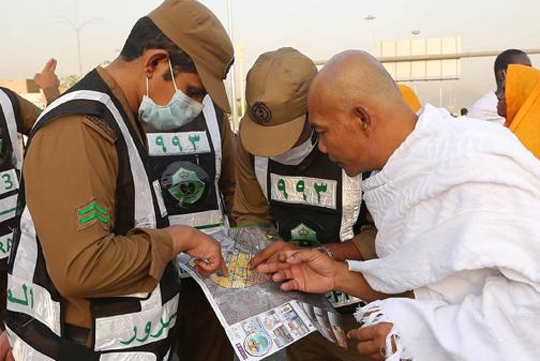
Haj agencies win royal plaudits for stellar work

October 8, 2014

Royal plaudits

Jeddah, Oct 8: Custodian of the Two Holy Mosques King Abdullah has commended the efforts of government agencies and private organizations in making this year’s Haj a "big success," enabling more than 2 million Hajis to perform their rituals in peace and comfort.

“We appreciate the efforts of your royal highness and the Supreme Haj Committee as well as security officers and employees of public and private agencies in making the Haj operation a big success,” the king said in a cable to Interior Minister Prince Mohammed bin Naif, chairman of the committee.

King Abdullah thanked the Almighty for His blessings and praised all officials and employees of Haj-related organizations for doing their jobs responsibly. “This has resulted in them efficiently carrying out the various plans related to Haj security, health services, traffic and pilgrim safety,” the king said.

King Abdullah underscored the coordinated efforts that allowed pilgrims to move smoothly to the tent city of Mina, Mount Arafat for the standing in prayer ritual, before moving to Muzdalifah and then Mina for the stoning of the Jamrat, without any major incidents.

“We thank God for protecting the health of pilgrims from infectious diseases,” the king said while praising the precautionary measures taken by the Health Ministry. He reiterated Saudi Arabia’s readiness to extend the best possible services to the guests of God.

Prince Mohammed had sent a message to King Abdullah congratulating him on the successful completion of the pilgrimage. He said over 2 million faithful, which included 1.4 million foreign Hajis, stood at Arafat on Friday. “There was uninterrupted water and electricity supply,” he said while praising municipal workers for cleaning Makkah and the holy sites.

According to a report carried by a local news website, two pilgrims died and 95 fainted inside the Grand Mosque on Monday after nearly 1.5 million thronged the mosque complex for Tawaf Al-Wida. The Civil Defense and Special Security Force deployed more officers at the mosque to control the crowd.

Mahmoud Al-Sayed from Egypt said he was extremely happy for having the rare opportunity to perform his first Haj. “I never expected this huge arrangements made by the Saudi government for the pilgrimage,” he said.

“Nobody can underestimate the marvelous services being extended by the Kingdom for the welfare of pilgrims,” said Anwar Al-Kuthairy of Yemen. “The introduction of the Mashair Railway was a wonderful idea that facilitated the movement of pilgrims between the holy sites,” said Tunisian Makhlafi Abdullah.

Sheikh Abdul Rahman Al-Sudais, head of the Presidency of the Two Holy Mosques, congratulated King Abdullah, Crown Prince Salman and Makkah Gov. Prince Mishaal for the successful Haj operation.

“Pilgrims have been able to make use of the second phase of mataf expansion and the historic giant expansion of the Grand Mosque ordered by the king during this Haj season,” Al-Sudais said.

Comments

Add new comment

  • Coastaldigest.com reserves the right to delete or block any comments.
  • Coastaldigset.com is not responsible for its readers’ comments.
  • Comments that are abusive, incendiary or irrelevant are strictly prohibited.
  • Please use a genuine email ID and provide your name to avoid reject.
News Network
July 1,2020

Riyadh, Jul 1: Saudis braced Wednesday for a tripling in value added tax, another unpopular austerity measure after the twin shocks of coronavirus and an oil price slump triggered the kingdom's worst economic decline in decades.

Retailers in the country reported a sharp uptick in sales this week of everything from gold and electronics to cars and building materials, as shoppers sought to stock up before VAT is raised to 15 percent.

The hike could stir public resentment as it weighs on household incomes, pushing up inflation and depressing consumer spending as the kingdom emerges from a three-month coronavirus lockdown.

"Cuts, cuts, cuts everywhere," a Saudi teacher in Riyadh told AFP, bemoaning vanishing subsidies as salaries remain stagnant.

"Air conditioner, television, electronic items," he said, rattling off a list of items he bought last week ahead of the VAT hike.

"I can't afford these things from Wednesday."

With its vast oil wealth funding the Arab world's biggest economy, the kingdom had for decades been able to fund massive spending with no taxes at all.

It only introduced VAT in 2018, as part of a push to reduce its dependence on crude revenues.

Then, seeking to shore up state finances battered by sliding oil prices and the coronavirus crisis, it announced in May that it would triple VAT and halt a cost-of-living monthly allowance to citizens.

The austerity push underscores how Saudi Arabia's once-lavish spending is becoming a thing of the past, with the erosion of the welfare system leaving a mostly young population to cope with reduced incomes and a lifestyle downgrade.

That could pile strain on a decades-old social contract whereby citizens were given generous subsidies and handouts in exchange for loyalty to the absolute monarchy.

The rising cost of living may prompt many to ask why state funds are being lavished on multi-billion-dollar projects and overseas assets, including the proposed purchase of English football club Newcastle United.

Shopping malls in the kingdom have drawn large crowds in recent days as retailers offered "pre-VAT sales" and discounts before the hike kicks in.

A gold shop in Riyadh told AFP it saw a 70 percent jump in sales in recent weeks, while a car dealership saw them tick up by 15 percent.

Once the new rate is in place, businesses are predicting depressed sales of everything from cars to cosmetics and home appliances.

Capital Economics forecast inflation will jump up to six percent year-on-year in July, from 1.1 percent in May, as a result.

"The government ended the country's lockdown (in June) and there are signs that economic activity has started to recover," Capital Economics said in a report.

"Nonetheless, we expect the recovery to be slow-going as fiscal austerity measures bite."

The kingdom also risks losing its edge against other Gulf states, including its principal ally the United Arab Emirates, which introduced VAT at the same time but has so far refrained from raising it beyond five percent.

"Saudi Arabia is taking massive risks with contractionary fiscal policies," said Tarek Fadlallah, chief executive officer of the Middle East unit of Nomura Asset Management.

But the kingdom has few choices as oil revenue declines.

Its finances have taken another blow as authorities massively scaled back this year's hajj pilgrimage, from 2.5 million pilgrims last year to around a thousand already inside the country, and suspended the lesser umrah because of coronavirus.

Together the rites rake in some $12 billion annually.

The International Monetary Fund warned the kingdom's GDP will shrink by 6.8 percent this year -- its worst performance since the 1980s oil glut.

The austerity drive would boost state coffers by 100 billion riyals ($26.6 billion), according to state media.

But the measures are unlikely to plug the kingdom's huge budget deficit.

The Saudi Jadwa Investment group forecasts the shortfall will rise to a record $112 billion this year.

Comments

Add new comment

  • Coastaldigest.com reserves the right to delete or block any comments.
  • Coastaldigset.com is not responsible for its readers’ comments.
  • Comments that are abusive, incendiary or irrelevant are strictly prohibited.
  • Please use a genuine email ID and provide your name to avoid reject.
News Network
July 5,2020

Riyadh, Jul 5: Custodian of the Two Holy Mosques King Salman has approved the extension of the validity of the expired iqama (residency permit) and exit and reentry visas of expatriates who are outside the Kingdom for a period of three months without any fee.

The iqama of expatriates inside the Kingdom as well as the visa of visitors who are in the Kingdom of which the validity expires during the period of suspension of entry and exit from the Kingdom will also be extended for a period of three months without any charge.

The validity of final exit visas as well as exit and reentry visas issued for expatriates, who are in the Kingdom, but were not used during the lockdown period will be extended for a period of three months without any fee, the Saudi Press Agency reported quoting an official source at the Ministry of Interior.

The ministry source said that these measures were taken as part of the continuous efforts made by the government of King Salman to mitigate the effects of the coronavirus pandemic on individuals as well as on private sector establishments and investors, economic activities in the Kingdom, following the adoption of the preventive measures to stem the spread of the pandemic.

The beneficiaries of the King’s order include all expatriates who are outside the Kingdom on exit and reentry visas, which expired during the lockdown period and after lifting of the lockdown.

These expatriates are not in a position to return to the Kingdom due to the enforcement of suspension of international flight service and temporary ban on entry and exit from the Kingdom.

The beneficiaries also include those expatriates who are still in the Kingdom after issuance of final exit visas or exit and reentry visas but could not travel because of the suspension of entry and exit from the Kingdom.

Comments

Add new comment

  • Coastaldigest.com reserves the right to delete or block any comments.
  • Coastaldigset.com is not responsible for its readers’ comments.
  • Comments that are abusive, incendiary or irrelevant are strictly prohibited.
  • Please use a genuine email ID and provide your name to avoid reject.
News Network
May 5,2020

Abu Dhabi, May 5: The overall real GDP (gross domestic product) of the United Arab Emirates is estimated to have grown by 1.7 percent in 2019, the country’s central bank said in a statement on Monday carried by WAM.

"The UAE hydrocarbon sector is estimated to have exhibited a growth of 3.4 percent in 2019. However, non-oil activities advanced at a softer pace growing by 1.0 percent. As a result, overall real GDP is estimated by FCSA (Federal Competitiveness and Statistics Authority) to have grown by 1.7 percent in 2019," said the financial regulator in its Annual Report 2019.

"The spread of COVID-19 is expected to impact trade and supply chain movements, coupled with travel restrictions which paves way for high volatility in capital markets and commodity prices. While the outbreak is expected to negatively affect the global and domestic economies, it is still early to gauge the scale of the economic fallout," the report added.

The report noted that the higher hydrocarbon output, as well as growth in non-hydrocarbon economic activity, supported the pace of the country's overall economic growth in 2019.

"Meanwhile, the fading effect of VAT, the appreciating Dirham, lower energy prices and decline in rents pushed inflation in negative territory. However, the employment rate registered a steady rebound. Looking ahead, the economic outlook for 2020 remains uncertain owing to the COVID-19 outbreak," the report elaborated.

Comments

Add new comment

  • Coastaldigest.com reserves the right to delete or block any comments.
  • Coastaldigset.com is not responsible for its readers’ comments.
  • Comments that are abusive, incendiary or irrelevant are strictly prohibited.
  • Please use a genuine email ID and provide your name to avoid reject.