



Haj made affordable

June 13, 2014

Jeddah, Jun 13: Domestic Haj companies have forged an alliance to provide 10,000 local pilgrims the opportunity to perform Haj this year for SR2,750.
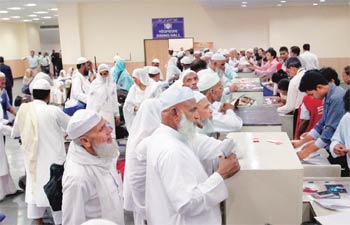
HajThe price for a low-cost Haj will range between SR2,750 and SR5,000 while those wanting extra services have to pay SR9,800 and more. Pilgrims opting for low-cost services will be given tents in different parts of Mina, said Saad Al-Qurashi, chairman of the Haj and Umrah Committee at the Makkah Chamber of Commerce and Industry.

Pilgrims who want to stay close to the Jamarat have to pay SR5,000 for A1 category, SR4,800 for A2, SR4,400 for B and SR4,150 for C. Pilgrims who applied for D1 category, located between King Abdul Aziz Bridge and the Muzdalifah border, have to pay SR3,600 while those staying in tents closer to Muzdalifah will pay SR2,750.

“As many as 41,000 domestic pilgrims will benefit from low-cost Haj services this year,” said Al-Qurashi.

Speaking with Arab News, he said 70 percent of these pilgrims would be selected by the Haj Ministry, while the rest would go through Haj service providers. Some 106 companies have signed a code of ethics to provide Haj services at low prices.

He said the package price covers all services including food, accommodation, transport and Mashair Railway charges. “There are 204 licensed companies to serve domestic pilgrims,” he said, adding that many of them have received their tents in Mina and other holy places from the ministry.

“The early allocation of tents will play a big role in reducing charges,” Al-Qurashi said. He estimated the total number of domestic pilgrims this year at 150,000 after a 50 percent cut in their number due to ongoing Haram expansion projects.

“This is the first time Mina tents are distributed among service providers before Ramadan,” he said and commended Haj Minister Bandar Hajjar for the initiative. He urged other government departments to follow the ministry’s example by quickly issuing visas for seasonal workers and easing procedures to rent buses from abroad.

Comments

Add new comment

  • Coastaldigest.com reserves the right to delete or block any comments.
  • Coastaldigset.com is not responsible for its readers’ comments.
  • Comments that are abusive, incendiary or irrelevant are strictly prohibited.
  • Please use a genuine email ID and provide your name to avoid reject.
Agencies
March 1,2020

Paris, Mar 1: Most of the riders and teams taking part in the abandoned UAE Tour, and who had been quarantined in their Abu Dhabi hotels since Thursday after a coronavirus scare, were cleared to leave the country, sources said.

"The pleasure of going home after several days spent at the hotel," tweeted 2018 world champion Alejandro Valverde, one of the top stars of the race along with Chris Froome, the four-time winner of the Tour de France.

"We are doing well and soon we will fly to Spain."

However, there was confusion over how many competitors and officials will be allowed to leave.

All 133 cyclists who were still in contention as well as team members were tested after it was announced by organisers Thursday that two Italian staff members on the race had tested positive for the COVID-19 virus.

Earlier Saturday, the UAE Tour, quoting health officials, said that 167 people had been tested and all were negative.

The Department of Health-Abu Dhabi were "still monitoring the condition of the remaining cases of contacts, whose lab testing findings will be available in the next few hours."

The UAE Tour cancelled its last two stages on Thursday after the coronavirus cases were confirmed.

Danish cyclist Michael Morkov of the Deceuninck-Quick-Step team, who took part in the first four stages, was placed in isolation in his hotel room after arriving in Berlin to take part in the world track championships.

However, on Saturday, he too was cleared to take part.

"The rider present in Berlin is currently in excellent health, with no suspicious clinical signs, and we are also guaranteed that he has not contacted the two members of the management of a team participating in the UAE Tour, originally suspected of coronavirus," governing body UCI said in a statement.

Comments

Add new comment

  • Coastaldigest.com reserves the right to delete or block any comments.
  • Coastaldigset.com is not responsible for its readers’ comments.
  • Comments that are abusive, incendiary or irrelevant are strictly prohibited.
  • Please use a genuine email ID and provide your name to avoid reject.
News Network
May 7,2020

Dubai, May 7: Saudi Arabia will emerge as the victor of the oil price war that sent global crude markets into a spin last month, according to two experts in the energy industry.

Jason Bordoff, professor and founding director of the Center for Global Energy policy at New York’s Columbia University, said: “While 2020 will be remembered as a year of carnage for oil nations, at least one will most likely emerge from the pandemic stronger, both economically and geopolitically: Saudi Arabia.”

Writing in the American publication Foreign Policy, Bordoff said that the Kingdom’s finances can weather the storm from lower oil prices as a result of the drastically reduced demand for oil in economies under pandemic lockdowns, and that it will end up with higher oil revenues and a bigger share of the global market once it stabilizes.

Bordoff’s view was reinforced by Sir Mark Moody-Stuart, former chairman of Royal Dutch Shell and one of the longest-standing directors of Saudi Aramco. In an interview with the Gulf Intelligence energy consultancy, he said that low-cost oil producers such as Saudi Arabia would emerge from the pandemic with increased market share.

“Oil is the only commodity where the lowest-cost producers have contained their production and allowed high-cost producers to benefit. When demand recovers this year or next, we will emerge from it with the lowest-cost producers having increased their market share,” Moody-Stuart said.

Bordfoff said that it would take years for the high-cost American shale industry to recover to pre-pandemic levels of output. “Depending on how long oil demand remains depressed, US oil production is projected to decline from its pre-coronavirus peak of around 13 million barrels per day.

“Shale's heady growth in recent years (with production growing by about 1 million to 1.5 million barrels per day each year) also reflected irrational exuberance in financial markets. Many US companies struggling with uneconomical production only managed to stay afloat with infusions of cheap debt. One quarter of US shale oil production may have been uneconomic even before prices crashed,” he said.

Moody-Stuart said that recent statements about cuts to the Saudi Arabian budget as a result of falling oil revenues were “an important step to wean the population of the Kingdom off an entitlement feeling. It means that everybody is joining in it.”

The former Shell boss said that other big oil companies would follow Shell’s recent decision to cut its dividend for the first time in more than 70 years. But he added that Aramco would stick by its commitment to pay $75 billion of dividends this year.

“When a company looks at its forecasts it looks ahead for one year, so for this year it (the dividend) is fine,” he said.

Bordoff added that Saudi Arabia’s action in cutting oil production in response to the pandemic would improve its global position.

“Saudi Arabia has improved its standing in Washington. Following intense pressure from the White House and powerful senators, the Kingdom’s willingness to oblige by cutting production will reverse some of the damage done when it was blamed for the oil crash after it surged production in March,” he said.

“Only a few weeks ago, the outlook for Saudi Arabia seemed bleak. But looking out a few years, it’s difficult to see the Kingdom in anything other than a strengthened position,” Bordoff said.

Comments

Add new comment

  • Coastaldigest.com reserves the right to delete or block any comments.
  • Coastaldigset.com is not responsible for its readers’ comments.
  • Comments that are abusive, incendiary or irrelevant are strictly prohibited.
  • Please use a genuine email ID and provide your name to avoid reject.
News Network
January 12,2020

Dubai, Jan 12: Saudi Arabian oil giant Aramco announced Sunday that its initial public offering raised a record $29.4 billion, a figure higher than previously announced, after the company used a so-called "greenshoe option" to sell millions more shares to meet investor demand.

The company said that the sale of an additional 450 million shares took place during the initial public offering process.

The oil and gas company, which is majority owned by the state, began publicly trading on the local Saudi Tadawul exchange on December 11. It hit hit upwards of $10 a share on the second day of trading. This gave Aramco a market capitalization of $2 trillion, making it comfortably the world's most valuable company.

Aramco's additional sales mean the company has publicly floated 1.7% of its shares. It's IPO, even before the added sales, was the world's largest ever.

The shares sold in the over-allotment option "had been allocated to investors during the book-building process and therefore, no additional shares are being offered into the market today," Aramco said.

Company shares traded down on Sunday, dipping to around 34.7 riyals, or $9.25 a share, amid heightened tensions in the Persian Gulf between Iran and the United States. Aramco was a target of rising tensions over the summer when a missile and drone attack, which Saudi Arabia and the US blame on Iran, temporarily halved its production.

Sunday's trading figures value Aramco at $1.85 trillion, still well ahead of Apple, the second largest company in the world after Aramco, but below the $2 trillion mark sought by Crown Prince Mohammed bin Salman.

Comments

Add new comment

  • Coastaldigest.com reserves the right to delete or block any comments.
  • Coastaldigset.com is not responsible for its readers’ comments.
  • Comments that are abusive, incendiary or irrelevant are strictly prohibited.
  • Please use a genuine email ID and provide your name to avoid reject.