


Haj pilgrims march to Mina as journey of faith begins

October 2, 2014

Jeddah, Oct 2: More than two million pilgrims have begun marching to Mina on the first leg of their journey of a lifetime.haji prays
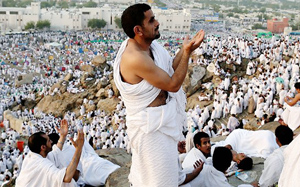
The government’s agencies have made elaborate arrangements to ensure the smooth flow of pilgrims from Makkah, Madinah, Jeddah, Riyadh, Taif and Dammam into the tent city. The pilgrims will spend the day and night in prayers and then head to the plains of Arafat on Friday morning. The standing at Arafat is the high point of Haj.

In Mina on Wednesday, thousands of young men employed by Haj operators and pilgrim establishments were preparing to receive pilgrims. Traffic police, Civil Defense personnel, Haj Ministry officials, doctors, nurses, paramedics and media personnel were already in the tent city ahead of the pilgrims.

Makkah was bustling with spiritual activity on Wednesday evening. Male pilgrims will don the ihram, two pieces of white seamless cloth that is mandatory before undertaking the journey on Thursday. The ihram for women is different.

“We are excited and happy and also a little nervous,” said Maulana Minhaj Akram, 69, a pilgrim from Khyber Pakhtunkhwa, Pakistan.

He was accompanied by his wheelchair-bound wife, Syeda Majida. “Haj is not easy,” he said via phone from Makkah. “It is physically demanding, but spiritually exhilarating.”

He said they were told by their organizers that they should be ready on Wednesday night. “Our bus is supposed to arrive immediately after Fajr on Thursday,” he said. “We will then head to Mina where we have been allotted a place in one of the many tents.”

Lateef Mohammad Jagirdar from Jaipur, Rajasthan, and his wife Shabana Begum were very happy to be here for Haj.

“We can’t describe our feelings. We have been in the queue for three years. More than 360,000 had applied for Haj this year in India and only 136,000 were lucky to come here. We are among the lucky ones.”

Jagirdar said his relatives and acquaintances have asked them for prayers. “We have a long list of requests. We will beseech Allah from Mina and the plains of Arafat to answer our prayers,” he said. “We have come all the way from such a distant land to seek forgiveness and Allah’s mercy.”

“It is the love for our Prophet (peace be upon him) and our beautiful religion that has brought us to the holy land,” said Jagirdar.

The weather was pleasant on Wednesday and is expected to be moderate on Thursday. A visit by Arab News photographer to the Jamrat Bridge and nearby area was full of pleasant feelings. “Excellent arrangements have been made to ensure a smooth Haj,” said Abdullah Bazuhair from Mina.

In Jeddah, Riyadh and other cities, men and women were seen heading in cars and buses to Makkah to perform Haj. They were chanting “Labbaik Allahuma Labbaik” (O God, here we are answering your call). Onlookers were encouraging and smiling at the pilgrims and asking them to pray for world peace.

Meanwhile, the Interior Ministry’s public security department has stopped 145,354 pilgrims from entering Makkah because they did not have Haj permits.

In a statement issued on Wednesday, the department said that its officers also barred 51,112 cars without entry permits. “The department also arrested the operators of 40 fake Haj service companies and launched investigations against them.”

In a related development, Hail police arrested 482 violators of Haj, labor and residency regulations. The operation was carried out by Hail Police Chief Maj. Gen. Ibrahim Al-Almaei, said Col. Saad Al-Horaish, assistant spokesman of the department. Legal action would take place against the violators, he said.

The interior and Haj ministries have launched a campaign to counter bogus Haj companies offering services for domestic pilgrims. The Interior Ministry said such operators were exploiting ignorant pilgrims, whom they abandon at the holy sites without accommodation and other services.

The ministry said it would severely punish such operators. The perpetrators would have to pay compensation to their victims. If they are expatriates, they would also be deported.

In an unfortunate development, five pilgrims died and eight others were injured when their vehicle was involved in an accident on the Al-Leith-Makkah Road on Tuesday night.

The Saudi Red Crescent took the bodies and the injured to King Abdul Aziz Hospital in Jeddah. Some of the injured sustained deep wounds.

All the pilgrims, including two women, were reportedly not carrying Haj permits. The accident took place while the driver was taking them through a desert road to evade the police. An online publication identified the injured as Sudanese and Eritrean nationals.

Comments

Add new comment

  • Coastaldigest.com reserves the right to delete or block any comments.
  • Coastaldigset.com is not responsible for its readers’ comments.
  • Comments that are abusive, incendiary or irrelevant are strictly prohibited.
  • Please use a genuine email ID and provide your name to avoid reject.
Agencies
July 31,2020

Mount Arafat, July 30: Muslim pilgrims converged Thursday on Saudi Arabia's Mount Arafat for the climax of this year's hajj, the smallest in modern times and a sharp contrast to the massive crowds of previous years.

A tight security cordon has been erected all around the foot of the rocky hill outside Mecca, also known as Jabal al-Rahma or Mount of Mercy.

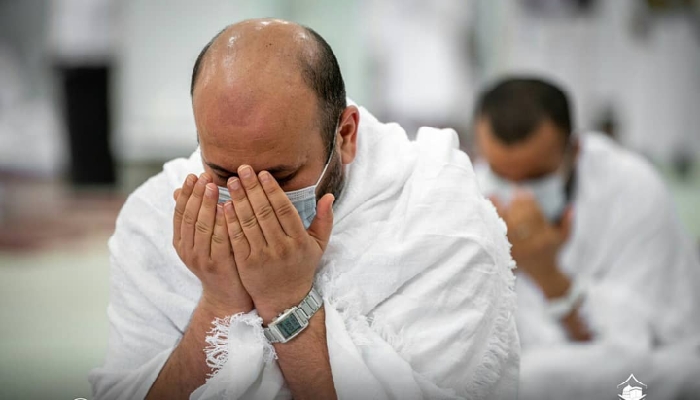
Pilgrims, donning masks and observing social distancing, were brought in buses from neighbouring Mina, state television showed, as Saudi authorities impose measures to prevent a coronavirus outbreak.

They were subject to temperature checks and attended a sermon -- which state media said was translated into 10 languages -- before they set off on the climb to the summit for hours of Koran recitals and prayers to atone for their sins.

The scene was strikingly different to last year's ritual when a sea of pilgrims ascended Mount Arafat, marshalled by tens of thousands of stewards in a bid to prevent any crushes.

After sunset prayers, pilgrims will make their way down Mount Arafat to Muzdalifah, another holy site where they will sleep under the stars to prepare for the final stage of hajj, the symbolic "stoning of the devil".

It takes place on Friday and also marks the beginning of Eid al-Adha, the festival of sacrifice.

The hajj, one of the five pillars of Islam and a must for able-bodied Muslims at least once in their lifetime, is usually one of the world's largest religious gatherings.

But only up to 10,000 people already residing in the kingdom will participate in this year's ritual, compared with 2019's gathering of some 2.5 million from around the world.

"You are not our guests but those of God, the custodian of the two holy mosques (Saudi Arabia's King Salman) and the nation," Hajj Minister Mohammad Benten said in a video released by the media ministry on Wednesday.

Security cordon

A security cordon has been thrown around the holy sites to prevent any security breaches, an interior ministry spokesman said.

Riyadh faced strong criticism in 2015 when some 2,300 worshippers were killed in the deadliest stampede in the gathering's history.

But this year, those risks are greatly reduced by the much smaller crowd.

The pilgrims have all been tested for the virus, and foreign journalists were barred from this year's hajj, usually a huge global media event.

As part of the rites completed over five days in the holy city of Mecca and its surroundings, the pilgrims converged on Mount Arafat after spending the night in Mina.

A district of Mecca, Mina sits in a narrow valley surrounded by rocky mountains, and is transformed each year into a vast encampment for pilgrims.

They began the hajj on Wednesday with their first "tawaf", the circumambulation of the Kaaba, a large structure in Mecca’s Grand Mosque towards which Muslims around the world pray.

The Kaaba is draped in a black cloth embroidered in gold with Koranic verses and known as the kiswa, which is changed each year during the pilgrimage.

Pilgrims were brought inside the mosque in small batches, walking along paths marked on the floor, in sharp contrast to the normal sea of humanity that swirls around the Kaaba during hajj.

Comments

Add new comment

  • Coastaldigest.com reserves the right to delete or block any comments.
  • Coastaldigset.com is not responsible for its readers’ comments.
  • Comments that are abusive, incendiary or irrelevant are strictly prohibited.
  • Please use a genuine email ID and provide your name to avoid reject.
News Network
May 18,2020

Abu Dhabi, May 18: Bollywood superstar Salman Khan has recorded a special message for Indian expats in the UAE as the country fights the coronavirus pandemic.

Khan - one of the biggest stars of Bollywood for decades - enjoys a large fan following in the Gulf, which is why Abu Dhabi roped in the actor to record a special video message for expats, urging them to cooperate with authorities in the capital and the country as they carry out sanitisation and testing programmes.

In the video, tweeted by the Abu Dhabi Media Office on Sunday night, the superstar appeals to Indians in Abu Dhabi to become heroes by staying home (stepping out for essential work/errands only), following precautionary measures and simply 'do the right thing' by getting tested if they have any Covid-19-related symptoms.

Khan, who has shot his recent super hit films (Race 3) in the capital, assured expats that Abu Dhabi authorities will not leave the community in these challenging times as it is a hospitable city who takes care of all residents.

"Following preventive measures also protects your family from the virus - so do the right thing as heroes do," Khan concludes.

The second phase of Abu Dhabi's sanitisation and testing in labour areas is underway, which started on May 16. Special testing facilities have been set up in the city for this purpose that test thousands of workers everyday.

As of May 17, UAE has confirmed over 23,000 cases along with over 8,000 recoveries and 220 deaths.

The country recently made a breakthrough in treating Covid-19 by using stem cells to help with the recovery.

The UAE leadership has thanked citizens and residents for their cooperation and assured that the country will take care of everyone in the country - with food and medicines being the red line, and that there will be no shortage of either during the crisis. Stimulus packages have been announced to help businesses stay afloat.

Comments

Add new comment

  • Coastaldigest.com reserves the right to delete or block any comments.
  • Coastaldigset.com is not responsible for its readers’ comments.
  • Comments that are abusive, incendiary or irrelevant are strictly prohibited.
  • Please use a genuine email ID and provide your name to avoid reject.
Agencies
February 27,2020

Riyadh, Feb 27: Saudi Arabia on Thursday halted travel to the holiest sites in Islam over fears about a new viral epidemic just months ahead of the annual hajj pilgrimage, a move coming as the Mideast has over 220 confirmed cases of the illness.

The extraordinary decision by Saudi Arabia stops foreigners from reaching the holy city of Mecca and the Kaaba, the cube-shaped structure the world's 1.8 billion Muslims pray toward five times a day. It also said travel was suspended to Prophet Muhammad's mosque in Medina.

The decision showed the worry about the outbreak potentially spreading into Saudi Arabia, whose oil-rich monarchy stakes its legitimacy on protecting Islam's holy sites. The epicenter in the Mideast's most-affected country, Iran, appears to be in the holy Shiite city of Qom, where a shrine there sees the faithful reach out to kiss and touch it in reverence.

"Saudi Arabia renews its support for all international measures to limit the spread of this virus, and urges its citizens to exercise caution before traveling to countries experiencing coronavirus outbreaks," the Saudi Foreign Ministry said in a statement announcing the decision.

"We ask God Almighty to spare all humanity from all harm." Disease outbreaks always have been a concern surrounding the hajj, required of all able-bodied Muslims once in their life, especially as pilgrims come from all over the world.

The earliest recorded outbreak came in 632 as pilgrims fought off malaria. A cholera outbreak in 1821, for instance, killed an estimated 20,000 pilgrims. Another cholera outbreak in 1865 killed 15,000 pilgrims and then spread worldwide.

More recently, Saudi Arabia faced a danger from a related coronavirus that caused Middle East respiratory syndrome, or MERS. The kingdom increased its public health measures in 2012 and 2013, though no outbreak occurred.

While millions attend the 10-day hajj, this year set for late July into early August, millions more come during the rest of the year to the holy sites in the kingdom.

"It is unprecedented, at least in recent times, but given the worldwide spread of the virus and the global nature of the umrah, it makes sense from a public health and safety point of view," said Kristian Ulrichsen, a research fellow at the James A Baker III Institute for Public Policy at Rice University. "Especially since the Iranian example illustrates how a religious crossroads can so quickly amplify the spread and reach of the virus." The virus that causes the illness named COVID-19 has infected more than 80,000 people globally, mainly in China. The hardest-hit nation in the Mideast is Iran, where Health Ministry spokesman Kianoush Jahanpour said 19 people have died among 139 confirmed cases.

Experts are concerned Iran may be underreporting cases and deaths, given the illness's rapid spread from Iran across the Persian Gulf. For example, Iran still has not confirmed any cases in Mashhad, even though a number of cases reported in Kuwait are linked to the Iranian city.

In Bahrain, which confirmed 33 cases as of Thursday morning, authorities halted all flights to Iraq and Lebanon. It separately extended a 48-hour ban overflights from Dubai and Sharjah in the United Arab Emirates, through which infected travellers reached the island kingdom off the coast of Saudi Arabia.

Iranian President Hassan Rouhani said there were no immediate plans to quarantine cities but acknowledged it may take "one, two or three weeks” to get control of the virus in Iran.

As Iran's 80 million people find themselves increasingly isolated in the region by the outbreak, the country's sanctions-battered economy saw its currency slump to its lowest level against the US dollar in a year on Wednesday.

Comments

Add new comment

  • Coastaldigest.com reserves the right to delete or block any comments.
  • Coastaldigset.com is not responsible for its readers’ comments.
  • Comments that are abusive, incendiary or irrelevant are strictly prohibited.
  • Please use a genuine email ID and provide your name to avoid reject.