Half a million pilgrims received medical treatment during Haj

October 14, 2014

Riyadh, Oct 14: Nearly half a million pilgrims made use of medical facilities that were available in Makkah and Madinah during Haj this year. Nineteen open heart surgeries were performed, Mansour Al-Hawasi, deputy health minister for Health Affairs, said here Sunday.
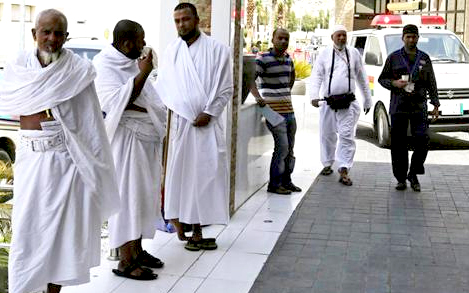
Haj MedicalAl-Hawasi was addressing health officials here during an Eid party hosted by the Ministry of Health to thank health officials who were affiliated with the Haj program in both cities.

Some 22,000 health officials were deployed in the holy cities this year, as well as at 14 ports of entry.

Offering his congratulations to Custodian of the Two Holy Mosques King Abdullah and Crown Prince Salman, deputy premier and minister of defense, for their unwavering cooperation in making the health program a success, the deputy minister said health officials did their part to offer the very best of services to pilgrims.

He also expressed gratitude to the World Health Organization (WHO) for its assistance in the prevention of infectious diseases.

Shoura Council member Abdul Rahman Al-Sweilem was present during the function.

Al-Hawasi said some 472,000 pilgrims availed themselves of the medical facilities at the holy sites and at the ports of entry.

He said that 329,000 pilgrims had visited medical centers in the holy sites and 111,000 had sought outpatient treatment at these clinics.

"A total of 28,000 pilgrims have sought emergency treatment, while 3,700 were admitted to various hospitals in Makkah and Madinah," he added.

Al-Hawasi pointed out that 19,000 units of blood were used to treat patients at the holy sites so far.

Some 19,000 pilgrims were given on-the-spot medical treatment at various points throughout the holy city.

According to statistics provided by the deputy minister, 988 pilgrims received dialysis treatment, while 330 underwent catheterization and 55 were given endoscopic treatment.

A comprehensive Haj health program was implemented under the leadership of the acting Health Minister Adel Fakeih this year in cooperation with the WHO.

The Health Ministry took preventive measures to combat the spread of the Ebola and the Middle East Respiratory Syndrome coronavirus (MERS-CoV) with the help of local and international medical experts, including officials from the WHO.

This year, the Ministry of Health fielded a total of 22,000 medics and paramedics to look after the welfare of the local and foreign Haj pilgrims in the holy cities of Makkah and Madinah.

In addition to a fleet of 100 ambulances, the ministry has also deployed some 50 mini-ambulances to be able to infiltrate crowded areas to ferry patients to nearby hospitals.

There are 141 primary health care centers, which includes 100 primary health care centers and 17 emergency centers near the Jamrat bridge.

The ministry also set up a central command center to monitor and coordinate with the health officials to serve the pilgrims who fall ill or need medical treatments during their stay in the holy cities.

The center focused on the Ebola virus and MERS-CoV during the pilgrimage.

There are 25 hospitals in the holy cities, including seven in Makkah, nine in Madinah, four in Mina and four in Arafat, in addition to King Abdullah Medical City.

There are a total of 5,250 beds in the holy cities, including 500 beds for ICU patients.

Comments

Add new comment

  • Coastaldigest.com reserves the right to delete or block any comments.
  • Coastaldigset.com is not responsible for its readers’ comments.
  • Comments that are abusive, incendiary or irrelevant are strictly prohibited.
  • Please use a genuine email ID and provide your name to avoid reject.
Agencies
July 30,2020

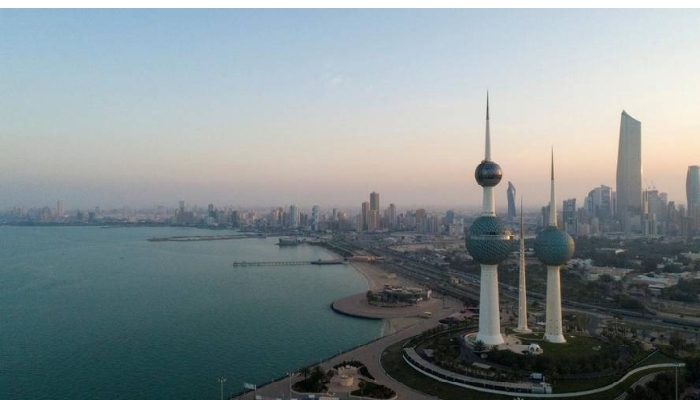
Kuwait will allow citizens and residents to travel to and from the country, starting August 1, the government communication center tweeted on early Thursday, citing a cabinet decision.

The decision excludes residents coming from Bangladesh, Philippines, India, Sri Lanka, Pakistan, Iran, Nepal.

Last month, Kuwait announced it would partially resume commercial flights from August, but does not expect to reach full capacity until a year later, as its aviation sector gradually recovers from a suspension sparked by the Covid-19 crisis.

Comments

Add new comment

  • Coastaldigest.com reserves the right to delete or block any comments.
  • Coastaldigset.com is not responsible for its readers’ comments.
  • Comments that are abusive, incendiary or irrelevant are strictly prohibited.
  • Please use a genuine email ID and provide your name to avoid reject.
Agencies
February 27,2020

Riyadh, Feb 27: Saudi Arabia on Thursday halted travel to the holiest sites in Islam over fears about a new viral epidemic just months ahead of the annual hajj pilgrimage, a move coming as the Mideast has over 220 confirmed cases of the illness.

The extraordinary decision by Saudi Arabia stops foreigners from reaching the holy city of Mecca and the Kaaba, the cube-shaped structure the world's 1.8 billion Muslims pray toward five times a day. It also said travel was suspended to Prophet Muhammad's mosque in Medina.

The decision showed the worry about the outbreak potentially spreading into Saudi Arabia, whose oil-rich monarchy stakes its legitimacy on protecting Islam's holy sites. The epicenter in the Mideast's most-affected country, Iran, appears to be in the holy Shiite city of Qom, where a shrine there sees the faithful reach out to kiss and touch it in reverence.

"Saudi Arabia renews its support for all international measures to limit the spread of this virus, and urges its citizens to exercise caution before traveling to countries experiencing coronavirus outbreaks," the Saudi Foreign Ministry said in a statement announcing the decision.

"We ask God Almighty to spare all humanity from all harm." Disease outbreaks always have been a concern surrounding the hajj, required of all able-bodied Muslims once in their life, especially as pilgrims come from all over the world.

The earliest recorded outbreak came in 632 as pilgrims fought off malaria. A cholera outbreak in 1821, for instance, killed an estimated 20,000 pilgrims. Another cholera outbreak in 1865 killed 15,000 pilgrims and then spread worldwide.

More recently, Saudi Arabia faced a danger from a related coronavirus that caused Middle East respiratory syndrome, or MERS. The kingdom increased its public health measures in 2012 and 2013, though no outbreak occurred.

While millions attend the 10-day hajj, this year set for late July into early August, millions more come during the rest of the year to the holy sites in the kingdom.

"It is unprecedented, at least in recent times, but given the worldwide spread of the virus and the global nature of the umrah, it makes sense from a public health and safety point of view," said Kristian Ulrichsen, a research fellow at the James A Baker III Institute for Public Policy at Rice University. "Especially since the Iranian example illustrates how a religious crossroads can so quickly amplify the spread and reach of the virus." The virus that causes the illness named COVID-19 has infected more than 80,000 people globally, mainly in China. The hardest-hit nation in the Mideast is Iran, where Health Ministry spokesman Kianoush Jahanpour said 19 people have died among 139 confirmed cases.

Experts are concerned Iran may be underreporting cases and deaths, given the illness's rapid spread from Iran across the Persian Gulf. For example, Iran still has not confirmed any cases in Mashhad, even though a number of cases reported in Kuwait are linked to the Iranian city.

In Bahrain, which confirmed 33 cases as of Thursday morning, authorities halted all flights to Iraq and Lebanon. It separately extended a 48-hour ban overflights from Dubai and Sharjah in the United Arab Emirates, through which infected travellers reached the island kingdom off the coast of Saudi Arabia.

Iranian President Hassan Rouhani said there were no immediate plans to quarantine cities but acknowledged it may take "one, two or three weeks” to get control of the virus in Iran.

As Iran's 80 million people find themselves increasingly isolated in the region by the outbreak, the country's sanctions-battered economy saw its currency slump to its lowest level against the US dollar in a year on Wednesday.

Comments

Add new comment

  • Coastaldigest.com reserves the right to delete or block any comments.
  • Coastaldigset.com is not responsible for its readers’ comments.
  • Comments that are abusive, incendiary or irrelevant are strictly prohibited.
  • Please use a genuine email ID and provide your name to avoid reject.
Agencies
May 17,2020

Jerusalem, May 17: The Chinese ambassador to Israel was found dead in his home north of Tel Aviv on Sunday, Israel's Foreign Ministry said.

No cause of death was given and Israeli police said it was investigating.

Du Wei, 58, was appointed envoy in February in the midst of the coronavirus pandemic. He previously served as China's envoy to Ukraine.

He is survived by a wife and son, both of whom were not in Israel.

Israel enjoys good relations with China.

The ambassador's death comes just two days after he condemned comments by visiting U.S. Secretary of State Mike Pompeo, who denounced Chinese investments in Israel and accused China of hiding information about the coronavirus outbreak.

Comments

Add new comment

  • Coastaldigest.com reserves the right to delete or block any comments.
  • Coastaldigset.com is not responsible for its readers’ comments.
  • Comments that are abusive, incendiary or irrelevant are strictly prohibited.
  • Please use a genuine email ID and provide your name to avoid reject.