



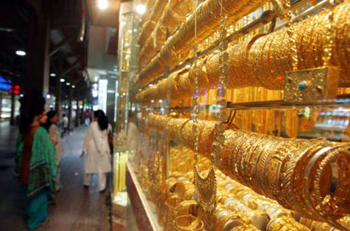
Dubai's jewellers see better value in 18K push

January 2, 2013

HL

Dubai, Jan 2: Seeking to put the sparkle back into the gold trade after a less than stellar showing in the second half of 2012, Dubai’s jewellers are set to put their marketing muscle behind 18-carat jewellery for the first time. They believe such a move would help considerably improve offtake of jewellery among Western and Chinese shoppers, particularly tourists during the peak holiday season and during DSF.

It also signals a not so subtle shift on the part of Dubai’s jewellery trade which has until now focussed exclusively on 22-carat jewellery and demand from Indian and Pakistani residents and those on visit.

“18K is the most popular caratage in jewellery internationally, especially in Europe; hence it will be appealing to tourists from there,” said Abdul Salam KP, group executive director at Malabar Gold and Diamonds. “It obviously has the advantage of a lower price compared to 22K and offers more design variety as it is acceptable internationally and easier to make in complicated designs.”

On pricing, there is a fairly significant gap between the carats. Yesterday, a gram of 22K was going for Dh180.94 ($49.26) in Dubai, while its 18K counterpart had a less sheen in value terms at Dh147.99 ($40.29) a gram. Moreover, the making charges on 18K are said to be considerably lower.

Apart from the Western tourist, jewellery chains are keeping an equally keen look out for Chinese shoppers. They were quite conspicuous jewellery buyers during DSF 2011, but less so last year. Retailers are hoping for a marked improvement in the upcoming one and expect the 18K push will win them over.

“The Chinese tourist prefer 18K gold jewellery as well as 24K gold bars,” said John Paul Joy Alukkas, executive director, Joyalukkas Group. “The preference for the former is because they can use it more as a day to day rather than special occasion jewellery. The gold bars are with an investment perspective.”

Dubai’s gold trade definitely needs a volume boost and if 18K can provide that, retailers will not mind much. Demand had taken a dent last year after the steady upturn in gold prices through 2011 stalled and went through a bit of volatility.

But a key factor for the subdued demand had to do with events in India, where customs authorities dusted off a long dormant 1967 gold import duty and started applying it vigorously since the second quarter of 2012. This effectively meant that the price differential buying gold jewellery in Dubai as opposed to doing the same in India came down significantly. It also meant that any Indian expat here taking gold back to India would be hit with steep duties. As a case in point, a woman passenger wearing a gold chain weighing 40-gram would have to shell out Rs4,100 as duty on arrival at an Indian airport.

“Implementation of the recent revision in customs duty for gold and the related hassles for passengers has affected the mindset of NRI passengers in a big way,” said Sunny Chittilappilly, chairman of Dubai Gold and Jewellery Group. “As a result gold buying in the Gulf reduced to an extent and demand for 22K Indian jewellery was affected during the high purchase season close to summer.”

Several depositions, both individual and at the industry level, have been made to the Indian authorities for a repeal or a relook at the 1967 provisions. Dubai’s jewellers believe something will come out of the collective action.

In the meantime, they hope the 18K push and DSF 2013 — in which 13 kilos of gold can be won daily - will cut them some slack.

Comments

Add new comment

  • Coastaldigest.com reserves the right to delete or block any comments.
  • Coastaldigset.com is not responsible for its readers’ comments.
  • Comments that are abusive, incendiary or irrelevant are strictly prohibited.
  • Please use a genuine email ID and provide your name to avoid reject.
News Network
February 21,2020

Washington, Feb 21: The fat around arteries may play an important role in keeping the blood vessels healthy, according to a study in rats that may affect how researchers test for treatments related to plaque buildup, as seen in conditions leading to heart attack.

The study, published in the journal Scientific Reports, noted that the fat, known as perivascular adipose tissue, or PVAT, helps arteries let go of muscular tension while under constant strain.

According to the researchers, including Stephanie W. Watts from the Michigan State University in the US, this feature is similar to how the bladder expands to accommodate more liquid, while at the same time keeping it from spilling out.

"In our study, PVAT reduced the tension that blood vessels experience when stretched," Watts said.

"And that's a good thing, because the vessel then expends less energy. It's not under as much stress," she added.

According to Watts and her team, PVAT has largely been ignored by researchers believing its main job was to store lipids and do little more.

Until now, she said, scientists only divided blood vessels into three parts, the innermost layer called the tunica intima, the middle layer called the tunica media, and the outermost layer called the tunica adventitia.

Watts believes PVAT is the fourth layer, which others have called tunica adiposa.

Tunica, she said, meant a membranous sheath enveloping or lining an organ, and adiposa is a synonym for fat.

"For years, we ignored this layer -- in the lab it was thrown out. In the clinic it wasn't imaged. But now we're discovering it may be integral to our blood vessels," Watts said.

"Our finding redefines what the functional blood vessels are, and is part of what can be dysfunctional in diseases that afflict us, including hypertension. We need to pay attention to this layer of a blood vessel because it does far more than we originally thought," she added.

Earlier studies, Watts said, had shown that PVAT plays a role in the functioning of blood vessels, finding that it secretes substances that can cause blood vessels to relax as well as substances that can cause it to contract.

In the current study, the researchers decided to test whether PVAT provides a structural benefit to arteries by assisting the function of stress relaxation.

They tested the thoracic aorta in rats, and found those with intact PVAT had more stress relaxation than those without.

The study revealed that the pieces of artery with surrounding fat had measurably relaxed more than those without.

Watts and her colleagues then tested other arteries, and were able to duplicate the same response.

"It's not something you see only in this particular vessel or this particular species or this particular strain. But that maybe it's a general phenomenon," she said.

Comments

Add new comment

  • Coastaldigest.com reserves the right to delete or block any comments.
  • Coastaldigset.com is not responsible for its readers’ comments.
  • Comments that are abusive, incendiary or irrelevant are strictly prohibited.
  • Please use a genuine email ID and provide your name to avoid reject.
Agencies
May 2,2020

Clinician-scientists have found that Irish patients admitted to hospital with severe coronavirus (COVID-19) infection are experiencing abnormal blood clotting that contributes to death in some patients.

The research team from the Royal College of Surgeons in Ireland found that abnormal blood clotting occurs in Irish patients with severe COVID-19 infection, causing micro-clots within the lungs.

According to the study, they also found that Irish patients with higher levels of blood clotting activity had a significantly worse prognosis and were more likely to require ICU admission.

"Our novel findings demonstrate that COVID-19 is associated with a unique type of blood clotting disorder that is primarily focussed within the lungs and which undoubtedly contributes to the high levels of mortality being seen in patients with COVID-19," said Professor James O'Donnell from St James's Hospital in Ireland.

In addition to pneumonia affecting the small air sacs within the lungs, the research team has also hundreds of small blood clots throughout the lungs.

This scenario is not seen with other types of lung infection and explains why blood oxygen levels fall dramatically in severe COVID-19 infection, the study, published in the British Journal of Haematology said.

"Understanding how these micro-clots are being formed within the lung is critical so that we can develop more effective treatments for our patients, particularly those in high-risk groups," O'Donnell said.

"Further studies will be required to investigate whether different blood-thinning treatments may have a role in selected high-risk patients in order to reduce the risk of clot formation," Professor O'Donnell added.

According to the study, emerging evidence also shows that the abnormal blood-clotting problem in COVID-19 results in a significantly increased risk of heart attacks and strokes.

As of Friday morning, the cases increased to 20,612 cases in Ireland, with 1,232 deaths so far, according to the Johns Hopkins University.

Comments

Add new comment

  • Coastaldigest.com reserves the right to delete or block any comments.
  • Coastaldigset.com is not responsible for its readers’ comments.
  • Comments that are abusive, incendiary or irrelevant are strictly prohibited.
  • Please use a genuine email ID and provide your name to avoid reject.
Agencies
May 17,2020

Geneva, May 17: Spraying disinfectant on the streets, as practised in some countries, does not eliminate the new coronavirus and even poses a health risk, the World Health Organization (WHO) warned on Saturday.

In a document on cleaning and disinfecting surfaces as part of the response to the virus, the WHO says spraying can be ineffective. "Spraying or fumigation of outdoor spaces, such as streets or marketplaces, is... not recommended to kill the Covid-19 virus or other pathogens because disinfectant is inactivated by dirt and debris," explains the WHO.

"Even in the absence of organic matter, chemical spraying is unlikely to adequately cover all surfaces for the duration of the required contact time needed to inactivate pathogens." The WHO said that streets and pavements are not considered as "reservoirs of infection" of Covid-19, adding that spraying disinfectants, even outside, can be "dangerous for human health".

The document also stresses that spraying individuals with disinfectants is "not recommended under any circumstances".

"This could be physically and psychologically harmful and would not reduce an infected person's ability to spread the virus through droplets or contact," said the document.

Spraying chlorine or other toxic chemicals on people can cause eye and skin irritation, bronchospasm and gastrointestinal effects, it adds.

The organisation is also warning against the systematic spraying and fumigating of disinfectants on to surfaces in indoor spaces, citing a study that has shown it to be ineffective outside direct spraying areas.

"If disinfectants are to be applied, this should be done with a cloth or wipe that has been soaked in disinfectant," it says.

The SARS-CoV-2 virus, the cause of the pandemic that has killed more than 300,000 people worldwide since its appearance in late December in China, can attach itself to surfaces and objects.

However, no precise information is currently available for the period during which the viruses remain infectious on the various surfaces.

Studies have shown that the virus can stay on several types of surfaces for several days. However, these maximum durations are only theoretical because they are recorded under laboratory conditions and should be "interpreted with caution" in the real-world environment.

Comments

Add new comment

  • Coastaldigest.com reserves the right to delete or block any comments.
  • Coastaldigset.com is not responsible for its readers’ comments.
  • Comments that are abusive, incendiary or irrelevant are strictly prohibited.
  • Please use a genuine email ID and provide your name to avoid reject.