



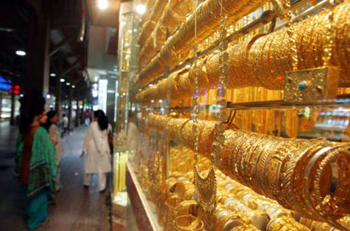
Dubai's jewellers see better value in 18K push

January 2, 2013

HL

Dubai, Jan 2: Seeking to put the sparkle back into the gold trade after a less than stellar showing in the second half of 2012, Dubai’s jewellers are set to put their marketing muscle behind 18-carat jewellery for the first time. They believe such a move would help considerably improve offtake of jewellery among Western and Chinese shoppers, particularly tourists during the peak holiday season and during DSF.

It also signals a not so subtle shift on the part of Dubai’s jewellery trade which has until now focussed exclusively on 22-carat jewellery and demand from Indian and Pakistani residents and those on visit.

“18K is the most popular caratage in jewellery internationally, especially in Europe; hence it will be appealing to tourists from there,” said Abdul Salam KP, group executive director at Malabar Gold and Diamonds. “It obviously has the advantage of a lower price compared to 22K and offers more design variety as it is acceptable internationally and easier to make in complicated designs.”

On pricing, there is a fairly significant gap between the carats. Yesterday, a gram of 22K was going for Dh180.94 ($49.26) in Dubai, while its 18K counterpart had a less sheen in value terms at Dh147.99 ($40.29) a gram. Moreover, the making charges on 18K are said to be considerably lower.

Apart from the Western tourist, jewellery chains are keeping an equally keen look out for Chinese shoppers. They were quite conspicuous jewellery buyers during DSF 2011, but less so last year. Retailers are hoping for a marked improvement in the upcoming one and expect the 18K push will win them over.

“The Chinese tourist prefer 18K gold jewellery as well as 24K gold bars,” said John Paul Joy Alukkas, executive director, Joyalukkas Group. “The preference for the former is because they can use it more as a day to day rather than special occasion jewellery. The gold bars are with an investment perspective.”

Dubai’s gold trade definitely needs a volume boost and if 18K can provide that, retailers will not mind much. Demand had taken a dent last year after the steady upturn in gold prices through 2011 stalled and went through a bit of volatility.

But a key factor for the subdued demand had to do with events in India, where customs authorities dusted off a long dormant 1967 gold import duty and started applying it vigorously since the second quarter of 2012. This effectively meant that the price differential buying gold jewellery in Dubai as opposed to doing the same in India came down significantly. It also meant that any Indian expat here taking gold back to India would be hit with steep duties. As a case in point, a woman passenger wearing a gold chain weighing 40-gram would have to shell out Rs4,100 as duty on arrival at an Indian airport.

“Implementation of the recent revision in customs duty for gold and the related hassles for passengers has affected the mindset of NRI passengers in a big way,” said Sunny Chittilappilly, chairman of Dubai Gold and Jewellery Group. “As a result gold buying in the Gulf reduced to an extent and demand for 22K Indian jewellery was affected during the high purchase season close to summer.”

Several depositions, both individual and at the industry level, have been made to the Indian authorities for a repeal or a relook at the 1967 provisions. Dubai’s jewellers believe something will come out of the collective action.

In the meantime, they hope the 18K push and DSF 2013 — in which 13 kilos of gold can be won daily - will cut them some slack.


Comments

Add new comment

  • Coastaldigest.com reserves the right to delete or block any comments.
  • Coastaldigset.com is not responsible for its readers’ comments.
  • Comments that are abusive, incendiary or irrelevant are strictly prohibited.
  • Please use a genuine email ID and provide your name to avoid reject.
Agencies
July 14,2020

UN, Jul 14: There will be no return to the "old normal" for the foreseeable future as a result of the ongoing COVID-19 pandemic, and too many countries were still headed in the wrong direction, the chief of the World Health Organization (WHO) warned.

"The virus remains public enemy number one, but the actions of many governments and people do not reflect this," Xinhua news agency quoted WHO Director-General Tedros Adhanom Ghebreyesus at as saying a regular briefing on Monday.

He noted that mixed messages from leaders are undermining trust, which is the most critical ingredient of any response, while the only aim of the virus is to find people to infect.

Things are going to "get worse and worse and worse", he warned, unless governments communicate clearly with their citizens and roll out a comprehensive strategy focused on suppressing transmission and saving lives, while populations follow the basic public health principles of physical distancing, hand washing, wearing masks, coughing etiquette and staying home when sick.

COVID-19 has been gaining its momentum lately.

According to Tedros, Sunday saw a record of 230,000 cases reported to WHO, of which almost 80% were from just 10 countries and about half from just two countries.

"But it does not have to be this way," he said, asking every single leader, government and individual "to do their bit to break the chains of COVID-19 transmission and end the collective suffering".

To control the disease and get on with people's lives, Tedros said, three things are required. The first is to focus on reducing mortality and suppressing transmission; the second is to focus on an empowered, engaged community that takes individual behaviour measures in the interest of each other.

And the third is a strong government leadership and coordination of comprehensive strategies that are communicated clearly and consistently.

"We weren't prepared collectively, but we must use all the tools we have to bring this pandemic under control. And we need to do it right now," he added.

At the WHO briefing on Monday, health experts also said there was evidence to suggest that children under the age of 10 were only very mildly affected by Covid-19, while those over 10 seemed to suffer similar mild symptoms to young adults.

To what extent children can transmit the virus, while it appears to be low, remains unknown.

On Tuesday, the number of global coronavirus cases cross the 13 million mark, according to the Johns Hopkins University.

The total number of cases currently stood at 13,070,097, while the fatalities rose to 572,411, the University's Center for Systems Science and Engineering (CSSE) revealed in its latest update.

The US accounted for the world's highest number of infections and fatalities at 3,363,056 and 135,605, respectively, according to the CSSE.

Brazil came in the second place with 1,884,967 infections and 72,833 deaths.

Comments

Add new comment

  • Coastaldigest.com reserves the right to delete or block any comments.
  • Coastaldigset.com is not responsible for its readers’ comments.
  • Comments that are abusive, incendiary or irrelevant are strictly prohibited.
  • Please use a genuine email ID and provide your name to avoid reject.
Agencies
August 2,2020

Washington, Aug 2: Children under the age of five have between 10 to 100 times greater levels of genetic material of the coronavirus in their noses compared to older children and adults, a study in JAMA Pediatrics said Thursday.

Its authors wrote this meant that young children might be important drivers of Covid-19 transmission within communities -- a suggestion at odds with the current prevailing narrative.

The paper comes as the administration of US President Donald Trump is pushing hard for schools and daycare to reopen in order to kickstart the economy.

Between March 23 and April 27, researchers carried out nasal swab tests on 145 Chicago patients with mild to moderate illness within one week of symptom onset.

The patients were divided into three groups: 46 children younger than five-years-old, 51 children aged five to 17 years, and 48 adults aged 18 to 65 years.

The team, led by Dr Taylor Heald-Sargent of the Ann & Robert H. Lurie Children's Hospital, observed, "a 10-fold to 100-fold greater amount of SARS-CoV-2 in the upper respiratory tract of young children."

15 countries with the highest number of cases, deaths due to the Covid-19 pandemic

The authors added that a recent lab study had demonstrated that the more viral genetic material was present, the more infectious virus could be grown.

It has also previously been shown that children with high viral loads of the respiratory syncytial virus (RSV) are more likely to spread the disease.

"Thus, young children can potentially be important drivers of SARS-CoV-2 spread in the general population," the authors wrote.

"Behavioral habits of young children and close quarters in school and daycare settings raise concern for SARS-CoV-2 amplification in this population as public health restrictions are eased," they concluded.

The new findings are at odds with the current view among health authorities that young children -- who, it has been well established, are far less likely to fall seriously ill from the virus -- don't spread it much to others either.

However, there has been fairly little research on the topic so far.

One recent study in South Korea found children aged 10 to 19 transmitted Covid-19 within households as much as adults, but children under nine transmitted the virus at lower rates.

Comments

Add new comment

  • Coastaldigest.com reserves the right to delete or block any comments.
  • Coastaldigset.com is not responsible for its readers’ comments.
  • Comments that are abusive, incendiary or irrelevant are strictly prohibited.
  • Please use a genuine email ID and provide your name to avoid reject.