



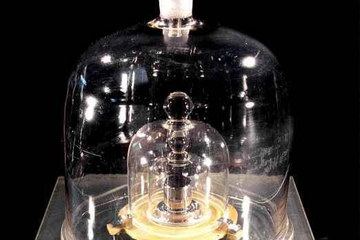
The kilogram has put on weight

January 8, 2013

kilogram

London:Jan 8: The official kilogram - a cylinder-shaped hunk of metal - that defines the fundamental unit of mass, has itself gained weight, scientists say.

Scientists at Newscastle University have found that due to surface contamination the original kilogram is likely to be tens of microgrammes heavier than it was when the first standard was set in 1875.

As a result, each country that has one of these standard masses has a slightly different definition of the kilogram, which could throw off science experiments that require very precise weight measurements or international trade in highly restricted items that are restricted by weight, such as radioactive materials.

The original kilogram - known as the International Prototype Kilogram or the IPK - is the standard against which all other measurements of mass are set.

Stored in the International Bureau of Weights and Measures in Paris, 40 official replicas of the IPK were made in 1884 and distributed around the world in order to standardise mass.

Now Professor Peter Cumpson and Dr Naoko Sano have used cutting-edge X-ray Photoelectron Spectroscopy to analyse surfaces similar to the standard kilogram to assess the build-up of hydrocarbons – and how to remove them.

Ozone and ultraviolet light could be used to clean the kilograms without damaging them, LiveScience reported.

“Statute decrees the IPK is the kilogram,” explained research lead Peter Cumpson, Professor of MicroElectroMechanical Systems at Newcastle University.

“It doesn’t really matter what it weighs as long as we are all working to the same exact standard. The problem is there are slight differences. Around the world, the IPK and its 40 replicas are all growing at different rates, diverging from the original,” Cumpson said.

“We’re only talking about a very small change – less than 100 microgrammes – so, unfortunately, we can’t all take a couple of kilograms off our weight and pretend the Christmas over-indulgence never happened,” Cumpson added.

“But mass is such a fundamental unit that even this very small change is significant and the impact of a slight variation on a global scale is absolutely huge. There are cases of international trade in high-value materials or waste where every last microgramme must be accounted for,” he said.

“What we have done at Newcastle is effectively give these surfaces a suntan. By exposing the surface to a mixture of UV and ozone we can remove the carbonaceous contamination and potentially bring prototype kilograms back to their ideal weight,” he added.

Work is underway internationally in several national measurement institutes to find an alternative to the IPK — a standardised value for the kilogram that is not based on a matchbox—sized piece of metal.

The study was published in the journal of Metrologia.

Comments

Add new comment

  • Coastaldigest.com reserves the right to delete or block any comments.
  • Coastaldigset.com is not responsible for its readers’ comments.
  • Comments that are abusive, incendiary or irrelevant are strictly prohibited.
  • Please use a genuine email ID and provide your name to avoid reject.
Agencies
June 24,2020

New Delhi, Jun 24: Expanding the testing criterion for coronavirus, the Indian Council of Medical Research has said it should be made widely available to all symptomatic individuals across the country.

"Since test, track and treat' is the only way to prevent spread of infection and save lives, it is imperative that testing should be made widely available to all symptomatic individuals in every part of the country and contact tracing mechanisms for containment of infection are further strengthened," it said in an advisory on 'Newer Additional Strategies for COVID-19 Testing' on Tuesday.

In its revised testing strategy for COVID-19 issued on May 18, the Indian Council of Medical Research (ICMR) had advised testing for all symptomatic Influenza-like illness (ILI) among returnees and migrants within seven days of illness.

All hospitalised patients who develop ILI symptoms, symptomatic individuals living within hotspots or containment zones and healthcare and frontline workers involved in containment and mitigation of coronavirus were also advised testing.

The apex health research body has also advised authorities to enable all government and private hospitals, offices and public sector units to perform antibody-based COVID-19 testing for surveillance to help allay fears and anxiety of healthcare workers and office employees.

The earlier advisories on rapid antibody testing advisories had focused on areas reporting clusters (containment zones), large migration gatherings/evacuees centers and testing of symptomatic ILI individuals at facility level.

Besides, the ICMR on Tuesday also recommended deployment of rapid antigen detection tests for COVID-19 in combination with RT-PCR tests in all containment zones, all central and state government medical colleges and government hospitals, all private hospitals approved by the National Accreditation Board for Hospitals and Healthcare (NABH), all NABL-accredited and ICMR approved private labs, for COVID-19 testing.

All hospitals, laboratories and state governments intending to perform the point-of-care antigen tests need to register with ICMR to obtain the login credentials for data entry.

"ICMR advises all state governments, public and private institutions concerned to take required steps to scale up testing for COVID-19 by deploying combination of various tests as advised," the advisory added.

Comments

Add new comment

  • Coastaldigest.com reserves the right to delete or block any comments.
  • Coastaldigset.com is not responsible for its readers’ comments.
  • Comments that are abusive, incendiary or irrelevant are strictly prohibited.
  • Please use a genuine email ID and provide your name to avoid reject.
Agencies
March 15,2020

Should you let your babies "cry it out" or rush to their side? Researchers have found that leaving an infant to 'cry it out' from birth up to 18 months does not adversely affect their behaviour development or attachment.

The study, published in the Journal of Child Psychology and Psychiatry, found that an infant's development and attachment to their parents is not affected by being left to "cry it out" and can actually decrease the amount of crying and duration.

"Only two previous studies nearly 50 or 20 years ago had investigated whether letting babies 'cry it out' affects babies' development. Our study documents contemporary parenting in the UK and the different approaches to crying used," said the study's researcher Ayten Bilgin from the University of Warwick in the UK.

For the study, the researchers followed 178 infants and their mums over 18 months and repeatedly assessed whether parents intervened immediately when a baby cried or let the baby let it cry out a few times or often.

They found that it made little difference to the baby’s development by 18 months.

The use of parent’s leaving their baby to ‘cry it out’ was assessed via maternal report at term, 3, 6 and 18 months and cry duration at term, 3 and 18 months.

Duration and frequency of fussing and crying was assessed at the same ages with the Crying Pattern Questionnaire.

According to the researchers, how sensitive the mother is in interaction with their baby was video-recorded and rated at 3 and 18 months of age.

Attachment was assessed at 18 months using a gold standard experimental procedure, the strange situation test, which assesses how securely an infant is attached to the major caregiver during separation and reunion episodes.

Behavioural development was assessed by direct observation in play with the mother and during assessment by a psychologist and a parent-report questionnaire at 18 months.

Researchers found that whether contemporary parents respond immediately or leave their infant to cry it out a few times to often makes no difference on the short - or longer term relationship with the mother or the infants behaviour.

This study shows that 2/3 of mum's parent intuitively and learn from their infant, meaning they intervene when they were just born immediately, but as they get older the mother waits a bit to see whether the baby can calm themselves, so babies learn self-regulation.

Comments

Add new comment

  • Coastaldigest.com reserves the right to delete or block any comments.
  • Coastaldigset.com is not responsible for its readers’ comments.
  • Comments that are abusive, incendiary or irrelevant are strictly prohibited.
  • Please use a genuine email ID and provide your name to avoid reject.
Agencies
April 4,2020

Washington D.C., Apr 4: While consuming a high-diet salt can result in high blood pressure, a recent study has revealed a link between salt-rich diet and weaker immune system.

The study was conducted under the leadership of the University Hospital Bonn, and the results were published in the journal Science Translational Medicine.

The research was conducted on mice that were fed a high-salt diet. Later, they were found to suffer from much more severe bacterial infections.

Human volunteers who consumed an additional six grams of salt per day also showed pronounced immune deficiencies.

The World Health Organization (WHO) has recommended a maximum amount of five grams of salt a day.

It corresponds approximately to one level teaspoon. In reality, however, many Germans exceed this limit considerably. 

Figures from the Robert Koch Institute suggest that on average men consume ten, and women more than eight grams a day.

This means that we reach for the salt shaker much more than is good for us. After all, sodium chloride, which is its chemical name, raises blood pressure and thereby increases the risk of heart attack or stroke.

"We have now been able to prove for the first time that excessive salt intake also significantly weakens an important arm of the immune system," said Prof. Dr. Christian Kurts from the Institute of Experimental Immunology at the University of Bonn.

This finding is unexpected, as some studies point in the opposite direction. For example, infections with certain skin parasites in laboratory animals heal significantly faster if these consume a high-salt diet.

The study also sheds light on the fact that the skin serves as a salt reservoir.

"Our results show that this generalization is not accurate," emphasized Katarzyna Jobin, lead author of the study.

The body keeps the salt concentration in the blood and in the various organs largely constant. Otherwise important biological processes would be impaired. The only major exception is the skin which functions as a salt reservoir of the body. This is why the additional intake of sodium chloride works so well for some skin diseases.

However, other parts of the body are not exposed to the additional salt consumed with food. Instead, it is filtered out by the kidneys and excreted in the urine.

"We examined volunteers who consumed six grams of salt in addition to their daily intake," said Prof. Kurts. This is roughly the amount contained in two fast-food meals, i.e. two burgers and two portions of French fries.

After one week, from the results, it showed that the immune cells coped much worse with bacteria after the test subjects had started to eat a high-salt diet.

In human volunteers, excessive salt intake also resulted in increased glucocorticoid levels.

Comments

Add new comment

  • Coastaldigest.com reserves the right to delete or block any comments.
  • Coastaldigset.com is not responsible for its readers’ comments.
  • Comments that are abusive, incendiary or irrelevant are strictly prohibited.
  • Please use a genuine email ID and provide your name to avoid reject.