



The kilogram has put on weight

January 8, 2013

kilogram

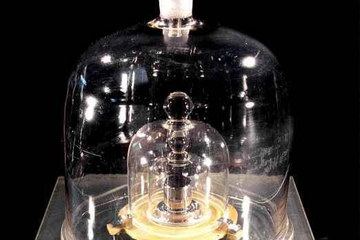
London:Jan 8: The official kilogram - a cylinder-shaped hunk of metal - that defines the fundamental unit of mass, has itself gained weight, scientists say.

Scientists at Newscastle University have found that due to surface contamination the original kilogram is likely to be tens of microgrammes heavier than it was when the first standard was set in 1875.

As a result, each country that has one of these standard masses has a slightly different definition of the kilogram, which could throw off science experiments that require very precise weight measurements or international trade in highly restricted items that are restricted by weight, such as radioactive materials.

The original kilogram - known as the International Prototype Kilogram or the IPK - is the standard against which all other measurements of mass are set.

Stored in the International Bureau of Weights and Measures in Paris, 40 official replicas of the IPK were made in 1884 and distributed around the world in order to standardise mass.

Now Professor Peter Cumpson and Dr Naoko Sano have used cutting-edge X-ray Photoelectron Spectroscopy to analyse surfaces similar to the standard kilogram to assess the build-up of hydrocarbons – and how to remove them.

Ozone and ultraviolet light could be used to clean the kilograms without damaging them, LiveScience reported.

“Statute decrees the IPK is the kilogram,” explained research lead Peter Cumpson, Professor of MicroElectroMechanical Systems at Newcastle University.

“It doesn’t really matter what it weighs as long as we are all working to the same exact standard. The problem is there are slight differences. Around the world, the IPK and its 40 replicas are all growing at different rates, diverging from the original,” Cumpson said.

“We’re only talking about a very small change – less than 100 microgrammes – so, unfortunately, we can’t all take a couple of kilograms off our weight and pretend the Christmas over-indulgence never happened,” Cumpson added.

“But mass is such a fundamental unit that even this very small change is significant and the impact of a slight variation on a global scale is absolutely huge. There are cases of international trade in high-value materials or waste where every last microgramme must be accounted for,” he said.

“What we have done at Newcastle is effectively give these surfaces a suntan. By exposing the surface to a mixture of UV and ozone we can remove the carbonaceous contamination and potentially bring prototype kilograms back to their ideal weight,” he added.

Work is underway internationally in several national measurement institutes to find an alternative to the IPK — a standardised value for the kilogram that is not based on a matchbox—sized piece of metal.

The study was published in the journal of Metrologia.

Comments

Add new comment

  • Coastaldigest.com reserves the right to delete or block any comments.
  • Coastaldigset.com is not responsible for its readers’ comments.
  • Comments that are abusive, incendiary or irrelevant are strictly prohibited.
  • Please use a genuine email ID and provide your name to avoid reject.
News Network
February 21,2020

Washington, Feb 21: The fat around arteries may play an important role in keeping the blood vessels healthy, according to a study in rats that may affect how researchers test for treatments related to plaque buildup, as seen in conditions leading to heart attack.

The study, published in the journal Scientific Reports, noted that the fat, known as perivascular adipose tissue, or PVAT, helps arteries let go of muscular tension while under constant strain.

According to the researchers, including Stephanie W. Watts from the Michigan State University in the US, this feature is similar to how the bladder expands to accommodate more liquid, while at the same time keeping it from spilling out.

"In our study, PVAT reduced the tension that blood vessels experience when stretched," Watts said.

"And that's a good thing, because the vessel then expends less energy. It's not under as much stress," she added.

According to Watts and her team, PVAT has largely been ignored by researchers believing its main job was to store lipids and do little more.

Until now, she said, scientists only divided blood vessels into three parts, the innermost layer called the tunica intima, the middle layer called the tunica media, and the outermost layer called the tunica adventitia.

Watts believes PVAT is the fourth layer, which others have called tunica adiposa.

Tunica, she said, meant a membranous sheath enveloping or lining an organ, and adiposa is a synonym for fat.

"For years, we ignored this layer -- in the lab it was thrown out. In the clinic it wasn't imaged. But now we're discovering it may be integral to our blood vessels," Watts said.

"Our finding redefines what the functional blood vessels are, and is part of what can be dysfunctional in diseases that afflict us, including hypertension. We need to pay attention to this layer of a blood vessel because it does far more than we originally thought," she added.

Earlier studies, Watts said, had shown that PVAT plays a role in the functioning of blood vessels, finding that it secretes substances that can cause blood vessels to relax as well as substances that can cause it to contract.

In the current study, the researchers decided to test whether PVAT provides a structural benefit to arteries by assisting the function of stress relaxation.

They tested the thoracic aorta in rats, and found those with intact PVAT had more stress relaxation than those without.

The study revealed that the pieces of artery with surrounding fat had measurably relaxed more than those without.

Watts and her colleagues then tested other arteries, and were able to duplicate the same response.

"It's not something you see only in this particular vessel or this particular species or this particular strain. But that maybe it's a general phenomenon," she said.

Comments

Add new comment

  • Coastaldigest.com reserves the right to delete or block any comments.
  • Coastaldigset.com is not responsible for its readers’ comments.
  • Comments that are abusive, incendiary or irrelevant are strictly prohibited.
  • Please use a genuine email ID and provide your name to avoid reject.
News Network
January 31,2020

Jan 31: Cervical cancer could be eliminated worldwide as a public health issue within the next 100 years, according to two studies which may lead to better strategies for screening and vaccination against the malignant disease.

According to the studies, published in the journal The Lancet, more than 74 million cervical cancer cases, and 60 million deaths could be averted, and the disease eliminated in the 78 countries which have the highest disease burden.

The researchers, including those from Laval University in Canada, said cervical cancer is the second most frequent cancer among women in low-income and lower-middle-income countries (LMICs) with 2,90,000 (51 per cent) of the 5,70,000 new cases worldwide reported in women living in LMICs.

In the current studies, the scientists used the WHO draft strategy of cervical cancer elimination which defines plans for vaccination against the disease's causative agent, the human papillomavirus (HPV).

These plans, they explained, call for 90 per cent of girls to be vaccinated against HPV by 2030, and for 70 per cent of women to be screened for cervical cancer once or twice in their lifetime.

About 90 per cent of women with precancerous lesions, or cervical cancer are also advised to receive appropriate treatment, according to the WHO draft strategy, the scientists said.

In the second study, the research team analysed the impact of three elements of the WHO strategy on deaths from cervical cancer -- modelling the impact of scaling up cancer treatment, as well as vaccination and screening

"Our findings emphasise the importance of acting immediately to combat cervical cancer on all three fronts," said Karen Canfell from the University of Sydney in Australia, who co-led both the studies.

"In just 10 years, it's possible to reduce deaths from the disease by a third and, over the next century, more than 60 million women's lives could be saved. This would represent an enormous gain in terms of both quality of life, and lives saved," Canfell said.

By adding the two screening tests, and with the treatment of precancerous cervical lesions, cases of the cancer may drop by 97 per cent, and 72 million cervical cancer cases could be averted over the next century, the researchers said.

Scaling-up of appropriate cancer treatment could avert 62 million cervical cancer deaths, the study noted.

"For the first time, we've estimated how many cases of cervical cancer could be averted if WHO's strategy is rolled out and when elimination might occur," said Marc Brisson, study co-author from Laval University.

"Our results suggest that to eliminate cervical cancer it will be necessary to achieve both high vaccination coverage, and a high uptake of screening and treatment, especially in countries with the highest burden of the disease," Brisson added.

Based on the results of the studies, WHO's cervical cancer elimination strategy has been updated which will be presented for adoption at the World Health Assembly in May 2020, the scientists noted.

"If the strategy is adopted and applied by member states, cervical cancer could be eliminated in high income countries by 2040, and across the globe within the next century, which would be a phenomenal victory for women's health," Brisson said.

"However, this can only be achieved with considerable international financial and political commitment, in order to scale-up prevention and treatment," he added.

Comments

Add new comment

  • Coastaldigest.com reserves the right to delete or block any comments.
  • Coastaldigset.com is not responsible for its readers’ comments.
  • Comments that are abusive, incendiary or irrelevant are strictly prohibited.
  • Please use a genuine email ID and provide your name to avoid reject.
News Network
March 6,2020

Mar 6: The spread of the new coronavirus is shining the spotlight on a little-discussed gender split: men wash their hands after using the bathroom less than women, years of research and on-the-ground observations show.

Health officials around the world advise that deliberate, regular handwashing is one of the best weapons against the virus which causes a flu-like respiratory illness that can kill and has spread to around 80 countries.

The Centers for Disease Control and Prevention's online fact sheet "Handwashing: A corporate activity," cites a 2009 study that finds "only 31% of men and 65% of women washed their hands" after using a public restroom.

Social media comments about men's handwashing lapses forced an august British institution to caution visitors about bathroom behaviour this week.

After author Sathnam Sanghera complained on Twitter about "grown," "educated" men in the British Library toilets not washing their hands, the library responded, putting up additional signs reminding patrons to wash their hands in men's and women's bathrooms.

Thanks to "visitor feedback," a spokesman told Reuters, "we have increased further the number of posters in public toilets so that visitors are reminded of the importance of good hygiene at exactly the point where they can wash their hands."

Men and women approach handwashing after using the restroom differently, according to multiple surveys and field studies.

"Women wash their hands significantly more often, use soap more often, and wash their hands somewhat longer than men," according to a 2013 Michigan State University field study conducted by research assistants who observed nearly 4,000 people in restrooms around East Lansing, Michigan.

The study found 14.6% of men did not wash their hands at all after using the bathroom and 35.1% wet their hands but did not use soap, compared to 7.1% and 15.1% of women, respectively.

"If you stand in the men's bathroom at work, and watch men leave, they mostly don't wash their hands if they used the urinal," said one New York City public relations executive, who did not want to be identified for fear of alienating his colleagues.

Since the virus's spread, he's seen an uptick in men's handwashing at work, he noted. "I, for the record, do wash my hands all the time," he added.

Female medical staff in critical care units "washed their hands significantly more often than did their male counterparts after patient contact," a 2001 study published in the American Journal of Infection Control found.

Middle-aged women with some college education had the highest level of knowledge about hand hygiene, a survey published in 2019 by BMC Public Health, an open access public health journal, found.

Early information about coronavirus infection in China shows that men may be more susceptible to the disease. Just over 58% of the more than 1,000 COVID-19 patients reported in China through Jan. 29, 2020, were male, research published in the New England Journal of Medicine shows.

Researchers have not linked the difference to hand hygiene.

Comments

Add new comment

  • Coastaldigest.com reserves the right to delete or block any comments.
  • Coastaldigset.com is not responsible for its readers’ comments.
  • Comments that are abusive, incendiary or irrelevant are strictly prohibited.
  • Please use a genuine email ID and provide your name to avoid reject.