


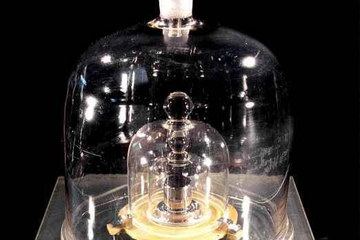
The kilogram has put on weight

January 8, 2013

kilogram

London:Jan 8: The official kilogram - a cylinder-shaped hunk of metal - that defines the fundamental unit of mass, has itself gained weight, scientists say.

Scientists at Newscastle University have found that due to surface contamination the original kilogram is likely to be tens of microgrammes heavier than it was when the first standard was set in 1875.

As a result, each country that has one of these standard masses has a slightly different definition of the kilogram, which could throw off science experiments that require very precise weight measurements or international trade in highly restricted items that are restricted by weight, such as radioactive materials.

The original kilogram - known as the International Prototype Kilogram or the IPK - is the standard against which all other measurements of mass are set.

Stored in the International Bureau of Weights and Measures in Paris, 40 official replicas of the IPK were made in 1884 and distributed around the world in order to standardise mass.

Now Professor Peter Cumpson and Dr Naoko Sano have used cutting-edge X-ray Photoelectron Spectroscopy to analyse surfaces similar to the standard kilogram to assess the build-up of hydrocarbons – and how to remove them.

Ozone and ultraviolet light could be used to clean the kilograms without damaging them, LiveScience reported.

“Statute decrees the IPK is the kilogram,” explained research lead Peter Cumpson, Professor of MicroElectroMechanical Systems at Newcastle University.

“It doesn’t really matter what it weighs as long as we are all working to the same exact standard. The problem is there are slight differences. Around the world, the IPK and its 40 replicas are all growing at different rates, diverging from the original,” Cumpson said.

“We’re only talking about a very small change – less than 100 microgrammes – so, unfortunately, we can’t all take a couple of kilograms off our weight and pretend the Christmas over-indulgence never happened,” Cumpson added.

“But mass is such a fundamental unit that even this very small change is significant and the impact of a slight variation on a global scale is absolutely huge. There are cases of international trade in high-value materials or waste where every last microgramme must be accounted for,” he said.

“What we have done at Newcastle is effectively give these surfaces a suntan. By exposing the surface to a mixture of UV and ozone we can remove the carbonaceous contamination and potentially bring prototype kilograms back to their ideal weight,” he added.

Work is underway internationally in several national measurement institutes to find an alternative to the IPK — a standardised value for the kilogram that is not based on a matchbox—sized piece of metal.

The study was published in the journal of Metrologia.

Comments

Add new comment

  • Coastaldigest.com reserves the right to delete or block any comments.
  • Coastaldigset.com is not responsible for its readers’ comments.
  • Comments that are abusive, incendiary or irrelevant are strictly prohibited.
  • Please use a genuine email ID and provide your name to avoid reject.
Agencies
June 11,2020

The World Health Organisation (WHO) Director-General Tedros Adhanom Ghebreyesus said that more research needs to be done to better understand the extent to which COVID-19 is being spread by people who don't show symptoms.

"Since early February, we have said that asymptomatic people can transmit COVID-19, but that we need more research to establish the extent of asymptomatic transmission," the WHO chief said at a virtual press conference from Geneva on Wednesday, Xinhua news agency reported.

"That research is ongoing, and we're seeing more and more research being done," he added.

Saying that the world has been achieving a lot in knowing the new virus, the WHO chief told reporters that "there's still a lot we don't

"WHO's advice will continue to evolve as new information becomes available," he said.

Tedros stressed that the most critical way to stop transmission is to find, isolate and test people with symptoms, and trace and quarantine their contacts.

"Many countries have succeeded in suppressing transmission and controlling the virus doing exactly this," Tedros said.

Meanwhile, Michael Ryan, executive director of WHO Health Emergencies Program, said Wednesday that the COVID-19 pandemic is still evolving.

"If we look at the numbers... this pandemic is still evolving. It is growing in many parts of the world," he said. "We have deep concerns that health systems of some countries are struggling, under a huge strain and require our support, our help and our solidarity."

He said "each and every country has a different combination of risks and opportunities, and it's really down to national authorities to carefully consider where they are in the pandemic."

In Europe, the risk issue now are about travels and the opening of the schools, around risk management, mass gathering, surveillance and contact tracing, said the WHO official.

In Southeast Asian countries, where to a great extent transmissions have been under control, governments are more concerned about the re-emergence of clusters, while in South America, the issue of PPE for health workers has not gone away, said Ryan.

As regards Africa, Ryan said the death rates have been very low in the past week, but the health system can be overwhelmed, as it would have to cope with other diseases such as malaria.

Comments

Add new comment

  • Coastaldigest.com reserves the right to delete or block any comments.
  • Coastaldigset.com is not responsible for its readers’ comments.
  • Comments that are abusive, incendiary or irrelevant are strictly prohibited.
  • Please use a genuine email ID and provide your name to avoid reject.
Agencies
March 15,2020

Should you let your babies "cry it out" or rush to their side? Researchers have found that leaving an infant to 'cry it out' from birth up to 18 months does not adversely affect their behaviour development or attachment.

The study, published in the Journal of Child Psychology and Psychiatry, found that an infant's development and attachment to their parents is not affected by being left to "cry it out" and can actually decrease the amount of crying and duration.

"Only two previous studies nearly 50 or 20 years ago had investigated whether letting babies 'cry it out' affects babies' development. Our study documents contemporary parenting in the UK and the different approaches to crying used," said the study's researcher Ayten Bilgin from the University of Warwick in the UK.

For the study, the researchers followed 178 infants and their mums over 18 months and repeatedly assessed whether parents intervened immediately when a baby cried or let the baby let it cry out a few times or often.

They found that it made little difference to the baby’s development by 18 months.

The use of parent’s leaving their baby to ‘cry it out’ was assessed via maternal report at term, 3, 6 and 18 months and cry duration at term, 3 and 18 months.

Duration and frequency of fussing and crying was assessed at the same ages with the Crying Pattern Questionnaire.

According to the researchers, how sensitive the mother is in interaction with their baby was video-recorded and rated at 3 and 18 months of age.

Attachment was assessed at 18 months using a gold standard experimental procedure, the strange situation test, which assesses how securely an infant is attached to the major caregiver during separation and reunion episodes.

Behavioural development was assessed by direct observation in play with the mother and during assessment by a psychologist and a parent-report questionnaire at 18 months.

Researchers found that whether contemporary parents respond immediately or leave their infant to cry it out a few times to often makes no difference on the short - or longer term relationship with the mother or the infants behaviour.

This study shows that 2/3 of mum's parent intuitively and learn from their infant, meaning they intervene when they were just born immediately, but as they get older the mother waits a bit to see whether the baby can calm themselves, so babies learn self-regulation.

Comments

Add new comment

  • Coastaldigest.com reserves the right to delete or block any comments.
  • Coastaldigset.com is not responsible for its readers’ comments.
  • Comments that are abusive, incendiary or irrelevant are strictly prohibited.
  • Please use a genuine email ID and provide your name to avoid reject.
Agencies
July 4,2020

The Union health ministry on Friday revised the dosage of anti-viral drug remdesivir to be administered to coronavirus patients in the moderate stage of illness from the earlier six days to five days as it issued an updated 'Clinical Management Protocols for COVID-19'.

The drug, administered in the form of injection, should be given at a dose of 200 mg on day one followed by 100 mg daily for four days (total five days), the new treatment protocols stated.

The Health Ministry on June 13 had allowed the use of remdesivir for restricted emergency use in moderate cases under "investigational therapies".

"Under emergency use authorisation, remdesivir may be considered for patients in moderate stage requiring oxygen support," the document stated.

It is not recommended for those with severe renal impairment and high level of liver enzymes, pregnant and lactating women, and those below 12 years, it said.

The ministry also okayed off-label application of tocilizumab, a drug that modifies the immune system or its functioning, and convalescent plasma for treating COVID-19 patients in the moderate stage of illness as "investigational therapies".

It also recommended hydroxychloroquine for patients during the early course of the disease and not for critically-ill patients.

On June 27, the ministry had included an inexpensive, widely used steroid dexamethasone in treatment protocols for COVID-19 patients in the moderate to severe stages of their illness among other therapeutic measures.

The ministry advised use of dexamethasone, which is already used in a wide range of conditions for its anti-inflammatory and immunosuppressant effects, as an alternative choice to methylprednisolone for managing moderate to severe cases of coronavirus infection.

India's COVID-19 cases soared by over 20,000 in a day for the first time taking the country's total tally to 6,25,544 on Friday while the death toll climbed to 18,213 with 379 new fatalities, according to the Union Health Ministry data updated at 8 am.

Comments

Add new comment

  • Coastaldigest.com reserves the right to delete or block any comments.
  • Coastaldigset.com is not responsible for its readers’ comments.
  • Comments that are abusive, incendiary or irrelevant are strictly prohibited.
  • Please use a genuine email ID and provide your name to avoid reject.