Healthy digestion to weight loss:?5 reasons why using ghee is the better option

May 23, 2017

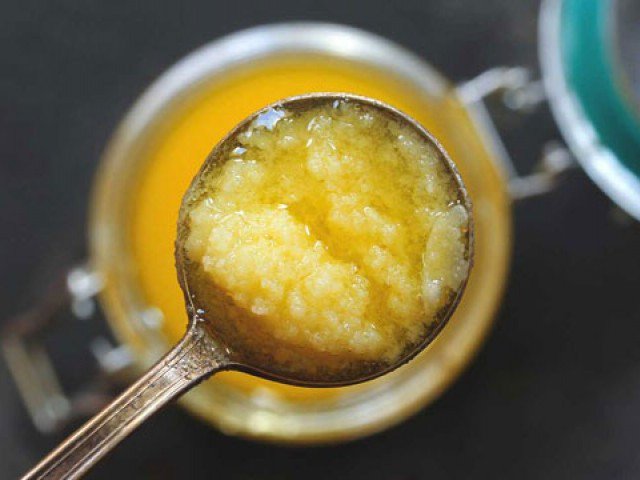
May 23: Ghee may look unhealthy but it is now one of the better option when it comes to cooking.

A recent report by the Express Tribune lists down five reasons as to why we should use ghee more often in cooking:

1. It is less toxic than oil

When cooking on high heat, ghee produces much less toxic compounds than vegetable and seed oils. According to a study, soybean produces more than ten times as much acrylamide as ghee when heated to 160°C.

ghee

2. Ghee has a high smoke point

When cooking at high temperatures, ghee is far more suitable as it has a high smoking point, and won’t burn or breakdown into free radicals (unstable molecules that can damage the cells in your body).

3. It does not spoil easily

Ghee does not require refrigeration and can be stored at room temperature for several weeks. And since its milk solids have been removed, it does not spoil easily.

4. Healthy digestive tract

Studies suggest that since ghee is more concentrated than butter, it provides a little more butyric acid and other short-chain saturated fats, which reduce soreness and support gut health.

5. Weight loss

Ghee is higher in conjugated linoleic acid, an unsaturated fatty acid, which causes fat loss.

Comments

Add new comment

  • Coastaldigest.com reserves the right to delete or block any comments.
  • Coastaldigset.com is not responsible for its readers’ comments.
  • Comments that are abusive, incendiary or irrelevant are strictly prohibited.
  • Please use a genuine email ID and provide your name to avoid reject.
Agencies
May 2,2020

Clinician-scientists have found that Irish patients admitted to hospital with severe coronavirus (COVID-19) infection are experiencing abnormal blood clotting that contributes to death in some patients.

The research team from the Royal College of Surgeons in Ireland found that abnormal blood clotting occurs in Irish patients with severe COVID-19 infection, causing micro-clots within the lungs.

According to the study, they also found that Irish patients with higher levels of blood clotting activity had a significantly worse prognosis and were more likely to require ICU admission.

"Our novel findings demonstrate that COVID-19 is associated with a unique type of blood clotting disorder that is primarily focussed within the lungs and which undoubtedly contributes to the high levels of mortality being seen in patients with COVID-19," said Professor James O'Donnell from St James's Hospital in Ireland.

In addition to pneumonia affecting the small air sacs within the lungs, the research team has also hundreds of small blood clots throughout the lungs.

This scenario is not seen with other types of lung infection and explains why blood oxygen levels fall dramatically in severe COVID-19 infection, the study, published in the British Journal of Haematology said.

"Understanding how these micro-clots are being formed within the lung is critical so that we can develop more effective treatments for our patients, particularly those in high-risk groups," O'Donnell said.

"Further studies will be required to investigate whether different blood-thinning treatments may have a role in selected high-risk patients in order to reduce the risk of clot formation," Professor O'Donnell added.

According to the study, emerging evidence also shows that the abnormal blood-clotting problem in COVID-19 results in a significantly increased risk of heart attacks and strokes.

As of Friday morning, the cases increased to 20,612 cases in Ireland, with 1,232 deaths so far, according to the Johns Hopkins University.

Comments

Add new comment

  • Coastaldigest.com reserves the right to delete or block any comments.
  • Coastaldigset.com is not responsible for its readers’ comments.
  • Comments that are abusive, incendiary or irrelevant are strictly prohibited.
  • Please use a genuine email ID and provide your name to avoid reject.
Agencies
January 11,2020

Europe, Jan 11: Researchers have revealed the people who drink tea at least three times a week have healthy years of life and longer life expectancy.

The research was published in the European Journal of Preventive Cardiology, a journal of the European Society of Cardiology (ESC).

Dr Xinyan Wang, who is the author of the study, said: "Habitual tea consumption is associated with lower risks of cardiovascular disease and all-cause death. The favourable health effects are the most robust for green tea and for long-term habitual tea drinkers."
The analysis that was conducted included about 100,902 participants of the China-PAR project2 with no history of heart attack, stroke, or cancer.

Participants were classified into two groups: Habitual tea drinkers and never or non-habitual tea drinkers and followed-up for a median of 7.3 years.

The analyses estimated that 50-year-old habitual tea drinkers would develop coronary heart disease and stroke 1.41 years later and live 1.26 years longer than those who never or seldom drank tea. Compared with never or non-habitual tea drinkers, the habitual tea consumers had a 20 per cent lower risk of incident heart disease and stroke, 22 per cent lower risk of fatal heart disease and stroke, and 15 per cent decreased risk of all-cause death.

The potential influence of changes in tea drinking behaviour was suspected in a subset of 14,081 participants with assessments at two-time points. The average duration between the two surveys was 8.2 years, and the median follow-up after the second survey was 5.3 years.

Habitual tea drinkers who maintained their habit in both surveys had a 39 per cent lower risk of incident heart disease and stroke, 56 per cent lower risk of fatal heart disease and stroke, and 29 per cent decreased risk of all-cause death compared to consistent never or non-habitual tea drinkers.

Senior author Dr Dongfeng Gu said: "The protective effects of tea were most pronounced among the consistent habitual tea drinking group. Mechanism studies have suggested that the main bioactive compounds in tea, namely polyphenols, are not stored in the body long-term. Thus, frequent tea intake over an extended period may be necessary for the cardioprotective effect."

In a subanalysis by type of tea, drinking green tea was linked with approximately 25 per cent lower risks for incident heart disease and stroke, fatal heart disease and stroke, and all-cause death. However, no significant associations were observed for black tea.
Dr Gu noted that a preference for green tea is unique to East Asia.

Two factors may be at play. First, green tea is a rich source of polyphenols which protect against cardiovascular disease and its risk factors including high blood pressure and dyslipidaemia. Black tea is fully fermented and during this process, polyphenols are oxidised into pigments and may lose their antioxidant effects. Second, black tea is often served with milk, which previous research has shown may counteract the favourable health effects of tea on vascular function.

Gender-specific analyses showed that the protective effects of habitual tea consumption were pronounced and robust across different outcomes for men, but only modest for women. Dr Wang said: "One reason might be that 48 per cent of men were habitual tea consumers compared to just 20 per cent of women. Secondly, women had a much lower incidence of, and mortality from, heart disease and stroke. These differences made it more likely to find statistically significant results among men."

She said: "The China-PAR project is ongoing, and with more person-years of follow-up among women the associations may become more pronounced."

In conclusion, the authors have found that randomised trials are required to validate the results and to illustrate nutritional guidelines and advice for lifestyle.


Comments

Add new comment

  • Coastaldigest.com reserves the right to delete or block any comments.
  • Coastaldigset.com is not responsible for its readers’ comments.
  • Comments that are abusive, incendiary or irrelevant are strictly prohibited.
  • Please use a genuine email ID and provide your name to avoid reject.
Agencies
February 23,2020

Los Angeles, Feb 23: According to researchers, if administered quickly, a common medication that reduces bleeding could be a treatment for bleeding stroke.

The Spot Sign and Tranexamic Acid on Preventing ICH Growth - Australasia Trial (STOP-AUST) was a multicenter, prospective, randomized, double-blind, placebo-controlled, phase 2 clinical trial using the antifibrinolytic agent tranexamic acid in people with intracerebral hemorrhage (ICH).

ICH is a severe form of acute stroke with few treatment options.

Tranexamic acid is currently used to treat or prevent excessive blood loss from trauma, surgery, tooth removal, nosebleeds and heavy menstruation. For this study, one hundred patients with active brain bleeding were given either intravenous tranexamic acid or placebo within 4.5 hours of symptom onset.

Researchers analyzed brain CT scans taken during the 24-hour period after treatment with tranexamic acid or placebo.

Researchers found a trend towards reduced hemorrhage expansion in the group treated with tranexamic acid, especially in those treated within 3 hours of the brain bleed. However, this trend was not statistically significant. The finding was consistent with previous research using the medication.

"Further trials using tranexamic acid are ongoing and focusing on ultra-early treatment - within 2 hours. 

This is where the greatest opportunity for intervention appears to be. Tranexamic acid is inexpensive, safe and widely available. Our results and others provide great impetus for further, focused research using this treatment," Nawaf Yassi said.

Larger trials focused on patient outcomes are required for this therapy to enter routine clinical practice.

Comments

Add new comment

  • Coastaldigest.com reserves the right to delete or block any comments.
  • Coastaldigset.com is not responsible for its readers’ comments.
  • Comments that are abusive, incendiary or irrelevant are strictly prohibited.
  • Please use a genuine email ID and provide your name to avoid reject.