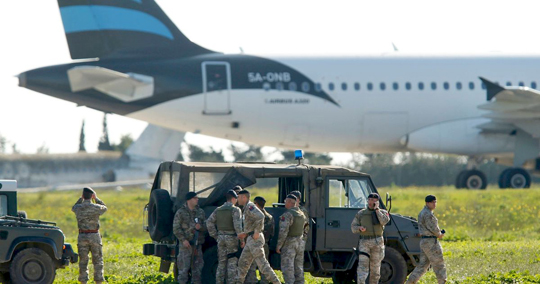
Hijackers threaten to blow up Libyan plane with 118 on board: Reports

December 23, 2016

Valletta, Dec 23: An airliner on an internal flight in Libya was hijacked and diverted to Malta where it landed on Friday, Maltese media reported. Two hijackers, reportedly having hand grenade, have threatened to blow up the Airbus A320, which had 118 people aboard, including seven crew, outlets including the Times of Malta said.

Hijackers

Maltese media reported that the hijacked plane was an Airbus 320 that had been on a domestic Libyan flight operated by Afriqiyah Airways. The aircraft had been flying from Sebha in southwest Libya to Tripoli.

The Malta airport authority said all emergency teams had been dispatched to the site of what it called an "unlawful interference" on the airport tarmac. The plane's engines were still running.

Maltese Prime Minister Joseph Muscat tweeted:

The tiny Mediterranean island of Malta is about 500 km (300 miles) north of the Libyan coast.

All flights in and out of Malta have been canceled.

Libya has been in a state of chaos since the 2011 overthrow of Moamer Kadhafi left warring militias battling for control of different parts of the country.

Forces loyal to a fledgling national unity government recently took control of the coastal city of Sirte, which had been a bastion for the ISIS since June 2015.

Western powers have pinned their hopes of containing jihadism in the energy-rich North African state on the government but it has failed to establish its authority over all of the country.

A rival authority rules the country's far east, backed by the forces under military strongman Marshal Khalifa Haftar, who have been battling terrorists in second city Benghazi.

Comments

Add new comment

  • Coastaldigest.com reserves the right to delete or block any comments.
  • Coastaldigset.com is not responsible for its readers’ comments.
  • Comments that are abusive, incendiary or irrelevant are strictly prohibited.
  • Please use a genuine email ID and provide your name to avoid reject.
Agencies
May 8,2020

United Nations, May 8: UN Secretary-General Antonio Guterres said Friday the coronavirus pandemic keeps unleashing a tsunami of hate and xenophobia, scapegoating and scare-mongering. 

The UN chief said anti-foreigner sentiment has surged online and in the streets, anti-Semitic conspiracy theories have spread, and COVID-19-related anti-Muslim attacks have occurred. 

Guterres said migrants and refugees have been vilified as a source of the virus -- and then denied access to medical treatment. 

With older persons among the most vulnerable, contemptible memes have emerged suggesting they are also the most expendable, he said. 

And journalists, whistleblowers, health professionals, aid workers and human rights defenders are being targeted simply for doing their jobs. 

Guterres appealed for an all-out effort to end hate speech globally. The secretary-general called on political leaders to show solidarity with all people, on educational institutions to focus on digital literacy at a time when extremists are seeking to prey on captive and potentially despairing audiences. 

He called on the media, especially social media, to remove racist, misogynist and other harmful content, on civil society to strengthen their outreach to vulnerable people, and on religious figures to serve as models of mutual respect. 

And I ask everyone, everywhere, to stand up against hate, treat each other with dignity and take every opportunity to spread kindness, Guterres said.

The secretary-general stressed that COVID-19 does not care who we are, where we live, what we believe or about any other distinction. His global appeal to address and counter COVID-19-related hate speech follows his April 23 message calling the coronarivus pandemic a human crisis that is fast becoming a human rights crisis. 

Guterres said then that the pandemic has seen disproportionate effects on certain communities, the rise of hate speech, the targeting of vulnerable groups, and the risks of heavy-handed security responses undermining the health response. 

With rising ethno-nationalism, populism, authoritarianism and a push back against human rights in some countries, the crisis can provide a pretext to adopt repressive measures for purposes unrelated to the pandemic, he warned.

In February, Guterres issued a call to action to countries, businesses and people to help renew and revive human rights across the globe, laying out a seven-point plan amid concerns about climate change, conflict and repression.

Comments

Add new comment

  • Coastaldigest.com reserves the right to delete or block any comments.
  • Coastaldigset.com is not responsible for its readers’ comments.
  • Comments that are abusive, incendiary or irrelevant are strictly prohibited.
  • Please use a genuine email ID and provide your name to avoid reject.
News Network
February 18,2020

Washington, Feb 18: The upcoming visit of President Donald Trump to India later this month has the potential to usher in a new era of bilateral ties between the two countries, a top American business advocacy group has said.

President Trump will pay a state visit to India on February 24 and 25 at the invitation of Prime Minister Narendra Modi. He would be accompanied by First Lady Melania Trump.

This would be the president's first bilateral visit in the third decade of the 21st century and also the first after his acquittal by the Senate in the impeachment trial.

"I believe President Trump's upcoming visit to India has the potential to usher in a new era of our bilateral ties," Mukesh Aghi, President of the US India Strategic and Partnership Forum (USISPF) said in a statement on Monday.

On the sidelines of the visit, the USISPF, in collaboration with the Federation of Indian Chambers of Commerce and Industry (FICCI) and the ORF, has announced to organise a program entitled "US-India Forum: Partners for Growth".

The full-day discussion will focus on the key pillars defining India and the US' strategic, economic, and cultural partnership over the next decade.

"We have an opportunity before us to make real progress on multiple aspects of the relationship— whether it is upholding peace and security in the Indo-Pacific region; building upon an already strong energy partnership; developing co-production and co-development opportunities in the defense space; or strengthening bilateral trade," Aghi said.

"We look forward to an extremely successful visit and some concrete outcomes from the visit," he said.

The day-long programme on February 25 in New Delhi, will bring together over 500 senior business executives, members of the US-India think tank community and leading figures of the Indian diaspora to set the agenda for this strategic partnership.

Discussions during the day will touch upon areas, including the Indo-Pacific Strategy and Maritime Security; the US-India Defence Partnership, the US-India Energy Partnership, Elevating US-India Trade and Investment and Role of the Indian Diaspora in US-India Relations.

Comments

Add new comment

  • Coastaldigest.com reserves the right to delete or block any comments.
  • Coastaldigset.com is not responsible for its readers’ comments.
  • Comments that are abusive, incendiary or irrelevant are strictly prohibited.
  • Please use a genuine email ID and provide your name to avoid reject.
News Network
April 28,2020

Washington, Apr 28: After nearly three weeks in an intensive care unit in Los Angeles, doctors treating 41-year-old Broadway actor Nick Cordero for COVID-19 were forced to amputate his right leg.

The flow of blood had been impeded by a blood clot: yet another dangerous complication of the disease that has been bubbling up in frontline reports from China, Europe and the United States.

To be sure, so-called "thrombotic events" occur for a variety of reasons among intensive care patients, but the rates among COVID-19 patients are far higher than would be otherwise expected.

"I have had 40-year-olds in my ICU who have clots in their fingers that look like they'll lose the finger, but there's no other reason to lose the finger than the virus," Shari Brosnahan, a critical care doctor at NYU Langone said.

One of these patients is suffering from a lack of blood flow to both feet and both hands, and she predicts an amputation may be necessary, or the blood vessels may get so damaged that an extremity could drop off by itself.

Blood clots aren't just dangerous for our limbs, but can make their way to the lungs, heart or brain, where they may cause lethal pulmonary embolisms, heart attacks, and strokes.

A recent paper from the Netherlands in the journal Thrombosis Research found that 31 percent of 184 patients suffered thrombotic complications, a figure that the researchers called "remarkably high" -- even if extreme consequences like amputation are rare.

Behnood Bikdeli, a doctor at New York-Presbyterian Hospital, assembled an international consortium of experts to study the issue. Their findings were published in the Journal of The American College of Cardiology.

The experts found the risks were so great that COVID-19 patients "may need to receive blood thinners, preventively, prophylactically," even before imaging tests are ordered, said Bikdeli.

What exactly is causing it? The reasons aren't fully understood, but he offered several possible explanations.

People with severe forms of COVID-19 often have underlying medical conditions like heart or lung disease -- which are themselves linked to higher rates of clotting.

Next, being in intensive care makes a person likelier to develop a clot because they are staying still for so long. That's why for example people are encouraged to stretch and move around on long haul flights.

It's also now clear the COVID-19 illness is associated with an abnormal immune reaction called "cytokine storm" -- and some research has indicated this too is linked to higher rates of clotting.

There could also be something about the virus itself that is causing coagulation, which has some precedent in other viral illnesses.

A paper in the journal The Lancet last week showed that the virus can infect the inner cell layer of organs and of blood vessels, called the endothelium. This, in theory, could interfere with the clotting process.

According to Brosnahan, while thinners like Heparin are effective in some patients, they don't work for all patients because the clots are at times too small.

"There are too many microclots," she said. "We're not sure exactly where they are."

Autopsies have in fact shown some people's lungs filled with hundreds of microclots.

The arrival of a new mystery however helps solve a slightly older one.

Cecilia Mirant-Borde, an intensive care doctor at a military veterans hospital in Manhattan, told AFP that lungs filled with microclots helped explain why ventilators work poorly for patients with low blood oxygen.

Earlier in the pandemic doctors were treating these patients according to protocols developed for acute respiratory distress syndrome, sometimes known as "wet lung."

But in some cases, "it's not because the lungs are occupied with water" -- rather, it's that the microclotting is blocking circulation and blood is leaving the lungs with less oxygen than it should.

It has just been a little under five months since the virus emerged in Wuhan, China, and researchers are learning more about its impact every day.

"While we react surprised, we shouldn't be as surprised as we were. Viruses tend to do weird things," said Brosnahan.

While the dizzying array of complications may seem daunting, "it's possible there'll be one or a couple of unifying mechanisms that describe how this damage happens," she said.

"It's possible it's all the same thing, and that there'll be the same solution."

Comments

Add new comment

  • Coastaldigest.com reserves the right to delete or block any comments.
  • Coastaldigset.com is not responsible for its readers’ comments.
  • Comments that are abusive, incendiary or irrelevant are strictly prohibited.
  • Please use a genuine email ID and provide your name to avoid reject.