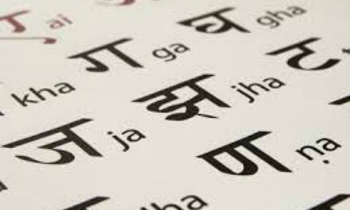
Hindi to be part of foreign languages for Australian pre-schoolers

November 14, 2016

Melbourne, Nov 14: In a bid to promote languages other than English, Australia today announced national rollout of an online programme for pre-schoolers to learn foreign languages, including Hindi, from next year onwards.

HindiThe Early Learning Languages Australia (ELLA) Polyglots applications will help students and their teachers to learn new languages.

According to Minister for Education and Training Simon Birmingham, the government would extend the programme to offer Australian pre-schoolers the opportunity to learn Italian and Spanish in 2017 and Hindi and Modern Greek in 2018.

Birmingham said almost 10,000 children had been part of the USD 9.8 million programme so far, with almost two in three students studying either Chinese or Japanese.

The government has committed an additional USD 5.9 million for the national roll out.

"We know life-long learning begins from the youngest years and our USD 15.7 million investment in the languages app highlights the Turnbull Government's commitment to reviving the study of languages throughout Australia's early education centres, schools and universities," Birmingham said.

"The ELLA programme has been extremely popular with children, parents and educators and it's exciting to see it not only expanded to a national rollout but to also include an additional four languages," he said.

"We live in a globalised world and initiatives like the languages app are vital to supporting our children to take full advantage of the new opportunities our economic transition presents," Birmingham said.

"It is particularly encouraging to see in what many describe as the 'Asian Century' that almost two in three students are studying the vital languages Chinese and Japanese," he added.

The minister said 32 per cent of the 8,540 current students were studying Chinese, 29 per cent Japanese, 24 per cent French, 13 per cent Indonesian and 2 per cent Arabic.

"Seeing and hearing young children counting, following recipes and singing in a language that isn't their native tongue, you understand how engaging this app is and why it has had such positive feedback from kids, educators and families," Birmingham said.

"The Turnbull Government is committed to backing evidence-based programmes, to backing programmes that inspire students, that involve families in learning and that are useful for educators – ELLA ticks all of the boxes, he said.

About half of the children had also displayed interest at home in the culture of the language they were learning.

"As the Asia Education Foundation's Senior Secondary Languages report has shown, the proportion of year 12 students studying another language has dropped from 40 per cent in the 1960s to just 12 per cent today, which is why it's encouraging that Australian children – and parents alike – have taken to the Polyglotsapps with such enthusiasm," he added.

Comments

Add new comment

  • Coastaldigest.com reserves the right to delete or block any comments.
  • Coastaldigset.com is not responsible for its readers’ comments.
  • Comments that are abusive, incendiary or irrelevant are strictly prohibited.
  • Please use a genuine email ID and provide your name to avoid reject.
Agencies
March 14,2020

New Delhi, Mar 14: Excise duty on petrol and diesel was on Saturday hiked by ₹3 per litre as the government looked to mop up gains arising from fall in international oil prices.

Special excise duty on petrol was hiked by ₹2 to ₹8 per litre incase of petrol and to Rs 4 incase of diesel, an official notification said.

Additionally, road cess on petrol was raised by ₹1 per litre each on petrol and diesel to ₹10.

The increase in excise duty would in normal course result in a hike in petrol and diesel prices but most of it would be adjusted against the fall in rates that would have necessitated because of slump in international oil prices.

Comments

Add new comment

  • Coastaldigest.com reserves the right to delete or block any comments.
  • Coastaldigset.com is not responsible for its readers’ comments.
  • Comments that are abusive, incendiary or irrelevant are strictly prohibited.
  • Please use a genuine email ID and provide your name to avoid reject.
Agencies
February 27,2020

Feb 27: With the window to submit comments on India's proposed personal data protection law closing on Tuesday, a period of anxious wait for final version of the Bill started for social media firms.

This comes even as global Internet companies have called on the government for improved transparency related to intermediary Guidelines (Amendment) Rules and allay fears about the prospect of increased surveillance and prompting a fragmentation of the Internet in India that would harm users.

As per the proposed amendments, an intermediary having over 50 lakh users in the country will have to be incorporated in India with a permanent registered office and address.

When required by lawful order, the intermediary shall, within 72 hours of communication, provide such information or assistance as asked for by any government agency or assistance concerning security of the state or cybersecurity.

This means that the government could pull down information provided by platforms such as Wikipedia, potentially hampering its functioning in India.

In the open letter to IT Minister Ravi Shankar Prasad, leading browser and software development platform like Mozilla, Microsoft-owned GitHub and Cloudflare earlier called for improved transparency by allowing the public an opportunity to see a final version of these amendments prior to their enactment.

According to a Business Insider report, Indian users may lose access to Wikipedia if the new intermediary rules for internet and social media companies are approved.

Since the rules would require the website to take down content deemed illegal by the government, it would require Wikipedia to show different content for different countries.

Anusha Alikhan, senior communications director for Wikimedia told Business Insider that the platform is built though languages and not geographies. Therefore, removing content from one country, while it is still visible to other country users may not work for the company’s model.

India is one of Wikipedia’s largest markets. Over 771 million Indian users accessed the site in just November 2019.

Also read: Explained: What is the Personal Data Protection Bill and why you should care

The Personal Data Protection Bill, 2019, which was introduced in Lok Sabha in the winter session last year, was referred to a Joint Parliamentary Committee (JPC) of both the Houses.

The government last month decided to seek views and suggestions on the Bill from individuals and associations and bodies concerned and the last date for submitting the comments was on Tuesday.

Prasad, while introducing the Personal Data Protection Bill, 2019, in the Lok Sabha on December 11, announced that the draft Bill empowers the government to ask companies including Facebook, Google and others for anonymised personal data and non-personal data.

There was a buzz when the Bill's latest version was introduced in the Lok Sabha, especially the provision seeking to allow the use of personal and non-personal data of users in some cases, especially when national security is involved.

Several legal experts red-flagged the issue and said the provision will give the government unaccounted access to personal data of users in the country.

In their submission to the JPC, several organisations also flagged that the power to collect non-personal and anonymised data by the government without notice and consent should not form part of the Bill because of issues regarding effective anonymisation and potential abuse.

"Clauses 35 and 36 of the Bill provide unbridled access to personal data to the Central Government by giving it powers to exempt its agencies from the application of the Bill on the basis of various broad worded grounds," SFLC.in, a New Delhi-based not-for-profit legal services organisation, commented.

The Software Alliance, also known as BSA, a trade group which includes tech giants such as Microsoft, IBM and Adobe, among others said that the current version of the privacy bill pose substantial challenges, including the sweeping new powers for the government to acquire non-personal data, restrictions on data transfers, and local storage requirements.

"We urge the Joint Parliamentary Committee, as it considers revisions to the Bill, to eliminate provisions concerning non-personal data from the Personal Data Protection Bill and to remove the data localisation requirements and restrictions on international data flows," said Venkatesh Krishnamoorthy, Country Manager-India, BSA.

The Personal Data Protection (PDP) Bill, 2019 draws its origins from the Justice B.N. Srikrishna Committee on data privacy, which produced a draft of legislation that was made public in 2018 ("the Srikrishna Bill").

The mandatory requirement for storing a mirror copy of all personal data in India as per Section 40 of the Srikrishna Bill has been done away with in the PDP Bill, 2019, meaning that companies like Facebook and Twitter would be able to store data of Indian users abroad if they so wish.

But the bill prohibits processing of sensitive personal data and critical personal data outside India.

What is more, what constitutes critical data has not been clearly defined.

As per the proposals, social media companies will have to modify their application as they are required to have a system in place by which a user can verify themselves.

So legal experts believe that some system to upload identification documents should be there and something like the Twitter blue tick mark should be there to identify verified accounts.

"The 2019 Bill introduces a new category of data fiduciaries called social media intermediaries ('SMIs'). SMIs are a subcategory of significant data fiduciaries ('SDFs') and will be notified by the Central government after due consultation with the DPA, or the Data Protection Authority. Clause 26(4) of the Bill defines SMIs as intermediaries who primarily or solely enable online interaction between two or more users," SFLC.in said.

"On a plain reading of the definition, online platforms like Facebook, Twitter, YouTube, TikTok, ShareChat and WhatsApp are likely to be notified as SMIs under the Bill," it added.


Comments

Add new comment

  • Coastaldigest.com reserves the right to delete or block any comments.
  • Coastaldigset.com is not responsible for its readers’ comments.
  • Comments that are abusive, incendiary or irrelevant are strictly prohibited.
  • Please use a genuine email ID and provide your name to avoid reject.
News Network
February 5,2020

Feb 5: Tesla is making Elon Musk a lot richer without paying him a dime.

A blistering stock rally has bolstered the value of CEO Musk's 19% stake in the electric car maker by $16 billion since the start of 2020, to $30 billion.

Tuesday's steep climb in the share price could sweeten Musk's payday under his record-breaking compensation package, which is built on stock options that rely on market value targets. Two milestones have now been achieved that could see Musk unlock options worth $1.8 billion.

The controversial chief executive, who is also the majority owner and CEO of rocket maker SpaceX, recently testified that he did not have a lot of cash as he successfully defended himself in a defamation lawsuit. He previously has taken loans using his Tesla shares as collateral.

Musk does not take a salary, choosing instead a risky options package that envisions the stock market value of Tesla rising to $650 billion over 10 years, a prospect that was derided by some investors when the deal was announced in 2018.

That target now looks less crazy. Shares of Tesla have rallied over 50% since the company posted its second consecutive quarterly profit last Wednesday, which was viewed as a major accomplishment for a company competing against established automotive heavyweights including General Motors Co  and BMW.

Tesla shares have climbed about 400% since early June, helped by the company's better-than-expected financial results and ramped-up production at its new car factory in Shanghai.

On Tuesday, Tesla surged as much as 24% before falling back in the final minutes of the trading session to end the day up 13.7%. That put its market capitalization at $160 billion, almost twice the combined value of Ford Motor and General Motors.

The shares had also rallied on Monday, partly fueled by Panasonic Corp's 6752.T saying its automotive battery venture with Tesla was profitable for the first time.

The options Musk was awarded in 2018 vest incrementally based on targets for Tesla's stock market value and its financial performance. The market capitalization would have to sustainably rise by $50 billion increments over the agreement's 10-year period, with the full package payout reached if the market cap reaches $650 billion, as well as the company's meeting revenue and profit targets.

Musk is on his way to seeing his first two tranches of options vest. He achieved operational targets on revenue and adjusted earnings last year.

The rise in Tesla's market capitalization last month to a target of $100 billion opened the way for Musk's first tranche of options to vest. With Tuesday's surging share price, the market capitalization blew past the second target of $150 billion, opening the way for the second tranche to vest. Tesla's market capitalization must stay at or above each target level for one- and six-month averages for each set of options to vest.

Tesla was valued at about $52 billion when shareholders approved the pay package in March 2018, a time when the company faced a cash crunch, production delays and increasing competition from rivals.

A full payoff for Musk would surpass anything previously granted to U.S. executives, according to Institutional Shareholder Services, a proxy advisor that recommended investors reject the pay package deal at the time.

Musk currently owns about 34 million Tesla shares, and his compensation package would let him buy another 20.3 million shares if all his options tranches vest.

When Tesla unveiled Musk’s package, it said he could in theory reap as much as $55.8 billion if no new shares were issued. However, Tesla has since awarded stock to employees and last year sold $2.7 billion in shares and convertible bonds, diluting the value of the stock.

Musk has transformed Tesla from a niche car maker with production problems into the global leader in electric vehicles, with U.S. and Chinese factories. So far it has stayed ahead of more established rivals including BMW and Volkswagen.

Many investors remain skeptical that Tesla can consistently deliver profit, cash flow and growth. More Wall Street analysts rate Tesla "sell" than "buy," and the company's stock is the most shorted on Wall Street.

Comments

Add new comment

  • Coastaldigest.com reserves the right to delete or block any comments.
  • Coastaldigset.com is not responsible for its readers’ comments.
  • Comments that are abusive, incendiary or irrelevant are strictly prohibited.
  • Please use a genuine email ID and provide your name to avoid reject.