



Historic Gandhi statue unveiled at Britain's Parliament Square

March 14, 2015

London, Mar 14: A historic bronze statue of Mahatma Gandhi was unveiled today at the Parliament Square here, standing adjacent to iconic leaders like Britain's war-time Prime Minister Winston Churchill and anti-apartheid icon Nelson Mandela.

A galaxy of political leaders led by British Prime Minister David Cameron and Finance Minister Arun Jaitley were joined by Bollywood legend Amitabh Bachchan and the Mahatma Gandhi's grandson Gopalkrishna Gandhi at the ceremony to unveil the 9-foot statue of India's Father of the Nation.
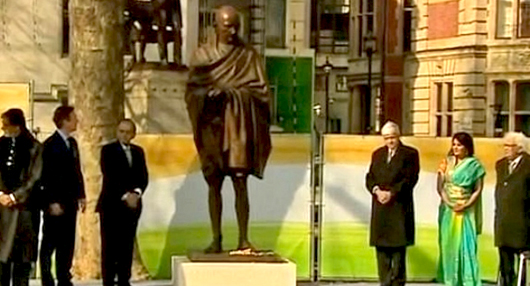
Historic Gandhi

Gandhi is the first Indian and the only person never to have been in a public office to be honoured with a statue at the Square.

The statue was unveiled jointly by Cameron and Jaitley as chants of "Raghupati Raghav Raja Ram", a popular bhajan that was Gandhi's favourite, reverberated in the air.

"This statue is a magnificent tribute to one of the most towering figures in the history of world politics and by putting Mahatma Gandhi in this famous Square we are giving him an eternal home in our country," said Cameron.

Quoting some of Gandhi's famous words, Cameron highlighted how his teachings remain as potent today.

"This statue celebrates the incredibly special friendship between the world's oldest democracy and its largest, as well as the universal power of Gandhi's message," Cameron said.

"Our ties with India have remained close throughout history and continue to go from strength to strength –- through mutual respect as equals, cooperation and trade, and of course through the one-and-a-half million Indians who do so much to make Britain the country it is today, bringing our two countries closer, to the benefit of both," he said.

Jaitley, invited to the UK especially for the unveiling, said the statue was a tribute to the British sense of civility that they now choose to honour someone who was conventionally regarded as their adversary.

"It is a great tribute to both British liberalism and British democracy that they have now chosen Gandhi to share what is the most prominent public space in this country. It is a great day when two adversaries and contrarian viewpoints converge to appreciate each other," Jaitley said.

"The statue will help ensure that the legacy of Gandhi lives on for future generations. It also marks an important, historic moment celebrating the strong bond between our two nations. India and the UK share the same values and we are a partnership of equals. This lasting friendship is just one of many legacies left by Gandhi, which I am keen that we work hard to strengthen further," he said.

His words were echoed by UK Treasury minister and Indian Diaspora Champion Priti Patel, who said: "Gandhiji was a man who became a great agitator of the British government back then. We have now got him coming to Parliament Square in front of the mother of all Parliaments. It is incredibly symbolic."

The sculptor, Philip Jackson, described his creation as an important symbol in the global fight against terror.

"We live in an age where terrorism and acts of random violence are used in an attempt to effect change. Gandhi's sculpture reminds us all that great change can be achieved peacefully and without violence," said the well-known British figurative artist.

Mahatma Gandhi's statue now stands exactly opposite Britain's Houses of Parliament in the Palace of Westminster with Churchill for company, an irony given the British ex-premier's dismissive thoughts of someone he described as a "half naked fakir".

It depicts the leader of the Indian national movement wrapped up in a shawl to shield himself from the London cold during his last visit to the British capital in 1931.

NRI economist and founder of the Gandhi Statue Memorial Trust, Lord Meghnad Desai, described the unveiling as "great occasion for India, UK and the world."

"Gandhi belongs to the whole world but has now found a home in the centre of London, a city which he loved. Let everyone come from everywhere and see for themselves Gandhi in Parliament Square in London," he told PTI.

Lady Kishwar Desai, a Trustee behind the 1-million pound global fund-raising efforts for the statue, said, "To have a permanent memory of Mahatma Gandhi in front of the British Parliament is something every Indian and British-Asian would have wished for."

The move to install Gandhi's statue was announced during an official UK ministerial visit last year and donors have included leading Indian-origin businessmen like steel tycoon Lakshmi N Mittal, Infosys co-founder Narayana Murthy and his family and Bajaj Auto chief Rahul Bajaj.

The sculpture is aimed as a focal point for commemoration of the 100th anniversary of Gandhi's return to India from South Africa to start India's struggle for freedom, as well as the passing of 70 years since his death in 2018, and the 150th anniversary of his birth in 2019.

Comments

Add new comment

  • Coastaldigest.com reserves the right to delete or block any comments.
  • Coastaldigset.com is not responsible for its readers’ comments.
  • Comments that are abusive, incendiary or irrelevant are strictly prohibited.
  • Please use a genuine email ID and provide your name to avoid reject.
News Network
May 19,2020

May 19: A Chinese laboratory has been developing a drug it believes has the power to bring the coronavirus pandemic to a halt.

The outbreak first emerged in China late last year before spreading across the world, prompting an international race to find treatments and vaccines.

A drug being tested by scientists at China's prestigious Peking University could not only shorten the recovery time for those infected, but even offer short-term immunity from the virus, researchers say.

Sunney Xie, director of the university's Beijing Advanced Innovation Center for Genomics, told AFP that the drug has been successful at the animal testing stage.

"When we injected neutralising antibodies into infected mice, after five days the viral load was reduced by a factor of 2,500," said Xie.

"That means this potential drug has (a) therapeutic effect."

The drug uses neutralising antibodies -- produced by the human immune system to prevent the virus infecting cells -- which Xie's team isolated from the blood of 60 recovered patients.

A study on the team's research, published Sunday in the scientific journal Cell, suggests that using the antibodies provides a potential "cure" for the disease and shortens recovery time.

Xie said his team had been working "day and night" searching for the antibody.

"Our expertise is single-cell genomics rather than immunology or virology. When we realised that the single-cell genomic approach can effectively find the neutralising antibody we were thrilled."

He added that the drug should be ready for use later this year and in time for any potential winter outbreak of the virus, which has infected 4.8 million people around the world and killed more than 315,000.

"Planning for the clinical trial is underway," said Xie, adding it will be carried out in Australia and other countries since cases have dwindled in China, offering fewer human guinea pigs for testing.

"The hope is these neutralised antibodies can become a specialised drug that would stop the pandemic," he said.

China already has five potential coronavirus vaccines at the human trial stage, a health official said last week.

But the World Health Organization has warned that developing a vaccine could take 12 to 18 months.

Scientists have also pointed to the potential benefits of plasma -- a blood fluid -- from recovered individuals who have developed antibodies to the virus enabling the body's defences to attack it.

More than 700 patients have received plasma therapy in China, a process which authorities said showed "very good therapeutic effects".

"However, it (plasma) is limited in supply," Xie said, noting that the 14 neutralising antibodies used in their drug could be put into mass production quickly.

Using antibodies in drug treatments is not a new approach, and it has been successful in treating several other viruses such as HIV, Ebola and Middle East Respiratory Syndrome (MERS).

Xie said his researchers had "an early start" since the outbreak started in China before spreading to other countries.

Ebola drug Remdesivir was considered a hopeful early treatment for COVID-19 -- clinical trials in the US showed it shortened the recovery time in some patients by a third -- but the difference in mortality rate was not significant.

The new drug could even offer short-term protection against the virus.

The study showed that if the neutralising antibody was injected before the mice were infected with the virus, the mice stayed free of infection and no virus was detected.

This may offer temporary protection for medical workers for a few weeks, which Xie said they are hoping to "extend to a few months".

More than 100 vaccines for COVID-19 are in the works globally, but as the process of vaccine development is more demanding, Xie is hoping that the new drug could be a faster and more efficient way to stop the global march of the coronavirus.

"We would be able to stop the pandemic with an effective drug, even without a vaccine," he said.

Comments

Add new comment

  • Coastaldigest.com reserves the right to delete or block any comments.
  • Coastaldigset.com is not responsible for its readers’ comments.
  • Comments that are abusive, incendiary or irrelevant are strictly prohibited.
  • Please use a genuine email ID and provide your name to avoid reject.
Agencies
February 4,2020

As the deadly coronavirus has spread worldwide, it has carried with it xenophobia -- and Asian communities around the world are finding themselves subject to suspicion and fear.

When a patient on Australia's Gold Coast refused to shake the hand of her surgeon Rhea Liang, citing the virus that has killed hundreds, the medic's first response was shock.

But after tweeting about the incident and receiving a flood of responses, the respected doctor learned her experience was all too common.

There has been a spike in reports of anti-Chinese rhetoric directed at people of Asian origin, regardless of whether they have ever visited the centre of the epidemic or been in contact with the virus.

Chinese tourists have reportedly been spat at in the Italian city of Venice, a family in Turin was accused of carrying the disease, and mothers in Milan have used social media to call for children to be kept away from Chinese classmates.

In Canada, a white man was filmed telling a Chinese-Canadian woman "you dropped your coronavirus" in the parking lot of a local mall.

In Malaysia, a petition to "bar Chinese people from entering our beloved country" received almost 500,000 signatures in one week.

The incidents are part of what the Australasian College for Emergency Medicine has described as "misinformation" which it says is fuelling "racial profiling" where "deeply distressing assumptions are being made about 'Chinese' or 'Asian-looking' people." Disease has long been accompanied by suspicions of foreigners -- from Irish immigrants being targeted in the Typhoid Mary panic of 1900s America to Nepali peacekeepers being accused of bringing cholera to earthquake-struck Haiti in the last decade.

"It's a common phenomenon," said Rob Grenfell, director of health and biosecurity for Australia's science and research agency CSIRO.

"With outbreaks and epidemics along human history, we've always tried to vilify certain subsets of the population," he said, comparing the behaviour to 1300s plague-ridden medieval Europe, where foreigners and religious groups were often blamed.

"Sure it emerged in China," he said of the coronavirus, "but that's no reason to actually vilify Chinese people." In a commentary for the British Medical Journal, doctor Abraar Karan warned this behaviour could discourage people with symptoms from coming forward.

Claire Hooker, a health lecturer at the University of Sydney, said the responses from governments may have compounded prejudice.

The World Health Organisation has warned against "measures that unnecessarily interfere with international travel and trade", but this has not stopped scores of countries from introducing travel bans.

The tiny Pacific nation of Micronesia has banned its citizens from visiting mainland China altogether.

"Travel bans respond largely to people's fears," said Hooker, and while sometimes warranted, they often "have the effect of cementing an association between Chinese people and scary viruses".

Abbey Shi, a Shanghai-born student in Sydney, said the attitude shown by some of her peers has "become almost an attack on students who are Chinese".

While Australia's conservative government has banished its citizens returning from Wuhan -- the central Chinese city at the epicentre of the virus -- to a remote island for quarantine, thousands of students still stuck in China risk their studies being torpedoed.

"Right now it looks like they have to miss the semester's start and potentially the whole year, because of the way the courses are set up," Shi said.

According to Hooker, studies in Toronto on the impact of Severe Acute Respiratory Syndrome, or SARS -- another global coronavirus outbreak in 2002 -- showed the impact of xenophobic sentiment often lasted much longer than the public health scare.

"While there may be a cessation of direct forms of racism as news about the disease dies down, it takes quite a bit of time for economic recovery and people continue to feel unsafe," she said.

People may not rush back to Chinese businesses or restaurants, and may even heed some of the more outlandish viral social media disinformation -- such as one popular post imploring people to avoid eating noodles for their own safety.

"In one sense you might think the effects lasted from the last coronavirus to this one because the representation as China being a place where diseases come from has been persistent," Hooker said.

Comments

Add new comment

  • Coastaldigest.com reserves the right to delete or block any comments.
  • Coastaldigset.com is not responsible for its readers’ comments.
  • Comments that are abusive, incendiary or irrelevant are strictly prohibited.
  • Please use a genuine email ID and provide your name to avoid reject.
News Network
June 3,2020

Washington, Jun 3: US President Donald Trump's administration on Tuesday announced investigations into foreign digital services taxes it says are aimed squarely at American tech firms.

Following a similar trade investigation against France last year, the US Trade Representative office now is looking into taxes in Britain and the European Union, as well as Indonesia, Turkey and India.

"President Trump is concerned that many of our trading partners are adopting tax schemes designed to unfairly target our companies," USTR Robert Lighthizer said in a statement.

"We are prepared to take all appropriate action to defend our businesses and workers against any such discrimination."

Washington opposes the efforts to tax revenues from online sales and advertising, saying they single out US tech giants like Google, Apple, Facebook, Amazon and Netflix.

The US and France have agreed to negotiate till the end of the year over a digital services tax Paris approved in 2019, after USTR found them to be discriminating and threatened retaliatory duties of up to 100 percent on French imports such as champagne and camembert cheese.

Trump has embroiled the US in numerous trade disputes since taking office in 2017, including a months-long trade war with China that cooled with the signing of a partial deal in January.

Comments

Add new comment

  • Coastaldigest.com reserves the right to delete or block any comments.
  • Coastaldigset.com is not responsible for its readers’ comments.
  • Comments that are abusive, incendiary or irrelevant are strictly prohibited.
  • Please use a genuine email ID and provide your name to avoid reject.