



Hitting campuses Left and Right

March 5, 2017

Mar, 5: An eternal rebel always hides in a student's mind. They believe, as French philosopher Albert Camus wrote 66-years ago in The Rebel: An Essay on Man in Revolt, “to remain silent is to give the impression that one has no opinions, that one wants nothing, and in certain cases it really amounts to wanting nothing”.daugh
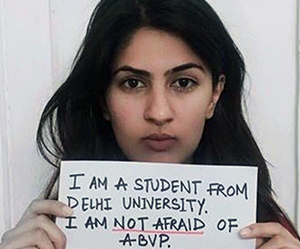
And Indian students do not want to remain bullied, scared or imprisoned to silence any more. What do they face? An insensitive police, an unimaginative political leadership of post-truth era, a restrictive society that wants to decide what will they wear and whom will they fall in love with. The rebel in the student is not willing to take it lying down and campuses are on fire again. Delhi University is the latest to be added to the list, as the Sangh-backed Akhil Bharatiya Vidyarti Parishat (ABVP) is at loggerheads with their opponents.

If Rohith Vemula stood up and was later silenced into suicide last year, Kanhaiya Kumar, Umar Khalid and Shehla Rashid rose to fill the gap. Now, 20-year-old Gurmeher Kaur has become the rallying point after she used just 25 words to oppose the ABVP whom several have accused of indulging in violence. The trigger was an invitation to Khalid, who was in the eye of a storm over a function on Parliament attack convict Afzal Guru to a seminar – 'Culture of Protests' in Delhi's Ramjas College.

Some say the fight is for controlling university campuses where the Right-wing has not had much hold. They cite protests and resistance that have been triggered in Hyderabad Central University (HCU), IIT-Madras, Jawaharlal Nehru University (JNU), Film and Television Institute of India (FTII) and elsewhere since the Narendra Modi government came to power in 2014. The campus has turned into a laboratory to test whether students are patriotic enough and not whether they have assimilated critical thinking ability.

The university campuses have not made headlines for some months now, but the lull was broken on February 21 in Ramjas College where the seminar was organised by the English Department. Violence broke out in the campus and the hands-tied police added fuel to the fire through its inaction. The ABVP made the invitation to Khalid a contentious issue. After ABVP-controlled DU Students Union (DUSU) raised objections about Khalid's presence and the police said they cannot assure protection, the invitation was recalled.

The seminar was held without Khalid but all was not over. The ABVP activists continued the protest which later turned violent as they pelted stones and bottles at students and teachers who took out a silent march to protest against the Sangh outfit. The ABVP's point was that they would not allow “anti-nationals” to propagate their views. The two-day seminar was called off. Had the violence been nipped in the bud, it would not have spiralled into a wider protest.

The next day, Delhi University's North Campus was tense and police were deployed. Students, including those belonging to the Left-affiliated All India Students Association (AISA), wanted to take out a march from Ramjas, but ABVP activists had other ideas. They blocked the entry and exit points and targeted students. Clashes broke out between both groups of students. An assistant professor had to be taken out in an ambulance.

Later, students went out to protest as police formed a human chain. Still they were attacked, and the police suddenly decided to clear the area and resorted to caning the students. Journalists, too, had to bear the police fury. Some of them removed their nameplates, punched and kicked protesting students and mediapersons who were covering the incident. An inspector was heard lamenting to a journalist later that his juniors did not listen and targeted students.

Partisan police

The police were accused of partisan behaviour. An FIR was filed on the basis of the ABVP complaint of raising “anti-national” slogans, which included demands for “azadi” for Kashmir and naxal-affected Bastar. But complaints from the other side were not turned into cases, students allege. The police did not take proactive steps to defuse the tension or ensure security of students, rather they beat them up. Girls were physically targeted by the police and some section of the students.

The police van stationed outside Ramjas became a platform for ABVP activists to pelt stones at their opponents. The police are supposed to uphold Constitution and not just law and order. It is their duty to ensure that freedom of expression, a vital right ensured in the Constitution, is protected. An imagined fear should not be the reason for restricting someone from speaking his mind.

One of the highlights of the protests came on February 24 when Gurmeher, a BA English Honours student at Lady Shri Ram College and the daughter of a martyred soldier, tweeted her photo with a poster, which read, “I am a student of Delhi University. I am not afraid of ABVP. I am not alone. Every student of India is with me. #StudentsAgainstABVP.” It struck a chord with many students.

But Gurmeher had to face more. Someone dug out an anti-war video made by her a year ago in which she says “Pakistan did not kill her father, but war did”. Some chose to twist the message or refused to understand what she meant. The troll machinery was on a roll and rape threats were issued online. Not just students or BJP supporters but Union ministers and senior BJP leaders and sportspersons jumped on to troll her and give her unsolicited advice on nationalism and how she was influenced by the “Leftists”.

Whether it was Minister of State for Home Kiren Rijiju or senior ministers like M Venkaiah Naidu, all waded into the controversy abandoning nuance. Campuses were once again pictured as den of criminals and anti-nationals while issuing warnings that no subversive action would be allowed. Curiously, all these comments were made while not a word was said against the country as they believe. Khalid had a point when he said ABVP indulged in violence though he did not participate and their problem is with dissent in democracy.

If a country fears a student with an independent mind, the problem is not with the student. As President Pranab Mukherjee said in Kochi recently, these temples of learning must “resound with creativity and free thinking” and those in universities must “engage in reasoned discussion and debate rather than propagate a culture of unrest”. It is important that our campuses do not slide into such an abyss.

Comments

Add new comment

  • Coastaldigest.com reserves the right to delete or block any comments.
  • Coastaldigset.com is not responsible for its readers’ comments.
  • Comments that are abusive, incendiary or irrelevant are strictly prohibited.
  • Please use a genuine email ID and provide your name to avoid reject.
Agencies
July 9,2020

Twitter has hinted that it is planning a paid subscription platform that can be reused by other teams in the future.

The news that the micro-blogging platform is building a subscription platform with a team codenamed "Gryphon" resulted in Twitter stock rising over 8% on Wednesday.

Twitter revealed its plan via a job listing that seeks a full-stack senior software engineer in New York to join "Gryphon".

Interestingly, Twitter "edited" the job listing once the news broke, removing the part about "Gryphon" and any mention of their internal team or their subscription feature. The listing said the company is looking for an Android engineer to "work on a bevy of backend engineering teams to build components that allow for experimentation to deliver the best experience possible to all of our users".

Later, Twitter users noticed that the company restored the earlier job listing that mentioned the upcoming subscription platform and "Gryphon".

A spokesperson for Twitter told CNN on Wednesday that it's only a job posting, not a product announcement.

This is not the first time Twitter has thought of a paid product. 

In 2017, it sent out a survey to users and a preview of what a premium offering of its TweetDeck app might look like, including breaking news alerts and more analytics, according to The Verge.

"We're conducting this survey to assess the interest in a new, more enhanced version of Tweetdeck. We regularly conduct user research to gather feedback about people's Twitter experience and to better inform our product investment decisions, and we're exploring several ways to make TweetDeck even more valuable for professionals," a Twitter spokesperson had said at that time.

Comments

Add new comment

  • Coastaldigest.com reserves the right to delete or block any comments.
  • Coastaldigset.com is not responsible for its readers’ comments.
  • Comments that are abusive, incendiary or irrelevant are strictly prohibited.
  • Please use a genuine email ID and provide your name to avoid reject.
Agencies
January 19,2020

New Delhi, Jan 19: Messaging service WhatsApp which on Sunday faced issues in transmitting multimedia content including pictures and images, prompting social media users to share hilarious memes and messages, resumed regular services after over two hours.

#WhatsAppDown was the trending hashtag on Twitter for most part of Sunday afternoon in India along with several other countries such as Brazil, Europe and also parts of Middle-East including UAE, reported downdetector.in, a realtime problem and outage monitoring website.

Users of the popular messaging app were unable to send media files, stickers and GIFs.

Most users immediately went to Twitter to find out about the problem and check if others were facing the same issue.

Numerous tweets and memes took over the internet as soon as the news broke about the WhatsApp tech issue. After around two hours of technical glitch, the app resumed full service.

Even after full recovery of media transfer, people globally still continued checking the status of the messaging app.

WhatsApp has been one of the prime messaging apps since May 2009 and has recently collaborated with Facebook.

Comments

Add new comment

  • Coastaldigest.com reserves the right to delete or block any comments.
  • Coastaldigset.com is not responsible for its readers’ comments.
  • Comments that are abusive, incendiary or irrelevant are strictly prohibited.
  • Please use a genuine email ID and provide your name to avoid reject.
News Network
April 17,2020

Paris, Apr 17: Even as virologists zero in on the virus that causes COVID-19, a very basic question remains unanswered: do those who recover from the disease have immunity?

There is no clear answer to this question, experts say, even if many have assumed that contracting the potentially deadly disease confers immunity, at least for a while.

"Being immunised means that you have developed an immune response against a virus such that you can repulse it," explained Eric Vivier, a professor of immunology in the public hospital system in Marseilles.

"Our immune systems remember, which normally prevents you from being infected by the same virus later on."

For some viral diseases such a measles, overcoming the sickness confers immunity for life.

But for RNA-based viruses such as Sars-Cov-2 -- the scientific name for the bug that causes the COVID-19 disease -- it takes about three weeks to build up a sufficient quantity of antibodies, and even then they may provide protection for only a few months, Vivier told AFP.

At least that is the theory. In reality, the new coronavirus has thrown up one surprise after another, to the point where virologists and epidemiologists are sure of very little.

"We do not have the answers to that -- it's an unknown," Michael Ryan, executive director of the World Health Organization's Emergencies Programme said in a press conference this week when asked how long a recovered COVID-19 patient would have immunity.

"We would expect that to be a reasonable period of protection, but it is very difficult to say with a new virus -- we can only extrapolate from other coronaviruses, and even that data is quite limited."

For SARS, which killed about 800 people across the world in 2002 and 2003, recovered patients remained protected "for about three years, on average," Francois Balloux director of the Genetics Institute at University College London, said.

"One can certainly get reinfected, but after how much time? We'll only know retroactively."

A recent study from China that has not gone through peer review reported on rhesus monkeys that recovered from Sars-Cov-2 and did not get reinfected when exposed once again to the virus.

"But that doesn't really reveal anything," said Pasteur Institute researcher Frederic Tangy, noting that the experiment unfolded over only a month.

Indeed,several cases from South Korea -- one of the first countries hit by the new coronavirus -- found that patients who recovered from COVID-19 later tested positive for the virus.

But there are several ways to explain that outcome, scientists cautioned.

While it is not impossible that these individuals became infected a second time, there is little evidence this is what happened.

More likely, said Balloux, is that the virus never completely disappeared in the first place and remains -- dormant and asymptomatic -- as a "chronic infection", like herpes.

As tests for live virus and antibodies have not yet been perfected, it is also possible that these patients at some point tested "false negative" when in fact they had not rid themselves of the pathogen.

"That suggests that people remain infected for a long time -- several weeks," Balloux added. "That is not ideal."

Another pre-publication study that looked at 175 recovered patients in Shanghai showed different concentrations of protective antibodies 10 to 15 days after the onset of symptoms.

"But whether that antibody response actually means immunity is a separate question," commented Maria Van Kerhove, Technical Lead of the WHO Emergencies Programme.

"That's something we really need to better understand -- what does that antibody response look like in terms of immunity."

Indeed, a host of questions remain.

"We are at the stage of asking whether someone who has overcome COVID-19 is really that protected," said Jean-Francois Delfraissy, president of France's official science advisory board.

For Tangy, an even grimmer reality cannot be excluded.

"It is possible that the antibodies that someone develops against the virus could actually increase the risk of the disease becoming worse," he said, noting that the most serious symptoms come later, after the patient had formed antibodies.

For the moment, it is also unclear whose antibodies are more potent in beating back the disease: someone who nearly died, or someone with only light symptoms or even no symptoms at all. And does age make a difference?

Faced with all these uncertainties, some experts have doubts about the wisdom of persuing a "herd immunity" strategy such that the virus -- unable to find new victims -- peters out by itself when a majority of the population is immune.

"The only real solution for now is a vaccine," Archie Clements, a professor at Curtin University in Perth Australia, told AFP.

At the same time, laboratories are developing a slew of antibody tests to see what proportion of the population in different countries and regions have been contaminated.

Such an approach has been favoured in Britain and Finland, while in Germany some experts have floated the idea of an "immunity passport" that would allow people to go back to work.

"It's too premature at this point," said Saad Omer, a professor of infectious diseases at the Yale School of Medicine.

"We should be able to get clearer data very quickly -- in a couple of months -- when there will be reliable antibody tests with sensitivity and specificity."

One concern is "false positives" caused by the tests detecting antibodies unrelated to COVID-19.

The idea of immunity passports or certificates also raises ethical questions, researchers say.

"People who absolutely need to work -- to feed their families, for example -- could try to get infected," Balloux.

Comments

Add new comment

  • Coastaldigest.com reserves the right to delete or block any comments.
  • Coastaldigset.com is not responsible for its readers’ comments.
  • Comments that are abusive, incendiary or irrelevant are strictly prohibited.
  • Please use a genuine email ID and provide your name to avoid reject.