



HRD Minister turns down demands to make Sanskrit compulsory

November 23, 2014

New Delhi, Nov 23: Taking on her critics, Human Resource Development (HRD) Minister Smriti Irani today dismissed charges that education was being saffronised even as she turned down demands that Sanskrit be made compulsory in the curriculum.SMRITI irani
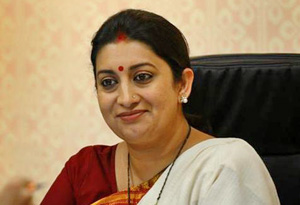
"Those who accuse me of being a RSS mascot or RSS representative possibly want to deflect the attention from the good work that we have done... this agenda will be flagged and I will be whipped for as long as there is a need to keep attention diverted away from the good work. I am ready for it. I have no problem," she told journalists at the agency headquarters here.

Answering questions on the controversial decision to replace German with Sanskrit as the third language in some 500 Centrally-run Kendriya Vidyalayas, Irani said that teaching of German under an MoU signed in 2011 had been in violation of the Constitution. An investigation has already been launched to find out how the MoU came to be signed.

Responding to demands that Sanskrit be made a compulsory language, the minister said that the three language formula was very clear that any of the 23 Indian languages listed in Schedule 8 of the Constitution could be opted for.

But she reiterated that German will continue to be taught as a foreign language.

"...we are teaching French, we are teaching Mandarin, we teach German in the same way. For the life in me, I can't understand why people are not understanding what I am saying," she said.

Irani had earlier strongly defended the decision to replace German with Sanskrit as the third language, saying the existing arrangement was in violation of the Constitution.

Dismissing charges that efforts were being made to saffronise education, the Minister said she has never tried to explain herself on the "basis of secularism with respect to saffronisation in terms of education" while citing examples of choosing heads of institutions irrespective of their religion.

Irani said while rolling back the Four Year Undergraduate Programme of Delhi University, she never had in mind which region or religion they (the students) had come from.

In this context, she defended the decision to roll back the programme, saying the degrees offered had no "legal sanction".

"My endeavour is whatever I do should be done so that it is within law and favours the students", she asserted while rejecting the notion that education is being politicised in the country.

Talking about the moves to have a new national education policy, the deliberation of which would start next year, she said the exercise would be exhaustive in nature and involve all stakeholders, besides academicians and experts, who are directly impacted by it.

"For the first time, in the history of our nation, an initiative will be undertaken where the citizen will also be engaged on this policy because education policy when we arrive upon it will have an impact for generations.

"So to ensure that those who will be impacted most also considered in terms of their views...something which I am currently structuring within the Ministry", she said.

A methodology is being prepared wherein the stakeholders apart from private sector, academicians, institutional experts and policy experts could also be engaged in drafting the policy.

It will be deliberated upon in the Ministry and in Central Advisory Board of Education (CABE) which is the highest decision-making body on education in the country.

Irani said that during her interaction with students and parents the views that came forth were that they wanted more updated information about the syllabus and variety in choice of courses.

"They want to pick up some option, which are applicable and viable now, but also some options, which will prepare them for the future.

Asked about the demands for re-introduction of Class X board examinations, Irani merely said that the decision has to be take by CABE.

"The big policy decision will be taken on the platform like CABE and taken in conjunction with the states.

When her attention was drawn to fleecing of students by institutes whose degrees were not recognised, the Minister said that she will soon hold a special meeting to see what can be done.

"If there is belligerent violation, then I will explore what are the possibilities that a regulator can undertake," she said and quoted the Prime Minister that, "There is no shortage of law, but there was lack of implementation".

Queried about criticisms that none of the Indian universities find a place among the top 100 institutions in the world, she pointed that ranking agencies have their own parameters for evaluation.

Irani further asserted that India will have its own ranking system in place soon.

"In India we are actually evolving a ranking system for our institutions. Vice Chancellors, IIT Directors and everybody are sitting together to tell us how to rank ourselves," she said.

Allaying apprehensions that new IITs and IIMs would erode the brand of the existing elite institutions, Irani said, "We are ensuring enhancement of capacities and capabilities of our faculty and other resource besides infrastructure in IITs and IIMs."

Comments

Add new comment

  • Coastaldigest.com reserves the right to delete or block any comments.
  • Coastaldigset.com is not responsible for its readers’ comments.
  • Comments that are abusive, incendiary or irrelevant are strictly prohibited.
  • Please use a genuine email ID and provide your name to avoid reject.
News Network
January 10,2020

New Delhi, Jan 10: One woman reported a rape every 15 minutes on average in India in 2018, according to government data released on Thursday, underlining its dismal reputation as one of the worst places in the world to be female.

The highly publicised gang rape and murder of a woman in a bus in New Delhi in 2012 brought tens of thousands onto the streets across India and spurred demands for action from film stars and politicians, leading to harsher punishments and new fast-track courts. But the violence has continued unabated.

Women reported almost 34,000 rapes in 2018, barely changed from the year before. Just over 85% led to charges, and 27% to convictions, according to the annual crime report released by the Ministry of Home Affairs.

Women's rights groups say crimes against women are often taken less seriously, and investigated by police lacking insensitivity.

"The country is still run by men, one (female prime minister) Indira Gandhi is not going to change things. Most judges are still men," said Lalitha Kumaramangalam, former chief of the National Commission for Women.

"There are very few forensic labs in the country, and fast-track courts have very few judges," said Kumaramangalam, a member of Prime Minister Narendra Modi's Bharatiya Janata Party (BJP).

The rape of a teenager in 2017 by former BJP state legislator Kuldeep Singh Sengar gained national attention when the accuser tried to kill herself the following year, accusing the police of inaction.

Five months before Sengar was convicted last December, the accuser's family had to be provided with security after a truck crashed into the car she was in, injuring her and killing two of her relatives.

A 2015 study by the Centre for Law & Policy Research in Bengaluru found that fast-track courts were indeed quicker, but did not handle a high volume of cases.

And a study in 2016 by Partners for Law in Development in New Delhi found that they still took an average of 8.5 months per case - more than four times the recommended period.

The government statistics understate the number of rapes as it is still considered a taboo to report rape in some parts of India and because rapes that end in the murder are counted purely as murders.

Comments

Add new comment

  • Coastaldigest.com reserves the right to delete or block any comments.
  • Coastaldigset.com is not responsible for its readers’ comments.
  • Comments that are abusive, incendiary or irrelevant are strictly prohibited.
  • Please use a genuine email ID and provide your name to avoid reject.
News Network
January 18,2020

New Delhi, Jan 18: Lieutenant Governor (LG) Anil Baijal has granted the power of detaining authority to the Delhi Police Commissioner under the National Security Act (NSA), according to a notification. The NSA allows preventive detention of an individual for months if the authorities feel that the individual is a threat to the national security, and law and order, sources said.

In exercise of the powers conferred by sub-section (3) of section 3, read with clause (c) of Section 2 of the National Security Act, 1980, the Lt Governor is pleased to direct that during the period January 19 to April 18, the Delhi Police Commissioner may also exercise the powers of detaining authority under sub-section (2) of the section 3 of the aforesaid Act, the notification stated.

The notification has been issued on January 10 following the approval of the LG.

It comes at a time when the national capital has been witnessing a number of protests against the Citizenship Amendment Act (CAA) and the National Register of Citizens (NRC).

However, the Delhi Police said it is a routine order that has been issued in every quarter and has nothing to do with the current situation.

Comments

Add new comment

  • Coastaldigest.com reserves the right to delete or block any comments.
  • Coastaldigset.com is not responsible for its readers’ comments.
  • Comments that are abusive, incendiary or irrelevant are strictly prohibited.
  • Please use a genuine email ID and provide your name to avoid reject.
News Network
May 29,2020

New Delhi, May 29: Union Home Minister Amit Shah on Friday met Prime Minister Narendra Modi and informed him about the views of all chief ministers on the extension of the ongoing nationwide lockdown beyond May 31, officials said.

During the meeting, Shah briefed Modi about the suggestions and the feedback he received from the chief ministers during his telephonic conversations on Thursday, a government official said.

The nationwide curbs were first announced by Prime Minister Narendra Modi on March 24 for 21 days in a bid to contain the spread of novel coronavirus. It was first extended till May 3 and then again till May 17. The lockdown was further extended till May 31.

The home minister's telephonic conversations with the chief ministers came just three days before the end of the fourth phase of the lockdown.

During his talks with the chief ministers, Shah sought to know the areas of concern of the states and the sectors they want to open up further from June 1, the official said.

Interestingly, till now, it was Modi who had interacted with all chief ministers through video conference before the extension of each phase of the coronavirus-induced lockdown and sought their views.

This was for the first time that the home minister spoke to the chief ministers individually before the end of another phase of the lockdown.

Shah was present in all the conferences of chief ministers along with the prime minister. It is understood that the majority of the chief ministers wanted the lockdown to continue in some form but also favoured opening up of the economic activities and gradual return of the normal life, another official said.

The central government is expected to announce its decision on the lockdown within the next two days.

The number of COVID-19 cases in India has climbed to 1,65,799 on Friday, making it the world's ninth worst-hit country by the coronavirus pandemic.

The Health Ministry said the death toll due to COVID-19 rose to 4,706 in the country. While extending the fourth phase of the lockdown till May 31, the central government had announced the continuation of the prohibition on the opening of schools, colleges and malls but allowed the opening of shops and markets.

It said hotels, restaurants, cinema halls, malls, swimming pools, gyms will remain shut even as all social, political, religious functions, and places of worship will remain closed till May 31.

The government, however, allowed limited operations of the train and domestic flights. The Indian Railways is also running special trains since May 1 for transportation of migrant workers from different parts of the country to their native states.

Comments

Add new comment

  • Coastaldigest.com reserves the right to delete or block any comments.
  • Coastaldigset.com is not responsible for its readers’ comments.
  • Comments that are abusive, incendiary or irrelevant are strictly prohibited.
  • Please use a genuine email ID and provide your name to avoid reject.