



Huge rallies in Turkey mark failed 2016 coup

Agencies
July 16, 2017

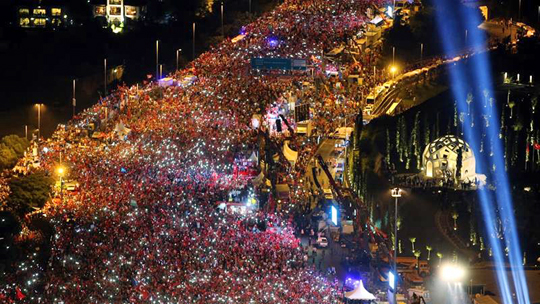
Turkey, Jul 16: Tens of thousands of people gathered at a massive rally in Istanbul, marking one year since the defeat of the coup aimed at ousting President Recep Tayyip Erdogan from power.
Turkey

Joining the crowd gathered on Saturday at the Bosphorus Bridge, now known as the July 15 Martyr's Bridge, Erdogan threatened to "chop off the heads" of those involved in the coup.

"First of all we will chop off the heads of those traitors," Erdogan said as reaffirmed previous comments to sign any bill passed restoring capital punishment.

"We are a state governed by rule of law. If it comes to me after parliament, I will sign it," he said. Restoring the death penalty would effectively end Ankara's European Union membership ambitions.

Erdogan also praised the "people's faith" in facing up the armed coup plotters.

Erdogan arrived from the capital Ankara on his official plane accompanied by an F-16 fighter jet, news agency reported.

The authorities declared July 15 an annual national holiday of "democracy and unity", billing the foiling of the putsch as a historic victory of Turkish democracy.

"It's one year since the darkest night was turned into an epic," Prime Minister Binali Yildirim told a special session of parliament that kicked off a day of celebrations set to last until dawn.

He said the night of July 15 was a "second War of Independence" after the war that led to the creation of the modern Turkish state in the ruins of the Ottoman Empire in 1923.

About 249 people, not including the plotters, were killed when a disgruntled faction of the army sent tanks into the streets and war planes into the sky in a bid to overthrow Erdogan.

But they were thwarted within hours as the authorities regrouped and people poured into the streets in support of Erdogan, who blamed followers of his ally-turned-nemesis, the US-based preacher Fethullah Gulen.

Tens of thousands carried the Turkish flag while others brandished pictures of the "martyrs" who died defeating the coup bid as a sea of people stretched from the bridge.

People chanted "we are soldiers of Tayyip [Erdogan]" and called for the reinstatement of the death penalty for the coup plotters, with some even brandishing nooses.

At 2100 GMT, people across Turkey took part in "democracy watches", rallies commemorating how people poured out into the streets.

'Post-coup purge'

In the wake of the failed coup bid, authorities embarked on the biggest purge in Turkey's history, arresting 50,000 people and sacking almost three times as many. Erdogan also shored up his position by winning a referendum on enhancing his powers earlier this year.

In the latest dismissals, another 7,563 police, soldiers and other state employees were fired late on Friday under the state of emergency that has been in place since July 20 last year.

Turkey's opposition put political disputes aside on the night of the putsch.

Erdogan, who was present at the session, gazed down stonily from the VIP balcony.

Erdogan later returned to Ankara and, at 2300 GMT, gave a speech in parliament to mark the time the building was bombed last year.

Al Jazeera's Sinem Koseoglu, reporting from Ankara, said Erdogan, in his speech in front of the parliament, said the fight against the treason will continue.

"In front of the parliament, the president emphasised its importance. He also said they will continue efforts to clean the institution of the Gulen group within the state," she said.

"Erdogan also named the coup plotters as traitors, saying the fight against treason will conitnue."

The coup bid also frayed ties between the United States and European Union with NATO member Turkey, which accused its allies of failing to show solidarity.

Gulen has always denied involvement and in a new statement Friday said the accusations were "baseless, politically motivated slanders" and slammed a "witch hunt" of Erdogan's critics.

Comments

hussain
 - 
Tuesday, 18 Jul 2017

very funny , promoter of shirk became promoter of peace. ))

Add new comment

  • Coastaldigest.com reserves the right to delete or block any comments.
  • Coastaldigset.com is not responsible for its readers’ comments.
  • Comments that are abusive, incendiary or irrelevant are strictly prohibited.
  • Please use a genuine email ID and provide your name to avoid reject.
Agencies
July 28,2020

Dubai, Jul 28: Abu Dhabi Commercial Bank (ADCB) (ADCB.AD) is letting go hundreds of employees, sources said, the latest in a round of lay-offs by regional banks as pressure mounts to cut costs amid lower oil prices and the coronavirus crisis.

The UAE’s third-biggest lender is laying off 400 employees, two sources familiar with the matter said, after it had committed to not cutting staff because of the crisis.

In a statement, a spokesman said ADCB had pursued efficiency over the last decade by managing out its lowest underachievers after regular reviews, while ensuring talent was deployed in high-growth areas, such as digital banking.

“A certain number of redundancies are therefore expected every year in the normal course of business,” the bank spokesman added.

The sources said the cuts would involve ADCB’s consumer business and several in top management were among those being let go. One source said the bank was looking to close 20 branches.

In March, ADCB had declared, “No employee will be made redundant during 2020 as a result of the COVID-19 pandemic.”

UAE banks have been hit by government measures to rein in the spread of the virus, forcing many businesses to shut temporarily.

Last week, Dubai’s largest bank, Emirates NBD, reported a slump of 58% in profits. In June, sources told Reuters the bank started a new round of hundreds of lay-offs.

In May, ADCB reported a fall of 84% in first-quarter net profit as it took impairments of $292 million on debt exposure to troubled hospital operator NMC Health and payments group Finablr.

It was a major lender, with an exposure of about $981 million, to NMC Health, which went into administration this year after months of turmoil following questions over financial reporting.

Comments

Add new comment

  • Coastaldigest.com reserves the right to delete or block any comments.
  • Coastaldigset.com is not responsible for its readers’ comments.
  • Comments that are abusive, incendiary or irrelevant are strictly prohibited.
  • Please use a genuine email ID and provide your name to avoid reject.
News Network
April 5,2020

Beirut, Apr 5: The novel coronavirus has put global trade on hold, placed half of the world population in confinement and has the potential to topple governments and reshape diplomatic relations.

The United Nations has appealed for ceasefires in all the major conflicts rocking the planet, with its chief Antonio Guterres on Friday warning "the worst is yet to come". But it remains unclear what the pandemic's impact will be on the multiple wars roiling the Middle East.

Here is an overview of the impact so far on the conflicts in Syria, Yemen, Libya and Iraq:

The COVID-19 outbreak turned into a pandemic just as a ceasefire reached by the two main foreign power brokers in Syria's nine-year-old war -- Russia and Turkey -- was taking effect.

The three million people living in the ceasefire zone, in the country's northwestern region of Idlib, had little hope the deal would hold.

Yet fears the coronavirus could spread like wildfire across the devastated country appear to have given the truce an extended lease of life.

According to the Syrian Observatory for Human Rights, the month of March saw the lowest civilian death toll since the conflict started in 2011, with 103 deaths.

The ability of the multiple administrations in Syria -- the Damascus government, the autonomous Kurdish administration in the northeast and the jihadist-led alliance that runs Idlib -- to manage the coronavirus threat is key to their credibility.

"This epidemic is a way for Damascus to show that the Syrian state is efficient and all territories should be returned under its governance," analyst Fabrice Balanche said.

However the pandemic and the global mobilisation it requires could precipitate the departure of US-led troops from Syria and neighbouring Iraq.

This in turn could create a vacuum in which the Islamic State jihadist group, still reeling from the demise of its "caliphate" a year ago, could seek to step up its attacks.

The Yemeni government and the Huthi rebels initially responded positively to the UN appeal for a ceasefire, as did neighbouring Saudi Arabia, which leads a military coalition in support of the government.

That rare glimmer of hope in the five-year-old conflict was short-lived however and last week Saudi air defences intercepted ballistic missiles over Riyadh and a border city fired by the Iran-backed rebels.

The Saudi-led coalition retaliated by striking Huthi targets in the rebel-held capital Sanaa on Monday.

Talks have repeatedly faltered but the UN envoy Martin Griffiths is holding daily consultations in a bid to clinch a nationwide ceasefire.

More flare-ups in Yemen could compound a humanitarian crisis often described as the worst in the world and invite a coronavirus outbreak of catastrophic proportions.

In a country where the health infrastructure has collapsed, where water is a rare commodity and where 24 million people require humanitarian assistance, the population fears being wiped out if a ceasefire doesn't allow for adequate aid.

"People will end up dying on the streets, bodies will be rotting in the open," said Mohammed Omar, a taxi driver in the Red Sea port city of Hodeida.

Much like Yemen, the main protagonists in the Libyan conflict initially welcomed the UN ceasefire call but swiftly resumed hostilities.

Fierce fighting has rocked the south of the capital Tripoli in recent days, suggesting the risk of a major coronavirus outbreak is not enough to make guns fall silent.

Turkey has recently played a key role in the conflict, throwing its weight behind the UN-recognised Government of National Accord.

Fabrice Balanche predicted that accelerated Western disengagement from Middle East conflicts could limit Turkish support to the GNA.

That could eventually favour forces loyal to eastern-based strongman Khalifa Haftar, who launched an assault on Tripoli one year ago and has the backing of Russia, Egypt and the United Arab Emirates.

Western countries have been hit hardest by the pandemic, which could prompt them to divert both military resources and peace-brokering capacity from foreign conflicts.

A report by the International Crisis Group said European officials had reported that efforts to secure a ceasefire in Libya were no longer receiving high-level attention due to the pandemic.

Iraq is no longer gripped by fully-fledged conflict but it remains vulnerable to an IS resurgence in some regions and its two main foreign backers are at each other's throats.

Iran and the United States are two of the countries most affected by the coronavirus but there has been no sign of any let-up in their battle for influence that has largely played out on Iraqi soil.

With most non-US troops in the coalition now gone and some bases evacuated, American personnel are now regrouped in a handful of locations in Iraq.

Washington has deployed Patriot air defence missiles, prompting fears of a fresh escalation with Tehran, whose proxies it blames for a spate of rocket attacks on bases housing US troops.

Comments

Add new comment

  • Coastaldigest.com reserves the right to delete or block any comments.
  • Coastaldigset.com is not responsible for its readers’ comments.
  • Comments that are abusive, incendiary or irrelevant are strictly prohibited.
  • Please use a genuine email ID and provide your name to avoid reject.
Agencies
July 8,2020

Jeddah, Jul 8: The Organization of Islamic Cooperation (OIC) writes to the members of the United Nations Security Council (UNSC), urging the body to come in the way of a plan announced by Israel for annexation of significant portions of the occupied West Bank.

The letter was addressed by the 57-member organization’s Secretary-General Yousef al-Othaimeen to the UNSC’s members as well as the members of the Middle East Quartet — the European Union, Russia, United Nations, and United States— the Arabic-language Rai al-Youm news website reported on Tuesday.

The letter urged the Council to adopt “the necessary measures” that would prevent the annexation and compel Israel to stop all its illegal activities.

The OIC also urged the UNSC to hold an emergency meeting to “salvage the [remaining] opportunities for peace, and revive attempts at reinstatement of the political process under international supervision.” Such meeting, it added, had to enable realization of “the two-state solution, and [creation of] a Palestinian state with East Jerusalem [al-Quds] as its capital.”

Israel’s Prime Minister Benjamin Netanyahu announced the plan to annex 30 percent of the occupied Palestinian territory — namely the areas upon which the regime has built its illegal settlements as well as the Jordan Valley — after US President Donald Trump backed the annexation in January.

Trump pledged the support while unveiling details of his Middle East scheme called the “deal of the century.”

The highly controversial scheme allegedly seeks to resolve the Palestinian-Israeli conflict, but is heavily tilted in favor of the occupying regime. As well as backing the annexation, the scheme re-endorses Washington’s incendiary recognition in late 2017 of al-Quds as “Israel’s capital,” although Palestinians want the occupied holy city’s eastern part to serve as the capital of their future state.

Palestinians have roundly rejected either the American design or the Israeli plan that is rooted in it.

Tel Aviv had previously announced July 1 as the date it sought to start implementing the annexation plan. It, however, is yet to get it off the ground amid far-and-wide international condemnation and speculation that the plan was announced in the first place to deflect attention from a massive corruption scandal involving Netanyahu.

Countries warn Israel of consequences to bilateral ties

Also on Tuesday, Egypt, France, Germany, and Jordan warned Israel against going ahead with the plan, saying that doing so could have consequences for their bilateral relations with the Tel Aviv regime.

In a statement distributed by the German Foreign Ministry, the countries said their foreign ministers had discussed how to restart talks between Israel and the Palestinian Authority.

Most other European countries have likewise communicated their objection to the plan.

“We concur that any annexation of Palestinian territories occupied in 1967 would be a violation of international law and imperil the foundations of the peace process,” the European and Middle Eastern foreign ministers said, referring to the year, when Israel occupied the West Bank.

“We would not recognize any changes to the 1967 borders that are not agreed by both parties in the conflict,” they added. “It could also have consequences for the relationship with Israel.”

Israel had no immediate response. In a separate statement, however, Netanyahu’s office communicated Tel Aviv’s intransigence on the matter.

The statement said the Israeli premier had told his British counterpart Boris Johnson on Monday that he was committed to Trump’s “realistic” plan.

“Israel is prepared to conduct negotiations on the basis of President Trump’s peace plan, which is both creative and realistic, and will not return to the failed formulas of the past,” the statement alleged.

Comments

Add new comment

  • Coastaldigest.com reserves the right to delete or block any comments.
  • Coastaldigset.com is not responsible for its readers’ comments.
  • Comments that are abusive, incendiary or irrelevant are strictly prohibited.
  • Please use a genuine email ID and provide your name to avoid reject.