I don’t appreciate such language: Rahul Gandhi on Khurshid’s ‘impotent’ Modi jibe

February 27, 2014

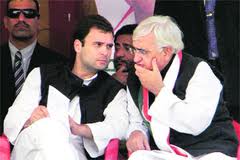
New Delhi, Feb 27: Congress vice-president Rahul Gandhi on Thursday said he does not appreciate the "impotent" remark made by Union ministerSalman Khurshid against Narendra Modi in the context of the 2002 Gujarat riots.

"I do not appreciate this kind of comment...the kind of language," Gandhi said disapproving Khurshid's remark.

The Congress leader was speaking to reporters at the AICC headquarters after a meeting of the campaign committee.

The external affairs minister had stoked a controversy by calling Modi "impotent" and insisted that he did nothing wrong as there was no other appropriate word to describe him in the context of the 2002 Gujarat riots.rahul

Slamming Modi for his handling of the riots, Khurshid had said he did not find any other word to express his anguish better and asked the BJP's prime ministerial candidate to admit the "truth" about the riots.

"I am not his doctor. I cannot physically examine him. So I have no business to be saying what his physical condition is. The word impotent is used in political vocabulary to show that somebody is incapable of doing something," the external affairs minister had said.

"Either you admit you are strong and fully capable and what had happened was done deliberately or say that I made lot of efforts but did not have the capability (to stop the riots). If there is no capability (to deal with) what is it called. Is it not called impotency. If it is called impotency and I said that then what's the problem," he had said.

Rebutting BJP's criticism for his comment, Khurshid had said if they do not understand the vocabulary then he can send a dictionary to them.

BJP leaders Arun Jaitley and Ravi Shanker Prasad had slammed Khurshid, saying some UPA ministers were trying to grab air time through foul language.

The party had asked him to apologise for the "regrettable" and "shameful" comment. BJP leaders said Congress and its leaders have "forgotten manners and etiquettes" and asked if Sonia Gandhi approved of this comment.

On Tuesday, the minister had said, "We don't accuse you (Modi) of killing people... Hamara aarop hai ki tum 'napunsak' (impotent) ho. (Our accusation is that you are impotent). You couldn't stop the killers."

Comments

Add new comment

  • Coastaldigest.com reserves the right to delete or block any comments.
  • Coastaldigset.com is not responsible for its readers’ comments.
  • Comments that are abusive, incendiary or irrelevant are strictly prohibited.
  • Please use a genuine email ID and provide your name to avoid reject.
News Network
July 26,2020

New Delhi, Jul 26: India reported a spike of 48,661 coronavirus cases in the last 24 hours, said the Union Ministry of Health and Family Welfare on Sunday.

The total COVID-19 positive cases stand at 13,85,522, including 4,67,882 active cases, 8,85,577 cured/discharged/migrated, it added.
With 705 deaths in the last 24 hours, the cumulative toll reached 32,063.

Maharashtra has reported 3,66,368 coronavirus cases, the highest among states and Union Territories in the country.

A total of 2,06,737 cases have been reported from Tamil Nadu till now, while Delhi has recorded a total of 1,29,531 coronavirus cases.

According to the Indian Council of Medical Research (ICMR), 4,42,263 samples were tested for coronavirus on Saturday and overall 1,62,91,331 samples have been tested so far.

Comments

Add new comment

  • Coastaldigest.com reserves the right to delete or block any comments.
  • Coastaldigset.com is not responsible for its readers’ comments.
  • Comments that are abusive, incendiary or irrelevant are strictly prohibited.
  • Please use a genuine email ID and provide your name to avoid reject.
News Network
January 13,2020

Jan 13: For the first time in years, the government of India’s Prime Minister Narendra Modi is playing defense. Protests have sprung up across the country against an amendment to India’s laws — which came into effect on Friday — that makes it easier for members of some religions to become citizens of India. The government claims this is simply an attempt to protect religious minorities in the Muslim-majority countries that border India; but protesters see it as the first step toward a formal repudiation of India’s constitutionally guaranteed secularism — and one that must be resisted.

Modi was re-elected prime minister last year with an enhanced majority; his hold over the country’s politics is absolute. The formal opposition is weak, discredited and disorganized. Yet, somehow, the anti-Citizenship Act protests have taken hold. No political party is behind them; they are generally arranged by student unions, neighborhood associations and the like.

Yet this aspect of their character is precisely what will worry Modi and his right-hand man, Home Minister Amit Shah. They know how to mock and delegitimize opposition parties with ruthless efficiency. Yet creating a narrative that paints large, flag-waving crowds as traitors is not quite that easy.

For that is how these protests look: large groups of young people, many carrying witty signs and the national flag. They meet and read the preamble to India’s Constitution, into which the promise of secularism was written in the 1970’s.

They carry photographs of the Constitution’s drafter, the Columbia University-trained economist and lawyer B. R. Ambedkar. These are not the mobs the government wanted. They hoped for angry Muslims rampaging through the streets of India’s cities, whom they could point to and say: “See? We must protect you from them.” But, in spite of sometimes brutal repression, the protests have largely been nonviolent.

One, in Shaheen Bagh in a Muslim-dominated sector of New Delhi, began simply as a set of local women in a square, armed with hot tea and blankets against the chill Delhi winter. It has now become the focal point of a very different sort of resistance than what the government expected. Nothing could cure the delusions of India’s Hindu middle class, trained to see India’s Muslims as dangerous threats, as effectively as a group of otherwise clearly apolitical women sipping sweet tea and sharing their fears and food with anyone who will listen.

Modi was re-elected less than a year ago; what could have changed in India since then? Not much, I suspect, in most places that voted for him and his party — particularly the vast rural hinterland of northern India. But urban India was also possibly never quite as content as electoral results suggested. India’s growth dipped below 5% in recent quarters; demand has crashed, and uncertainty about the future is widespread. Worse, the government’s response to the protests was clearly ill-judged. University campuses were attacked, in one case by the police and later by masked men almost certainly connected to the ruling party.

Protesters were harassed and detained with little cause. The courts seemed uninterested. And, slowly, anger began to grow on social media — not just on Twitter, but also on Instagram, previously the preserve of pretty bowls of salad. Instagram is the one social medium over which Modi’s party does not have a stranglehold; and it is where these protests, with their photogenic signs and flags, have found a natural home. As a result, people across urban India who would never previously have gone to a demonstration or a political rally have been slowly politicized.

India is, in fact, becoming more like a normal democracy. “Normal,” that is, for the 2020’s. Liberal democracies across the world are politically divided, often between more liberal urban centers and coasts, and angrier, “left-behind” hinterlands. Modi’s political secret was that he was that rare populist who could unite both the hopeful cities and the resentful countryside. Yet this once magic formula seems to have become ineffective. Five of India’s six largest cities are not ruled by Modi’s Bharatiya Janata Party in any case — the financial hub of Mumbai changed hands recently. The BJP has set its sights on winning state elections in Delhi in a few weeks. Which way the capital’s voters will go is uncertain. But that itself is revealing — last year, Modi swept all seven parliamentary seats in Delhi.

In the end, the Citizenship Amendment Act is now law, the BJP might manage to win Delhi, and the protests might die down as the days get unmanageably hot and state repression increases. But urban India has put Modi on notice. His days of being India’s unifier are over: From now on, like all the other populists, he will have to keep one eye on the streets of his country’s cities.


Comments

Add new comment

  • Coastaldigest.com reserves the right to delete or block any comments.
  • Coastaldigset.com is not responsible for its readers’ comments.
  • Comments that are abusive, incendiary or irrelevant are strictly prohibited.
  • Please use a genuine email ID and provide your name to avoid reject.
Agencies
July 31,2020

New Delhi, Jul 31: With the highest single-day spike of 55,079 COVID-19 cases in the last 24 hours, India's coronavirus tally breached the 16 lakh mark on Friday, informed the Union Ministry of Health and Family Welfare.

With this latest spike, the total cases in the country stand at 16,38,871. Among these cases 5,45,318 are active. A total of 10,57,806 patients have been cured/discharged/migrated.

779 deaths due to COVID-19 have been reported in the country in the last 24 hours, taking the death toll to 35,747.

As per the Union Health Ministry, Maharashtra has a total of 1,48,454 active cases and recorded 14,729 deaths due to COVID-19.
Tamil Nadu has a total of 57,962 active cases and 3,838 deaths in the state.

Delhi has a total of 10,743 active cases and 3,936 deaths.

The Indian Council of Medical Research on Friday informed that a total number of COVID-19 samples tested up to 30th July is 1,88,32,970 including 6,42,588 samples tested yesterday.

Comments

Add new comment

  • Coastaldigest.com reserves the right to delete or block any comments.
  • Coastaldigset.com is not responsible for its readers’ comments.
  • Comments that are abusive, incendiary or irrelevant are strictly prohibited.
  • Please use a genuine email ID and provide your name to avoid reject.