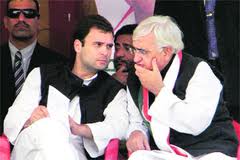
I don’t appreciate such language: Rahul Gandhi on Khurshid’s ‘impotent’ Modi jibe

February 27, 2014

New Delhi, Feb 27: Congress vice-president Rahul Gandhi on Thursday said he does not appreciate the "impotent" remark made by Union ministerSalman Khurshid against Narendra Modi in the context of the 2002 Gujarat riots.

"I do not appreciate this kind of comment...the kind of language," Gandhi said disapproving Khurshid's remark.

The Congress leader was speaking to reporters at the AICC headquarters after a meeting of the campaign committee.

The external affairs minister had stoked a controversy by calling Modi "impotent" and insisted that he did nothing wrong as there was no other appropriate word to describe him in the context of the 2002 Gujarat riots.rahul

Slamming Modi for his handling of the riots, Khurshid had said he did not find any other word to express his anguish better and asked the BJP's prime ministerial candidate to admit the "truth" about the riots.

"I am not his doctor. I cannot physically examine him. So I have no business to be saying what his physical condition is. The word impotent is used in political vocabulary to show that somebody is incapable of doing something," the external affairs minister had said.

"Either you admit you are strong and fully capable and what had happened was done deliberately or say that I made lot of efforts but did not have the capability (to stop the riots). If there is no capability (to deal with) what is it called. Is it not called impotency. If it is called impotency and I said that then what's the problem," he had said.

Rebutting BJP's criticism for his comment, Khurshid had said if they do not understand the vocabulary then he can send a dictionary to them.

BJP leaders Arun Jaitley and Ravi Shanker Prasad had slammed Khurshid, saying some UPA ministers were trying to grab air time through foul language.

The party had asked him to apologise for the "regrettable" and "shameful" comment. BJP leaders said Congress and its leaders have "forgotten manners and etiquettes" and asked if Sonia Gandhi approved of this comment.

On Tuesday, the minister had said, "We don't accuse you (Modi) of killing people... Hamara aarop hai ki tum 'napunsak' (impotent) ho. (Our accusation is that you are impotent). You couldn't stop the killers."

Comments

Add new comment

  • Coastaldigest.com reserves the right to delete or block any comments.
  • Coastaldigset.com is not responsible for its readers’ comments.
  • Comments that are abusive, incendiary or irrelevant are strictly prohibited.
  • Please use a genuine email ID and provide your name to avoid reject.
Agencies
February 11,2020

New Delhi, Feb 11: With Election Commission">Election Commission's trends indicating a landslide victory for the Aam Aadmi Party (AAP), party chief Arvind Kejriwal expressed his gratitude towards the people of the national capital and said that this is the victory of the people who consider him as their son.

Making his first public appearance after the day's results, Kejriwal made a brief address to supporters in which, AAP chief thanked supporters, outlined his personal connection with citizens and party workers as well as credited his family for their continued support.

"I thank people of Delhi for reposing their faith in AAP for the third time. This is not my personal victory, this is the victory of Delhiites. This the victory of the people who consider me as their son and voted for us," Kejriwal said at party office here.

He also referred to the trends of the assembly polls, as the beginning of a new kind of politics.

"This is the beginning of a new kind of politics. This is a new sign. Only the party will get vote who will built mohalla clinics and good schools... This is the victory of mother India and India. Today is Tuesday, Hanuman-ji's day. Hanumanji ji blessed Delhi today, I thank him. We pray that Hanuman Ji keeps showing the right path to us so that we continue to serve people for the next five years," he said.

According to Election Commission", AAP won 5 seats while the party is leading on 58 seats in 70-member Delhi Assembly. 

Comments

Add new comment

  • Coastaldigest.com reserves the right to delete or block any comments.
  • Coastaldigset.com is not responsible for its readers’ comments.
  • Comments that are abusive, incendiary or irrelevant are strictly prohibited.
  • Please use a genuine email ID and provide your name to avoid reject.
News Network
March 25,2020

New Delhi, Mar 25: The Congress said on Wednesday that it stood with Prime Minister Narendra Modi on his appeal for 21-day lockdown but was "deeply disappointed by the lack of coherent strategy" and demanded that Rs 7,500 should be transferred to every Jan Dhan, PM Kisan and pension account to tide over the nutrition needs for 21-days.
It also demanded that the Public Distribution System (PDS) ration should be given free.
In a series of tweets, Congress Communications in-charge Randeep Singh Surejwala said that the need of the hour was to implement 'Minimum Income Guarantee Scheme' (Nyay) mooted by the Congress and party leader Rahul Gandhi.
"Please transfer Rs 7,500 to every Jan Dhan, PM Kisan, and every pension account to tide over nutrition needs of 21 days and give free PDS ration. We will rise together as a nation and defeat COVID-19. We stand with lockdown but are deeply disappointed by the lack of coherent strategy or a clear 'way ahead' on your part," he said.
Surjewala asked what steps the government took despite an early warning about COVID-19 and sought details about isolation beds and ventilators available to people.
"Dear PM, India will adhere to the lockdown but what steps did the govt take to tackle the corona pandemic despite early warnings in Feb? When will doctors, nurses and health workers have adequate protection? How many 'isolation beds' and ventilators are available and where?" he said.
He asked how daily wagers and labourers will sustain during the 21-day lockdown.
"What's your plan to address the huge issue of bread and butter and livelihood for millions? How will daily wagers, labourers, MGNREGA workers, factory workers, unorganised workers, fishermen, farmers and farm labour sustain for 21 days?" he asked.
Surjewala said the crying need is to arm doctors, nurses and health workers with personal protection equipment and asked: "why are N-95 masks, Hazmat suits not available?"
"In March itself, India needs 7.25 lakh bodysuits, 60 lakh N-95 masks, 1 crore 3 ply masks? When will they be available?" he asked.
Surjewala said that the government banned the export of ventilators, respiratory devices and sanitisers only yesterday on March 24, "84 days after the spread of COVID-19."
"Is this your government's 'Modus operandi' to fight coronavirus? Too little, Too late!," he said.
Noting that two-thirds of the country's population is engaged in agriculture, he said that Prime Minister Modi did not refer to farmers during his address to the nation and demanded a moratorium on farmers' loans.
"Crop is ready for harvest in March itself. How will it be harvested and sold and who will buy at fair price? Indebtedness relief to farmers is the only way forward in these testing times. Please put a moratorium on farmers' loans and recoveries. Please ensure the procurement of crops at MSP. Let's not forget that farmers are the backbone of India's economy," he said.
Surjewala said the Prime Minister gave only four hours to prepare for 21-day lockdown.
"Did you think of over 5 lakh truck drivers, who are now stranded on roads? Did you think of millions of workers, who are stranded in cities away from home without food or money? What should they do," he asked.

Comments

Add new comment

  • Coastaldigest.com reserves the right to delete or block any comments.
  • Coastaldigset.com is not responsible for its readers’ comments.
  • Comments that are abusive, incendiary or irrelevant are strictly prohibited.
  • Please use a genuine email ID and provide your name to avoid reject.
News Network
February 19,2020

New Delhi, Feb 19: India will switch to the world's cleanest petrol and diesel from April 1 as it leapfrogs straight to Euro-VI emission compliant fuels from Euro-IV grades now - a feat achieved in just three years and not seen in any of the large economies around the globe.

India will join the select league of nations using petrol and diesel containing just 10 parts per million of sulphur as it looks to cut vehicular emissions that are said to be one of the reasons for the choking pollution in major cities.

Sanjiv Singh, Chairman of Indian Oil Corp (IOC) - the firm that controls roughly half of the country's fuel market, said almost all refineries began producing ultra-low sulphur BS-VI (equivalent to Euro-VI grade) petrol and diesel by the end of 2019 and oil companies have now undertaken the tedious task of replacing every drop of fuel in the country with the new one.

"We are absolutely on track for supplying BS-VI fuel from April 1. Almost all refineries have begun supplying BS-VI fuel and the same has reached storage depots across the country," he said.

From storage depots, the fuel has started travelling to petrol pumps and in the next few weeks all of them will only have BS-VI grade petrol and diesel, he said. "We are 100 per cent confident that fuel that will flow from nozzles at all the petrol pumps in the country on April 1 will be BS-VI emission compliant fuel."

India adopted Euro-III equivalent (or Bharat Stage-III) fuel with a sulphur content of 350 ppm in 2010 and then took seven years to move to BS-IV that had a sulphur content of 50 ppm. From BS-IV to BS-VI it took just three years.

"It was a conscious decision to leapfrog to BS-VI as first upgrading to BS-V and then shifting to BS-VI would have prolonged the journey to 4 to 6 years. Besides, oil refineries, as well as automobile manufacturers, would have had to make investments twice - first to producing BS-V grade fuel and engines and then BS-VI ones," he said.

State-owned oil refineries spent about Rs 35,000 crore to upgrade plants that could produce ultra-low sulphur fuel. This investment is on top of Rs 60,000 crore they spent on refinery upgrades in the previous switchovers.

BS-VI has a sulphur content of just 10 ppm and emission standards are as good as CNG.

Originally, Delhi and its adjoining towns were to have BS-VI fuel supplies by April 2019 and the rest of the country was to get same supplies from April 2020.

But oil marketing companies switched over to supply of BS-VI grade fuels in the national capital territory of Delhi on April 1, 2018.

The supply of BS-VI fuels was further extended to four contiguous districts of Rajasthan and eight of Uttar Pradesh in the National Capital Region (NCR) on April 1, 2019, together with the city of Agra.

BS-VI grade fuels were made available in 7 districts of Haryana from October 1, 2019.

Singh said the new fuel will result in a reduction in NOx in BS-VI compliant vehicles by 25 per cent in petrol cars and by 70 per cent in diesel cars.

The switchover, he said, is a tedious task as every drop of old, higher-sulphur content fuel has to be flushed out in depots, pipelines and tanks before being replaced by BS-VI.

"We are confident of disruption-free switchover to BS-VI supplies across the country," he said. "What we will be supplying is the best quality available anywhere in the world. You don't have any better fuel that is supplied in any part of the world. Perhaps our BS-VI fuel will be better than equivalent fuel in some parts of the US and Europe."

India adopted a fuel upgradation programme in the early 1990s. Low lead gasoline (petrol) was introduced in 1994 in Delhi, Mumbai, Kolkata and Chennai. On February 1, 2000, unleaded gasoline was mandated nationwide.

Similarly, BS-2000 (Euro-I equivalent, BS-1) vehicle emission norms were introduced for new vehicles from April 2000. BS-II (Euro-II equivalent) emission norms for new cars were introduced in Delhi from 2000 and extended to the other metro cities in 2001.

Benzene limits have been reduced progressively from 5 per cent in 2000 to 1 per cent nationwide. Lead content in gasoline was removed in phases and only unleaded gasoline is being produced and sold from February 1, 2000.

The octane number of gasoline signifies the improved performance of the engine. Loss in octane number due to phasing out of lead was made up by installing new facilities in the refinery and changes in refinery operation. RON (Research Octane Number) of gasoline for BS-2000 spec was increased to 88. This has over time been increased to 91.

Singh said sulphur reduction will reduce Particulate Matter (PM) emissions even in the in-use older generation diesel vehicles.


Comments

Add new comment

  • Coastaldigest.com reserves the right to delete or block any comments.
  • Coastaldigset.com is not responsible for its readers’ comments.
  • Comments that are abusive, incendiary or irrelevant are strictly prohibited.
  • Please use a genuine email ID and provide your name to avoid reject.