


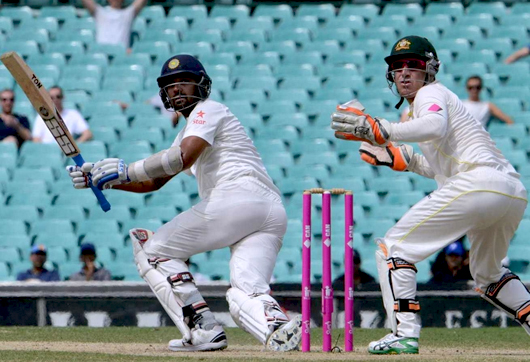
India 73 for one at lunch on final day

January 10, 2015

India score

Sydney, Jan 10: India produced a solid batting performance to reach 73 for one in their second innings while chasing 349 runs for victory at lunch on the fifth and final day of the fourth Test against Australia, at the Sydney Cricket Ground.

Australia had earlier declared their second innings at the overnight score of 251 for six, which gave them an overall lead of 348 runs.

India still need 276 more runs to win with two full sessions of play remaining.

At the break, Murali Vijay was batting on 35 off 77 balls with the help of two fours and one six, while giving him company was Rohit Sharma on 13 off 57 balls, during which he struck one boundary and a six. The duo had put on unbeaten 25 runs for the second wicket after the loss of Lokesh Rahul (16)

For Australia, Nathan Lyon (1/45) was the lone wicket—taker while Josh Hazlewood (0/1) bowled a brilliant opening spell inclusive of four consecutive maiden overs.

Mitchell Starc (0/5), Ryan Harris (0/14) and Steve Smith (0/5) bowled without any success in the first session of play today.

The day started with Australia skipper Smith declaring at the overnight score and giving India 90 overs for their first win in this series.

Vijay and Rahul then walked out to the crease, full of purpose, but they started slowly. They were both watchful against the new ball and hence the runs came in a trickle.

Only nine runs came in the first seven overs, with Lyon being introduced into the attack as early as in the sixth over.

In the 10th over of the innings, Vijay broke the shackles as he hit Lyon for a four and a six to pick up 16 runs from that over.

But while he was looking good at the crease, Rahul was struggling and after adding 48 runs for the opening wicket with Vijay, he ended up gloving one off Lyon in the 14th over to David Warner at backward short leg.

Rahul’s dismissal brought Rohit to the crease and he could have been out first ball, but survived a huge stumping chance by the narrowest of margins.

Thereafter, he took his time to settle down as there were no runs scored for 6.4 overs after the fall of Rahul. The 50—run mark came up when the Indians finally broke through the silence in the 20th over. Rohit then lashed out against Lyon hitting him for a four and a six in the 24th over, moving the scoreboard along to catch up for the lost time.

The two batsmen then saw off the little passage of play until lunch without much fuss.

Comments

Add new comment

  • Coastaldigest.com reserves the right to delete or block any comments.
  • Coastaldigset.com is not responsible for its readers’ comments.
  • Comments that are abusive, incendiary or irrelevant are strictly prohibited.
  • Please use a genuine email ID and provide your name to avoid reject.
Agencies
May 26,2020

Some of the ICC guidelines on resumption of cricket border on the impractical and will need a review when the cricketing world is closer to action, feel former players Aakash Chopra, Irfan Pathan and Monty Panesar.

Last week, the International Cricket Council recommended a host of "back to cricket" guidelines including 14-day pre-match isolation training camps to ensure the teams are free from COVID-19.

The world body issued training as well as playing guidelines which will drastically change the way the game is played.

Among them are regular hand sanitising when in contact with the ball, no loo or shower breaks while training, minimising time spent in the changing room before and after a game, no use of saliva on ball and no handing over of personal items (cap, sunglasses, towels) to fellow teammates or the on-field umpires.

"Social distancing is very doable in individual sport but very tough in a team sport like cricket and football. If you need a slip during the game, would you not employ it?

"If the team is going through a 14-day quarantine and is being tested for COVID-19, I am fine with that process. Now, after that, if we have more guidelines for the players during the game, then you are making things complicated. Then there is no point of a quarantine period," former India pacer Pathan told PTI.

Safety cannot be compromised but regularly sanitising hands during the game will be too much to ask from the players.

"Safety is paramount but we should not make the game complicated. If a bowler or fielder has to sanitise hands every time he touches the ball, then it would be very difficult.

"You can shorten the process of giving the ball to the bowler. Instead of the usual chain (wicket-keeper to cover fielder to bowler), the keeper can straight away give the ball to the bowler but even then the bowler will have to sanitise hands six times in an over," said Pathan seeking more clarity on the guidelines.

Former India opener Chopra said it is still pre-mature to prepare a fixed set of guidelines for resumption of cricket as the situation is evolving "every day".

"That (regular hand sanitisation after contact with ball) is obviously impractical but my big question is when the game happens in a bio secure environment and everyone is quarantined and tested, do these additional measures make a difference?

"On the field, I can still understand but what happens when you go back into the dressing room? How do you practice social distancing there? So it becomes quite complicated.

"To be honest it is all very premature. Once they get closer to resumption, which will take some time, there will be more clarity," said Chopra.

International cricket is likely to resume in July with England hosting West Indies and then Pakistan.

Bundesliga football league has already begun in Germany behind closed doors and by the time cricket resumes, more sporting competitions would have restarted and Chopra feels that will help cricket decide the way forward in post COVID-19 times.

"By the time cricket resumes, more football would have started after Bundesliga. Cricket can take lessons from there, collect data and ideas and see what is practical and what is not."

Former England spinner Panesar foresees the start of the England-West Indies series making things a lot clearer for the entire fraternity than they are at the moment.

"The 14 day quarantine is very much needed and well done to the ICC for including that. I think we will see resumption of international cricket with England hosting West Indies in July. We might have some practical ideas then, the other countries would also be watching keenly and will learn how to go about it.

"But measures like regular hand sanitising is not going to be practical. May be you could sanitise every one hour but it can't be regular during the game," said Panesar.

While Pathan feels the on-field safety measures will make managing over-rate a bigger challenge for teams, Chopra said no loo or shower breaks during training won't be that much of an issue.

"Training is still controllable. You don't have to be there for a long time but you would still have to use the restroom at some stage. You may avoid taking a shower but you will have to use the restroom.

"I think the idea of these guidelines is to make cricketers more aware that you have to take care of yourself and inculcate habits which are in everyone's interest in the current scenario," added Chopra.

Comments

Add new comment

  • Coastaldigest.com reserves the right to delete or block any comments.
  • Coastaldigset.com is not responsible for its readers’ comments.
  • Comments that are abusive, incendiary or irrelevant are strictly prohibited.
  • Please use a genuine email ID and provide your name to avoid reject.
News Network
June 22,2020

New Delhi, Jun 22: Claiming to be saddled with faulty equipment from China, the Indian Weightlifting Federation (IWLF) on Monday called for a boycott of sports apparatus made in that country after the violent face-off in eastern Ladakh killed 20 Army personnel last week.

The IWLF ordered four weightlifting sets, comprising barbells and weight plates, from Chinese company 'ZKC' last year. The body said that the equipment turned out to be faulty and the weightlifters are no longer using them.

"We should boycott all Chinese equipment. The Indian Weightlifting Federation has taken the decision that it will not use any equipment made in China," IWLF secretary general Sahdev Yadav said.

The IWLF, in a letter, has informed the Sports Authority of India (SAI) about its decision to stop using any equipment made in China.

"In a letter to SAI we have written that IWLF won't be using the Chinese equipment," he said.

"In future also we will not use made in china sets. We will use sets made by Indian origin companies or any other company but not from China," Yadav added.

National coach Vijay Sharma revealed that the plates were found to be sub-standard when the lifters started training again earlier this month following the easing of the COVID-19 lockdown restrictions.

"The sets were spoilt. We can't use them now," Sharma said.

"All the weightlifters in the camp are against China. They have stopped using Chinese apps like Tik Tok. Even while ordering things online, they check where the product has been manufactured," he added.

Asked why the sets were even ordered, Sharma said they had no option as the equipment from China is to be used in the Tokyo Olympics and lifters needed to be familiar with it.

"We had ordered four sets from China for Olympic training a year ago. Now, since we have resumed training post the lockdown we haven't used them. All the lifters are against the use of Chinese equipment," he said.

He said equipment was ordered from China for the first time.

"We don't order equipment from China as the quality is very bad. This was the first time we got it."

The weightlifters are currently training with equipment made in Sweden.

"Post the lockdown we started training on sets from Swedish company 'ELICKO'. SAI has issued 10 sets for us. The main training takes place with those. Maximum international competitions have sets from ELICKO," Sharma said.

Yadav also said that there are ready alternatives to Chinese equipment.

"We have a lot of alternatives. We already have good Indian sets and we also have equipment from Sweden. We will use that, why should we use Chinese?" Yadav said.

Calls to boycott China-made goods erupted across India after the Galwan valley clash last Monday. It was the most violent face-off between the troops from the two countries in more than four decades.

The Indian Olympic Association (IOA) has said it is open to boycotting Chinese products in the wake of the incident.

The BCCI will also review IPL's sponsorship deals, including the title deal with Chinese mobile manufacturing company Vivo later this week.

Comments

Add new comment

  • Coastaldigest.com reserves the right to delete or block any comments.
  • Coastaldigset.com is not responsible for its readers’ comments.
  • Comments that are abusive, incendiary or irrelevant are strictly prohibited.
  • Please use a genuine email ID and provide your name to avoid reject.
Agencies
April 2,2020

Lausanne, Apr 2: The postponement of the Tokyo Olympics and the shutdown of the sporting calendar because of the coronavirus pandemic are going to hit international sports federations hard financially.

Many sports that are part of the Games depend heavily on the payouts every four years from the International Olympic Committee (IOC).

"The situation is tense and very gloomy. An assessment will be made, but clearly some posts are under threat," said an official of a major international federation.

The 28 international federations (IF) of the sports that were due to be present at the Tokyo Olympics, would have received substantial sums from the IOC.

However, the postponement of the Games until 2021 could lead to a freeze of their payment.

"We have a lot of IF with substantial reserves, but others work on a different business model, they have income from major events which are suspended, which can be a problem for the cashflow if they don't have enough reserves," said Andrew Ryan, director general of the Association of International Olympic Summer Sports Federations (ASOIF), which is responsible for distributing this money.

The five additions to the Tokyo Games programme - karate, surfing, skateboarding, climbing and baseball/softball - are not eligible.

The Olympic payout totalled 520 million after the Rio Games, four years ago.

"The Olympic money could be less than for Rio 2016," Ryan warned before adding: "My advice is to budget the same as in Rio".

The federations receive money on a sliding scale determined by their audience and size.

The three largest (athletics, swimming and gymnastics) can expect approximately 40 million.

For the second tier, made up of cycling, basketball, volleyball, football and tennis, the sum is 25 million.

For group three, which contains eight sports, including boxing, rowing, judo and table tennis, it is 17 million.

The nine sports in the next level (including sailing, canoing and fencing) receive 12 million.

For the three in the last category (rugby, golf, modern pentathlon) the payout is 7 million.

For the largest associations, such as football's FIFA which has a 1.5 billion nest egg, or basketball body FIBA which has CHF 44.4 million (42 million euros) in reserves, IOC aid represents a small proportion of their income.

For others, it is vital.

"Some IF probably don't have the cashflow to survive one year," said Ryan.

For most federations, the postponement of the Olympic Games has a domino effect, forcing them to reschedule their own money-earning competitions.

"The revenues from these events will eventually come in," said Ryan. "But this impacts the cashflow." World Athletics has already postponed the 2021 World Championships in Eugene, Oregon to 2022.

The International Swimming Federation (FINA) will have to do the same for its World Championships scheduled for next summer in Fukuoka, Japan, when they would probably clash with the Tokyo Games.

"One edition of the World Championships means for us 10 million in revenues," said one sports federation official, speaking on condition of anonymity.

"If this income is postponed, totally or partially, for a year, we will face major problems, especially if the IOC money, originally expected in September, is not paid out."

The Singapore-based International Table Tennis Federation has already taken steps, with "the Executive Committee agreeing to reduce their expenses and senior staff offering to take a salary reduction," said marketing director Matt Pound, but, he added,"further cuts will take place if needed."

- 'Significant loss of revenue' -

The ITTF has suspended all its competitions until June and that is costly.

Kim Andersen, the Danish president of London-based World Sailing, said commercial revenues are not immune.

"The IOC will eventually pay out its aid, but what weighs most heavily is the uncertainty about whether our competitions will be held and whether our sponsors will be maintained," he said.

The IOC is not prepared to go into details of what it plans.

"It is not possible at this stage to assess the overall impact" of the postponement of the Tokyo Olympics, an official told AFP.

"It depends on a number of variables that are currently being studied." According to an official of one federation: "the IOC will discuss on a case-by-case basis, sport by sport".

Another option is for the federations to ask for a share of the public aid set up to deal with the coronavirus crisis, in Switzerland, where 22 ASOIF members are based and also in the United Kingdom, home of World Sailing.

"Can sports federations benefit from federal aid? The answer is yes, in principle," Philippe Leuba, State Councillor of the canton of Vaud, in charge of the economy and sport, told.

Comments

Add new comment

  • Coastaldigest.com reserves the right to delete or block any comments.
  • Coastaldigset.com is not responsible for its readers’ comments.
  • Comments that are abusive, incendiary or irrelevant are strictly prohibited.
  • Please use a genuine email ID and provide your name to avoid reject.