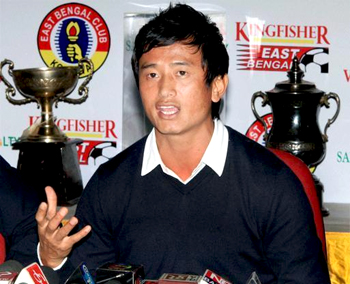
India can be in Asia top 10: Baichung Bhutia backs Constantine's faith in youngsters

January 6, 2016

Kolkata, Jan 6: Former India football captain Baichung Bhutia on Wednesday said the national team can be among the top 10 countries in Asia in near future through developing strong U-15 and U-17 teams.

Bhutia"Through the under-15, under-17, we are going to develop so that within the next 10 to 15 years we can be one of the top 10 teams in Asia. Let's not talk about the World Cup and be unrealistic,"

Bhutia told reporters in Kolkata at a Walk For a Cause media conference where he has been roped in as a goodwill ambassador."We are now spending on the youth, at the moment we should give strong support, money to grassroot development."

The 39-year-old Bhutia credited coach Stephen Constantine for the SAFF Cup triumph recently.

India defeated Afghanistan 2-1 to win their seventh SAFF Cup.

"In the SAFF games, we have seen a lot of new players have been brought in. We have to congratulate Stephen on the success and for getting in guys like Lallianzuala (Chhangte). He was also under a lot of pressure after the World Cup qualifiers but he has now won the SAFF with so many new players, so we must give him credit," Bhutia said.

"It is all on the training camps. If Stephen gets time to prepare players, India will have results. Ultimately, if the national team does well, Indian football will progress. If national team does not do well, I-League, ISL -- nothing will succeed."

On the I-League, he said, "I-League is deteriorating in terms of crowd and fan following. We should not forget I-League has produced many players. There's no doubt that the competition and the standard of the league has increased but in terms of popularity and crowd it hasn't happened.

"For the federation, I-League is very important. Whoever wins it can play in the Asian Football Confederation Cup (AFC) and all, so it is a very important tournament. The clubs and the federation should work towards the betterment of I-League. Even though we have ISL now, the federation should support the I-League."

Comments

Add new comment

  • Coastaldigest.com reserves the right to delete or block any comments.
  • Coastaldigset.com is not responsible for its readers’ comments.
  • Comments that are abusive, incendiary or irrelevant are strictly prohibited.
  • Please use a genuine email ID and provide your name to avoid reject.
News Network
February 21,2020

Sydney, Feb 21: Leg-spinner Poonam Yadav bowled a magical spell in her comeback game to steer India to a comfortable 17-run win over defending champions Australia in the opening match of the Women's T20 World Cup on Friday.

Put in to bat, India struggled to a below par 132 before Poonam (4/19 in 4 overs) foxed the Aussies with her googlies, turning the match decisively into her team's favour.

Australia, who have won the competition four times in six editions, were all out for 115 in 19.5 overs

"A bowler like Poonam is someone who leads from the front. We were expecting a great comeback from her. Our team is looking nice, earlier we depended on two-three players," India skipper Harmanpreet Kaur said after the match.

Poonam, who missed the preceding tri-series due to a hand injury, also got good support from other bowlers including pacer Shikha Pandey.

The 28-year-old from Agra was on a hat-trick but narrowly missed out as wicketkeeper Taniya Bhatia dropped a difficult chance.

The tournament-opener saw a record 13,000 plus attendance with a sizeable chunk supporting India.

India next play against Bangladesh in Perth on February 24.

"It was great for me to come back from injury and perform like this. It was the third time that I was on a hat-trick but satisfied that I was able to do the job for the team," said Poonam at the post-match presentation.

Australia were off to a good start to their chase with opener Alyssa Healy making a 35-ball 51, laced with six boundaries and a six.

However, Indian spinners led by Poonam triggered a collapse as Australia suddenly slipped to 82 for six.

Poonam (4/19) snapped four wickets, two in successive deliveries in the 12th over, to break the back of Australia's chase.

Ashleigh Gardner (34 off 36) tried her bit but didn't get any support from the other end.

Earlier, India squandered a flying start to end up with a below-par total.

Sixteen-year-old Shafali Verma took India to 40 for no loss in four overs with a typically aggressive 29 off 15 balls but her fall derailed the innings as the other batters disappointed.

Deepti Sharma made a composed 46-ball 49 in the second half of the innings but the firepower that India needed in the death overs was badly missing.

India were cruising initially with Shafali taking the opposition to the cleaners, hitting five fours and a six.

However, left-arm spinner Jess Jonassen (2/24) snapped two quick wickets, Smriti Mandhana (10 off 11) and Harmanpreet (2 off 5) to reduce India to 47 for three.

Deepti then shared 53 runs with Jemimah Rodrigues (26 off 33) to bring up the 100 in the 16th over.

For Australia, Ellyse Perry (1/15) and Delissa Kimmince (1/24) were the other wicket-takers.

Comments

Add new comment

  • Coastaldigest.com reserves the right to delete or block any comments.
  • Coastaldigset.com is not responsible for its readers’ comments.
  • Comments that are abusive, incendiary or irrelevant are strictly prohibited.
  • Please use a genuine email ID and provide your name to avoid reject.
Agencies
May 17,2020

Berlin, May 17: Top-flight football in Germany kicked off again on the weekend, becoming the first major sports league in the world to resume play, as parts of Europe took more tentative steps towards normality after the devastation unleashed by the coronavirus pandemic.

With the worldwide death toll past 310,000 and the global economy reeling from the vast damage caused by lockdowns, the reopenings in some of the hardest-hit countries provided much-needed relief from the pandemic.

The French returned to the beach and Italy announced a resumption of European tourism with outbreaks in Europe slowing, but the rising number of fatalities in the United States and Brazil were a grim reminder of the scale of the crisis, with more than 4.6 million infections reported globally.

With governments trying to reopen their economies while avoiding the second wave of infections that could necessitate more lockdowns, Germany's Bundesliga resumed its season on Saturday with games played in vacant, echoing stadiums.

League heavyweights Borussia Dortmund hosted rivals Schalke at the all-but-empty Signal Iduna Park -- which would usually be packed with more than 80,000 raucous fans.

"It's sad that matches are played in empty stadiums, but it's better than nothing," said 45-year-old Borussia Dortmund fan Marco Perz, beer in hand, as he prepared to watch the game on TV.

Dortmund's Erling Braut Haaland became the first player to score a goal after the two-month shutdown and celebrated by dancing alone -- away from his applauding teammates -- in keeping with the strict hygiene guidelines which allowed the league to resume.

The only noise was the cheering and clapping of players and coaches.

League champions Bayern Munich will play Union Berlin in the capital on Sunday, with the resumption in Germany seen as a test case as other top sports competitions try to find ways to resume play without increasing health risks.

"The whole world will be looking at Germany, to see how we get it done," said Bayern boss Hansi Flick.

Prime Minister Giuseppe Conte of Italy, however, said Saturday he needed more guarantees before the government can give the green light for the resumption of its top football league, which is struggling with logistical difficulties as clubs try to arrange training sessions and quarantine facilities.

With the Northern Hemisphere's summer approaching, authorities are moving to help tourism industries salvage something from the wreckage.

Italy, for a long stretch the world's worst-hit country, announced that European Union tourists would be allowed to visit from June 3 and a 14-day mandatory quarantine would be scrapped.

"We're facing a calculated risk in the knowledge that the contagion curve may rise again," Conte said during a televised address.

"We have to accept it otherwise we will never be able to start up again."

In France, the first weekend after the strictest measures were lifted saw many ventures out into the spring sunshine -- and hit the beach.

In the Riviera city of Nice, keen swimmers jumped into the surf at daybreak.

"We were impatient because we swim here all year round," said retiree Gilles, who declined to give his full name.

With the threat of a second wave of infections on their minds, authorities in many countries have asked people not to throng public spaces like beaches as they are made accessible again.

Officials in parts of England on Saturday warned people to stay away from newly reopened beauty spots and avoid overcrowding.

Germany also saw the latest in a growing wave of anti-lockdown protests in many parts of the world, with rallies in major cities bringing together conspiracy theorists, anti-vaccine activists and other extremists.

There were similar protests in France, Switzerland and Poland.

Since emerging in China late last year, the coronavirus has whipped up a catastrophic economic storm, which has left tens of millions unemployed in the United States and many are wondering when a recovery will be possible.

With more than 88,000 deaths and 1.47 million confirmed coronavirus cases, the United States is the worst-hit country on the planet, and the administration of President Donald Trump has faced intense criticism of the way it has handled the crisis.

Former president Barack Obama took a swipe at the response to the pandemic, telling graduates at a virtual commencement ceremony that many leaders today "aren't even pretending to be in charge" -- a remark widely regarded as a rare rebuke of his successor.

Trump is keen to reopen the US economy -- the world's largest -- despite warnings from experts that infections could flare up again if social distancing measures are eased too quickly.

Forty-eight of the 50 US states have now eased lockdown rules to some extent.

Much like Trump and his political allies, Brazil's far-right President Jair Bolsonaro is also keen to end lockdowns, which he claims have unnecessarily damaged the South American nation's economy over a disease he has dismissed as "a little flu".

But the virus has continued its deadly march in Brazil, where the death toll passed 15,000 on Saturday and it became the country with the fourth-largest coronavirus caseload with 230,000 infections.

Comments

Add new comment

  • Coastaldigest.com reserves the right to delete or block any comments.
  • Coastaldigset.com is not responsible for its readers’ comments.
  • Comments that are abusive, incendiary or irrelevant are strictly prohibited.
  • Please use a genuine email ID and provide your name to avoid reject.
Agencies
April 2,2020

Lausanne, Apr 2: The postponement of the Tokyo Olympics and the shutdown of the sporting calendar because of the coronavirus pandemic are going to hit international sports federations hard financially.

Many sports that are part of the Games depend heavily on the payouts every four years from the International Olympic Committee (IOC).

"The situation is tense and very gloomy. An assessment will be made, but clearly some posts are under threat," said an official of a major international federation.

The 28 international federations (IF) of the sports that were due to be present at the Tokyo Olympics, would have received substantial sums from the IOC.

However, the postponement of the Games until 2021 could lead to a freeze of their payment.

"We have a lot of IF with substantial reserves, but others work on a different business model, they have income from major events which are suspended, which can be a problem for the cashflow if they don't have enough reserves," said Andrew Ryan, director general of the Association of International Olympic Summer Sports Federations (ASOIF), which is responsible for distributing this money.

The five additions to the Tokyo Games programme - karate, surfing, skateboarding, climbing and baseball/softball - are not eligible.

The Olympic payout totalled 520 million after the Rio Games, four years ago.

"The Olympic money could be less than for Rio 2016," Ryan warned before adding: "My advice is to budget the same as in Rio".

The federations receive money on a sliding scale determined by their audience and size.

The three largest (athletics, swimming and gymnastics) can expect approximately 40 million.

For the second tier, made up of cycling, basketball, volleyball, football and tennis, the sum is 25 million.

For group three, which contains eight sports, including boxing, rowing, judo and table tennis, it is 17 million.

The nine sports in the next level (including sailing, canoing and fencing) receive 12 million.

For the three in the last category (rugby, golf, modern pentathlon) the payout is 7 million.

For the largest associations, such as football's FIFA which has a 1.5 billion nest egg, or basketball body FIBA which has CHF 44.4 million (42 million euros) in reserves, IOC aid represents a small proportion of their income.

For others, it is vital.

"Some IF probably don't have the cashflow to survive one year," said Ryan.

For most federations, the postponement of the Olympic Games has a domino effect, forcing them to reschedule their own money-earning competitions.

"The revenues from these events will eventually come in," said Ryan. "But this impacts the cashflow." World Athletics has already postponed the 2021 World Championships in Eugene, Oregon to 2022.

The International Swimming Federation (FINA) will have to do the same for its World Championships scheduled for next summer in Fukuoka, Japan, when they would probably clash with the Tokyo Games.

"One edition of the World Championships means for us 10 million in revenues," said one sports federation official, speaking on condition of anonymity.

"If this income is postponed, totally or partially, for a year, we will face major problems, especially if the IOC money, originally expected in September, is not paid out."

The Singapore-based International Table Tennis Federation has already taken steps, with "the Executive Committee agreeing to reduce their expenses and senior staff offering to take a salary reduction," said marketing director Matt Pound, but, he added,"further cuts will take place if needed."

- 'Significant loss of revenue' -

The ITTF has suspended all its competitions until June and that is costly.

Kim Andersen, the Danish president of London-based World Sailing, said commercial revenues are not immune.

"The IOC will eventually pay out its aid, but what weighs most heavily is the uncertainty about whether our competitions will be held and whether our sponsors will be maintained," he said.

The IOC is not prepared to go into details of what it plans.

"It is not possible at this stage to assess the overall impact" of the postponement of the Tokyo Olympics, an official told AFP.

"It depends on a number of variables that are currently being studied." According to an official of one federation: "the IOC will discuss on a case-by-case basis, sport by sport".

Another option is for the federations to ask for a share of the public aid set up to deal with the coronavirus crisis, in Switzerland, where 22 ASOIF members are based and also in the United Kingdom, home of World Sailing.

"Can sports federations benefit from federal aid? The answer is yes, in principle," Philippe Leuba, State Councillor of the canton of Vaud, in charge of the economy and sport, told.


Comments

Add new comment

  • Coastaldigest.com reserves the right to delete or block any comments.
  • Coastaldigset.com is not responsible for its readers’ comments.
  • Comments that are abusive, incendiary or irrelevant are strictly prohibited.
  • Please use a genuine email ID and provide your name to avoid reject.