India 'misleading the public' on Sikkim stand-off, says China

Agencies
July 5, 2017

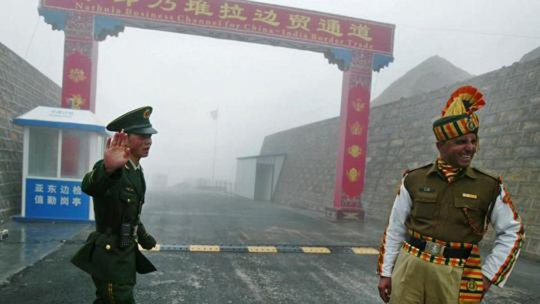
Beijing, Jul 5: China on Wednesday accused India of running "misleading the public" by claiming that the Chinese troops are building a road close to the Chicken's Neck in the Sikkim sector which could endanger India's access to the north-eastern states.

india

"In disregard of the 1890 Sino-Britain convention, the Indian side said that Doklam is located within the tri- junction of the three countries, that is misleading the public," Chinese Foreign Ministry spokesman Gen Shuang was quoted as saying.

"The 1890 convention said that the Sikkim section of the boundary commences from East mountain and the incident (of road building) took place about 2,000 meters away from Mount Gipmochi," Geng asserted.

He claimed that the incident has nothing to do with the tri-junction between China, India and Bhutan.

"The Indian side is actually misleading the public by saying that the incident took place at the tri-junction point," Geng said defending China's road building which India and Bhutan have objected to.

India has expressed concern over the road building, apprehending that it may allow Chinese troops to cut India's access to its north-eastern states.

Comments

Add new comment

  • Coastaldigest.com reserves the right to delete or block any comments.
  • Coastaldigset.com is not responsible for its readers’ comments.
  • Comments that are abusive, incendiary or irrelevant are strictly prohibited.
  • Please use a genuine email ID and provide your name to avoid reject.
Agencies
June 6,2020

Seoul, Jun 6: South Korea on Saturday reported 51 new cases of COVID-19, mostly in the densely populated capital region, as authorities scramble to stem transmissions among low-income workers who can't afford to stay home.

The figures announced by South Korea's Centers for Disease Control and Prevention brought national totals to 11,719 workers and 273 deaths.

At least 34 of the new coronavirus cases were linked to door-to-door sellers hired by Richway, a Seoul-based health product provider.

Vice Health Minister Kim Gang-lip said the spread of the virus among Richway sellers was particularly alarming as most of them are in their 60s and 70s. He called for officials to strengthen their efforts to find and examine workplaces vulnerable to infections.

More than 120 infections have also been linked to a massive warehouse operated by Coupang, a local e-commerce giant, which has been accused of failing to properly implement preventive measures and having employees work even when sick.

South Korea was reporting around 500 new cases per day in early March due to a massive outbreak surrounding the southern city of Daegu, before officials managed to stabilize the situation with aggressive tracking and testing.

But the recent resurgence of COVID-19 in the greater capital area, where about half of South Korea's 51 million people live, is now threatening to erase some of the country's hard-won gains. It has also led to second-guessing whether officials were too quick to ease social distancing and reopen schools.

Health authorities and hospital officials on Friday participated in a table-top exercise for sharing hospital capacities between Seoul and nearby cities and ensure swift transports of patients so that a spike of cases in one area doesn't overwhelm its hospital system. 

Comments

Add new comment

  • Coastaldigest.com reserves the right to delete or block any comments.
  • Coastaldigset.com is not responsible for its readers’ comments.
  • Comments that are abusive, incendiary or irrelevant are strictly prohibited.
  • Please use a genuine email ID and provide your name to avoid reject.
Agencies
July 8,2020

Washington D.C, Jul 8:  US Secretary of State, Mike Pompeo on Tuesday (local time) announced visa restrictions on some Chinese officials under the Reciprocal Access to Tibet Act, 2018.

"Today I am announcing visa restrictions on PRC government and Chinese Communist Party officials determined to be "substantially involved in the formulation or execution of policies related to access for foreigners to Tibetan areas," pursuant to the Reciprocal Access to Tibet Act of 2018," Pompeo said.

"Access to Tibetan areas is increasingly vital to regional stability, given the PRC's human rights abuses there, as well as Beijing's failure to prevent environmental degradation near the headwaters of Asia's major rivers," he said.

The US Secretary of State pointed out that Beijing has continued "systematically to obstruct travel to the Tibetan Autonomous Region (TAR) and other Tibetan areas" by U.S. diplomats and other officials, journalists, and tourists, while PRC officials and other citizens enjoy far greater access to the United States.

"The United States will continue to work to advance the sustainable economic development, environmental conservation, and humanitarian conditions of Tibetan communities within the People's Republic of China and abroad," he said.

Pompeo said US also remains "committed to supporting meaningful autonomy for Tibetans, respect for their fundamental and unalienable human rights, and the preservation of their unique religious, cultural, and linguistic identity".

"In the spirit of true reciprocity, we will work closely with the U.S. Congress to ensure U.S. citizens have full access to all areas of the People's Republic of China, including the TAR and other Tibetan areas," he said.

Comments

Add new comment

  • Coastaldigest.com reserves the right to delete or block any comments.
  • Coastaldigset.com is not responsible for its readers’ comments.
  • Comments that are abusive, incendiary or irrelevant are strictly prohibited.
  • Please use a genuine email ID and provide your name to avoid reject.
News Network
July 1,2020

Jul 1: Hong Kong police moved swiftly on Wednesday against protesters gearing up for the first rally since the introduction of sweeping security legislation, making their first arrest under it and warning of punishment for pro-independence material.

Beijing on Tuesday unveiled the details of the much-anticipated law after weeks of uncertainty, pushing China's freest city and one of the world's most glittering financial hubs onto a more authoritarian path.

As hundreds of protesters gathered downtown for an annual rally marking the 23rd anniversary of the former British colony's handover to China, riot police used pepper spray to arrest at least two people, while one metro station closed.

Police, who earlier banned the rally, cited the law for the first time in confronting protesters and they also made their first arrest under it - a man holding a flag advocating independence.

"You are displaying flags or banners/chanting slogans/or conducting yourselves with an intent such as secession or subversion, which may constitute offences under the ... national security law," police said in a message displayed on a purple banner.

The law will punish crimes of secession, subversion, terrorism and collusion with foreign forces with up to life in prison, heralding a more authoritarian era for the Asian financial hub.

China's parliament adopted it in response to months of pro-democracy protests last year triggered by fears that Beijing was stifling the city's freedoms, guaranteed by a "one country, two systems" formula agreed when it returned to Chinese rule.

Authorities in Beijing and Hong Kong have repeatedly said the legislation is aimed at a few "troublemakers" and will not affect rights and freedoms, nor investor interests.

But critics fear it will crush the freedoms that are seen as key to Hong Kong's success as a financial centre.

"With the release of the full detail of the law, it should be clear to those in any doubt that this is not the Hong Kong they grew up in," said Hasnain Malik, head of equity research, Tellimer in Dubai.

"The difference is that U.S. and China relations are far worse and this could be used as a pretext to impede the role of Hong Kong as a finance hub."

In Beijing, Zhang Xiaoming, executive deputy director of Beijing's Hong Kong and Macau Affairs Office, told reporters suspects arrested by Beijing's new security office in Hong Kong could be tried on the mainland.

He said the mainland's national security office abided by Chinese law and that Hong Kong's legal system could not be expected to implement the laws of the mainland. Article 55 of the law states that Beijing's national security office in Hong Kong could exercise jurisdiction over "complex" or "serious" cases.

Mainland security agencies will also be based in Hong Kong officially for the first time, with powers that go beyond city laws.

"The law is a birthday gift to (Hong Kong) and will show its precious value in the future," Zhang said, adding the law would not be applied retroactively.

On July 1 last year, hundreds of protesters stormed and vandalised the city's legislature to protest against a now-scrapped bill that would have allowed extraditions to mainland China.

Those protests evolved into calls for greater democracy, paralysing parts of the city and paving the way for Beijing's imposition of the law this week.

'INEVITABLE'

Speaking at a flag-raising ceremony to mark the handover anniversary, the city's Beijing-backed leader, Carrie Lam, said the law was the most important development since the city's return to Chinese rule.

"It is also an inevitable and prompt decision to restore stability," Lam said at the same harbour-front venue where 23 years ago the last colonial governor, Chris Patten, a staunch critic of the security law, tearfully handed back Hong Kong to Chinese rule.

Some pro-Beijing officials and political commentators say the law is aimed at sealing Hong Kong's "second return" to the motherland after the first failed to bring residents to heel.

Luo Huining, the head of Beijing's top representative office in Hong Kong, said at the ceremony the law was a "common aspiration" of Hong Kong citizens.

Critics denounced the lack of transparency surrounding the details of the legislation until it was unveiled. It came into force at 11 p.m. (1500 GMT) on Tuesday.

Some pro-democracy activists gave up membership of their groups just before the law came into force, though calling for the campaign for democracy to go on offshore.

"I saw this morning there are celebrations for Hong Kong's handover, but to me it is a funeral, a funeral for 'one country two systems'," said democracy lawmaker Kwok Ka-ki.


Comments

Add new comment

  • Coastaldigest.com reserves the right to delete or block any comments.
  • Coastaldigset.com is not responsible for its readers’ comments.
  • Comments that are abusive, incendiary or irrelevant are strictly prohibited.
  • Please use a genuine email ID and provide your name to avoid reject.