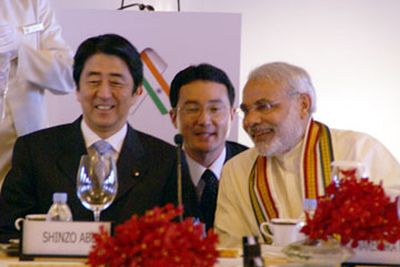
India offers red carpet, not red tape: Modi

September 2, 2014

Tokyo, Sep 2: Telling Japanese investors that there was no better place than India to set up their overseas enterprises, Prime Minister Narendra Modi Tuesday said: "I've come to assure you there is no red tape but only red carpet that awaits you in India."

India red carpetDelivering the keynote address at the Tokyo Stock Exchange, co-hosted by Japan External Trade Organization (Jetro), Modi said India was also the only place where the Japanese industry will pleasantly find all the three 'Ds" -- democracy, demography and demand.

"I have come here to assure you that if you have to look anywhere outside Japan, you do not need to look here or there," he said, adding: "We particularly want to encourage and invite small and medium enterprises, as also small-scale industries."

The prime minister said India now has a government that is working on development and wants to step up manufacturing. He said he wished for India what he himself experienced when he was young when he did not have to think twice if a product said "Made in Japan".

Modi also recalled the major initiative launched by former prime minister Atal Bihari Vajpayee -- the Look East Policy -- to strengthen India-Japan relations and said it had now taken firm shape.

"Just as India is focusing on Look East policy, it seems Japan is now pursuing a 'Look at India Policy'," he said, adding India will strive to replicate the Japanese model of work culture so as to attract more Japanese investment.

According to the organisers, some 4,000 people had wanted to hear Modi speak at the event, hoping for an interaction as well, but only 2,000 could be accommodated.

Comments

Add new comment

  • Coastaldigest.com reserves the right to delete or block any comments.
  • Coastaldigset.com is not responsible for its readers’ comments.
  • Comments that are abusive, incendiary or irrelevant are strictly prohibited.
  • Please use a genuine email ID and provide your name to avoid reject.
News Network
May 25,2020

Islamabad/Dhaka, May 25: The coronavirus pandemic and lockdowns coupled with travel restrictions and social distancing norms have muted the Eid celebrations in Pakistan and Bangladesh as worshippers in the two Muslim-majority countries marked the end of Ramzan in strictly-regulated prayer congregations.

A large number of people in the two countries were forced to stay indoors on the occasion of Eid al-Fitr, marking the end of the fasting month of Ramzan, due to the fears of contracting the novel coronavirus which has killed nearly 3.5 lakh people and infected over 5.4 million across the world.

In Pakistan, the government has issued strict instructions to observe social distancing while offering Eid prayers and asked people to avoid visiting relatives and hosting parties.

As the railways remained closed, many people could not travel to their hometowns for the most important festival.

Eid congregations were held at open places, mosques and Eidgahs in all major cities and towns while following strict standard operating procedures (SOPs) of social distancing and other precautionary measures. But in some areas, the people did not adhere to the SOPs and were seen thronging to their favourite shops to celebrate Eid.

Pakistan Prime Minister's Special Assistant on Health Zafar Mirza on Friday said the deadly infection would continue to multiply if precautions are not taken.

Earlier this month, the government announced the lifting of the countrywide lockdown imposed to curb the spread of the COVID-19 in phases, even as infections continued to rise in the country.

Pakistan's coronavirus cases on Monday reached 56,349 with 1,748 new patients while the death toll climbed to 1,167 after 34 people lost their lives in the last 24 hours.

The trajectory showed that the number was steadily going up with authorities fearing a rise in cases in the wake of the easing of lockdown before Eid.

But Prime Minister Imran Khan cited the economic havoc the virus restrictions had wreaked on citizens as the reason behind the decision to ease the restrictions.

He urged Pakistanis to forgo the traditional Eid festivity in view of the hundreds of fatalities caused by the coronavirus and the lives lost in Friday's plane crash in Karachi.

Ninety-seven people, including nine children, were killed and two passengers miraculously survived a fiery crash when a Pakistan International Airlines plane with 99 travellers on board plunged into a densely populated residential area near the Jinnah International Airport.

Most of the victims were travelling home to celebrate Eid.

In Bangladesh, millions of Muslims joined the strictly-regulated prayer congregations across the country.

Thousands of worshippers attended the prayer services at the Baitul Mukarram National Mosque in Dhaka while following the health and social distancing protocols to limit the spread of the coronavirus, bdnews24.com reported.

Despite the government directive for children and senior citizens not to participate in Eid prayers, many children and people aged over 60 attended the Eid prayers. Although social distancing rules were maintained to a large extent, people were seen flouting the norms, the report said.

As per the government order, no Eid congregation will be held in an open space, but people can perform the Eid prayers in mosques. However, everyone coming to the mosques for prayer must wear a mask, follow social distancing and other hygiene rules, said Islamic Foundation Secretary Kazi Nurul Islam.

On Sunday, Bangladesh reported 28 new fatalities, the highest single-day increase, bringing the death toll to 480.

The number of coronavirus cases in the country rose to 33,610 after 1,532 people tested positive on Sunday.


Comments

Add new comment

  • Coastaldigest.com reserves the right to delete or block any comments.
  • Coastaldigset.com is not responsible for its readers’ comments.
  • Comments that are abusive, incendiary or irrelevant are strictly prohibited.
  • Please use a genuine email ID and provide your name to avoid reject.
Agencies
January 9,2020

Washington, Jan 9: The U.S. and Iran stepped back from the brink of possible war Wednesday as President Donald Trump signaled he would not retaliate militarily for Iran's missile strikes on Iraqi bases housing U.S. troops. No one was harmed in the strikes, but U.S. forces in the region remained on high alert.

Speaking from the White House, Trump seemed intent on deescalating the crisis, which spiralled after he authorized the assassination of Iran's top general, Qassem Soleimani. Iran responded overnight by firing more than a dozen missiles at two installations in Iraq, its most direct assault on America since the 1979 seizure of the U.S. Embassy in Tehran.

Trump's takeaway was that “Iran appears to be standing down, which is a good thing for all parties concerned and a very good thing for the world.”

The region remained on edge, however, and American troops including a quick-reaction force dispatched over the weekend were on high alert. Hours after Trump spoke, an ‘incoming’ siren went off in Baghdad's Green Zone after what seemed to be small rockets “impacted” the diplomatic area, a Western official said. There were no reports of casualties.

Iran's Supreme Leader Ayatollah Ali Khamenei said the overnight strike was not necessarily the totality of Iran's response. “Last night they received a slap,” Khamenei said. “These military actions are not sufficient (for revenge). What is important is that the corrupt presence of America in this region comes to an end.”

The strikes had pushed Tehran and Washington perilously close to all-out conflict and left the world waiting to see whether the American president would respond with more military force. Trump, in his nine-minute, televised address, spoke of a robust U.S. military with missiles that are “big, powerful, accurate, lethal and fast.'' But then he added: “We do not want to use it."

Iran for days had been promising to respond forcefully to Soleimani's killing, but its limited strike on two bases--one in the northern Iraqi city of Irbil and the other at Ain al-Asad in western Iraq--appeared to signal that it too was uninterested in a wider clash with the U.S. Foreign minister Mohammad Javad Zarif tweeted that the country had “concluded proportionate measures in self-defence.”

Trump said the U.S. was “ready to embrace peace with all who seek it.” That marked a sharp change in tone from his warning a day earlier that “if Iran does anything that they shouldn't be doing, they're going to be suffering the consequences, and very strongly.”

Trump opened his remarks at the White House by reiterating his promise that “Iran will never be allowed to have a nuclear weapon.” Iran had announced in the wake of Soleimani's killing that it would no longer comply with any of the limits on uranium enrichment in the 2015 nuclear deal crafted to keep it from building a nuclear device.

The president, who had earlier pulled the U.S. out of the deal, seized on the moment of calm to call for negotiations toward a new agreement that would do more to limit Iran's ballistic missile programmes and constrain regional proxy campaigns like those led by Soleimani.

Trump spoke of new sanctions on Iran, but it was not immediately clear what those would be.

Comments

Add new comment

  • Coastaldigest.com reserves the right to delete or block any comments.
  • Coastaldigset.com is not responsible for its readers’ comments.
  • Comments that are abusive, incendiary or irrelevant are strictly prohibited.
  • Please use a genuine email ID and provide your name to avoid reject.
News Network
March 12,2020

Beijing, Mar 12: The number of fresh infections at the epicentre of China's coronavirus epidemic dropped to a new low on Thursday but the country imported more cases from abroad.

Another 11 people died, the lowest daily increase since late January, bringing the toll in China to 3,169 deaths, according to the National Health Commission.

There were only eight new cases in Wuhan, the city where the virus first emerged in December before growing into a national crisis and a pandemic.

It is the first time that new cases in Wuhan, the capital of Hubei province, have fallen to single-digits since figures started to be reported in January.

With cases falling dramatically in recent weeks, authorities this week began to loosen some restrictions on Hubei's 56 million people, who have been under quarantine since late January.

Healthy people living in low-risk areas of the province can now travel within Hubei. While Wuhan is not included, some of the city's companies were told they could resume work.

Only one other non-imported case was recorded elsewhere in the country.

But as global hotspots emerge elsewhere, China fears that cases arriving from abroad could undermine its progress.

On Thursday there were six more imported cases reported, bringing the total of infections from overseas to 85, health officials said.

Beijing has ordered a 14-day quarantine for everyone arriving in the city from any country.

Travellers flying into Beijing Capital International Airport from high-risk countries are now handled separately from other passengers.

A total of 80,793 people have now been infected in China.

President Xi Jinping said this week during his first visit to Wuhan since the crisis erupted that the spread of the disease has been "basically curbed" in China.

Comments

Add new comment

  • Coastaldigest.com reserves the right to delete or block any comments.
  • Coastaldigset.com is not responsible for its readers’ comments.
  • Comments that are abusive, incendiary or irrelevant are strictly prohibited.
  • Please use a genuine email ID and provide your name to avoid reject.