


India stunned by South Korea in Kabaddi World Cup opener

October 8, 2016

Ahmedabad, Oct 8: India suffered a shock defeat in the inaugural match of the ongoingKabaddi World Cup as they were upstaged 32-34 by South Korea here on Friday (Oct 7).
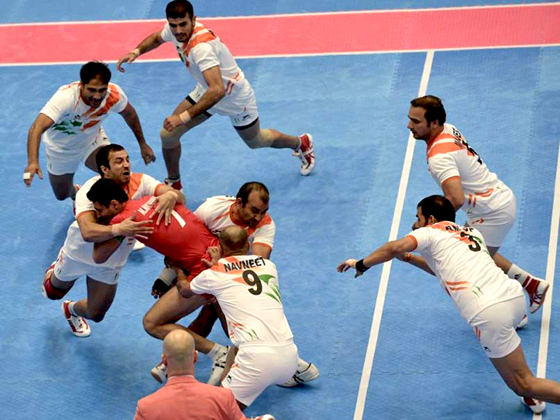
kabaddi

The Koreans, who were trailing by seven points at one stage, capitalised on a few defensive errors towards the end to stage a superb comeback and clinch victory in the last two minutes.

Jang Kun Lee produced a terrific performance in the last two minutes to turn the game in his team's favour. South Korea looked down and out in the second half but recovered strongly to record a famous win over the hosts. Anup Kumar scored eight points for India but it wasn't enough for his team.

It was a slow start by both teams as they exchanged empty raids in the first three minutes. Dharmaraj Cheralathan scored the first defence point for India in the 2nd minute.

The Korean defence sent Rahul Chaudhry to the bench in fourth minute as the visitors led 3-2.

Anup Kumar scored three points with a super raid in the sixth minute as India led 5-4. The Koreans forced a super tackle in the seventh minute to lead 7-6. Rahul Chaudhry scored his first raid point in the 10th minute as India inflicted an all out to lead 12-9.

Korean star man Jang Kun Lee was kept quiet by the Indian defence as he scored just one point in the first 10 minutes.

Rahul Chaudhry scored two raid points in the 12th minute as India opened a five-point gap to lead 14-9. Jang Kun Lee had just one successful raid in the first half as Korean raiders struggled to get points.

Pardeep Narwal came on as a substitute in the 18th minute and scored with his first raid as India led 18-10. Korean defence forced another super tackle in the 19th minute as they trailed 12-18. South Korean captain Hong Dong Ju scored a raid point in the 20th minute to close the gap to five points as they trailed 13-18 at the end of first half.

South Korea began the second half strongly as they scored two points in three minutes to trail 15-18. Manjeet Chhillar forced a super tackle in 25th minute as India led 21-15. Pardeep Narwal scored a raid point in the 26th minute to give India 23-15 lead.

With eight minutes to go, the Korean defence sent Pardeep Narwal to the bench as they trailed 19-24. A superb raid by Lee Dong in 35th minute turned the game on its head as India was reduced to just one man.

Ajay Thakur scored two points and saved India from an all out but Korea successfully inflicted an all out in 37th minute as South Korea trailed 25-28. Jang Kun Lee scored with a bonus point in 37th minute as Korea cut the deficit to just two points.

It was tense last few minutes for the Indian team as Korea fought back on multiple occasions to reduce the deficit. Jang Kun Lee then produced a brilliant super raid in the 39th minute as Korea tied the game at 30-30.

Anup Kumar scored with a raid in the last minute but Jang Kun Lee scored two more points to lead 32-31. Korea held their nerve in the dying seconds and scored a remarkable upset to win 34-32.

Comments

Add new comment

  • Coastaldigest.com reserves the right to delete or block any comments.
  • Coastaldigset.com is not responsible for its readers’ comments.
  • Comments that are abusive, incendiary or irrelevant are strictly prohibited.
  • Please use a genuine email ID and provide your name to avoid reject.
News Network
February 11,2020

Mt. Maunganui (New Zealand), Feb 11: KL Rahul struck a combative 112 but New Zealand completed a 3-0 whitewash of India by winning the third ODI by five wickets, here on Tuesday.

Rahul helped India recover from a shaky start to post a challenging 296 for 7 but the Kiwis overhauled the target with 17 balls to spare.

This is the first whitewash that India has suffered in an ODI series in more than a decade.

Sent in to bat, India were down 62 for 3 in the 13th over after the dismissals of Mayank Agarwal (1), captain Virat Kohli (9) and Prithvi Shaw (40) but Rahul got a useful ally in in-form Shreyas Iyer (62) to take India to a competitive total.

Rahul, who hit nine fours and two sixes during his 113-ball innings, and Iyer stitched exactly 100 runs from 18.2 overs for the fourth wicket to revive the Indian innings.

After the end of the promising innings of Iyer, Rahul shared another 107 runs for the fifth wicket with Manish Pandey (42).

The Kiwis were off to a confident start in their chase with Martin Guptill (66) and Henry Nicholls (80) and putting on a 106-run stand. However, wrist spinner Yuzvendra Chahal took three wickets to bring India back in the game.

Colin de Grandhomme (58) and Tom Latham (32), though, took their side past the finish line with an unbeaten 80-run partnership.

Brief Scores:

India: 296 for 7 in 50 overs (KL Rahul 112, Shreyas Iyer 62; Hamish Bennett 4/64).

New Zealand: 300 for 5 in 47.1 overs. (H Nicholls 80, M Guptill 66; Y Chahal 3/47).

Comments

Add new comment

  • Coastaldigest.com reserves the right to delete or block any comments.
  • Coastaldigset.com is not responsible for its readers’ comments.
  • Comments that are abusive, incendiary or irrelevant are strictly prohibited.
  • Please use a genuine email ID and provide your name to avoid reject.
Agencies
April 2,2020

Lausanne, Apr 2: The postponement of the Tokyo Olympics and the shutdown of the sporting calendar because of the coronavirus pandemic are going to hit international sports federations hard financially.

Many sports that are part of the Games depend heavily on the payouts every four years from the International Olympic Committee (IOC).

"The situation is tense and very gloomy. An assessment will be made, but clearly some posts are under threat," said an official of a major international federation.

The 28 international federations (IF) of the sports that were due to be present at the Tokyo Olympics, would have received substantial sums from the IOC.

However, the postponement of the Games until 2021 could lead to a freeze of their payment.

"We have a lot of IF with substantial reserves, but others work on a different business model, they have income from major events which are suspended, which can be a problem for the cashflow if they don't have enough reserves," said Andrew Ryan, director general of the Association of International Olympic Summer Sports Federations (ASOIF), which is responsible for distributing this money.

The five additions to the Tokyo Games programme - karate, surfing, skateboarding, climbing and baseball/softball - are not eligible.

The Olympic payout totalled 520 million after the Rio Games, four years ago.

"The Olympic money could be less than for Rio 2016," Ryan warned before adding: "My advice is to budget the same as in Rio".

The federations receive money on a sliding scale determined by their audience and size.

The three largest (athletics, swimming and gymnastics) can expect approximately 40 million.

For the second tier, made up of cycling, basketball, volleyball, football and tennis, the sum is 25 million.

For group three, which contains eight sports, including boxing, rowing, judo and table tennis, it is 17 million.

The nine sports in the next level (including sailing, canoing and fencing) receive 12 million.

For the three in the last category (rugby, golf, modern pentathlon) the payout is 7 million.

For the largest associations, such as football's FIFA which has a 1.5 billion nest egg, or basketball body FIBA which has CHF 44.4 million (42 million euros) in reserves, IOC aid represents a small proportion of their income.

For others, it is vital.

"Some IF probably don't have the cashflow to survive one year," said Ryan.

For most federations, the postponement of the Olympic Games has a domino effect, forcing them to reschedule their own money-earning competitions.

"The revenues from these events will eventually come in," said Ryan. "But this impacts the cashflow." World Athletics has already postponed the 2021 World Championships in Eugene, Oregon to 2022.

The International Swimming Federation (FINA) will have to do the same for its World Championships scheduled for next summer in Fukuoka, Japan, when they would probably clash with the Tokyo Games.

"One edition of the World Championships means for us 10 million in revenues," said one sports federation official, speaking on condition of anonymity.

"If this income is postponed, totally or partially, for a year, we will face major problems, especially if the IOC money, originally expected in September, is not paid out."

The Singapore-based International Table Tennis Federation has already taken steps, with "the Executive Committee agreeing to reduce their expenses and senior staff offering to take a salary reduction," said marketing director Matt Pound, but, he added,"further cuts will take place if needed."

- 'Significant loss of revenue' -

The ITTF has suspended all its competitions until June and that is costly.

Kim Andersen, the Danish president of London-based World Sailing, said commercial revenues are not immune.

"The IOC will eventually pay out its aid, but what weighs most heavily is the uncertainty about whether our competitions will be held and whether our sponsors will be maintained," he said.

The IOC is not prepared to go into details of what it plans.

"It is not possible at this stage to assess the overall impact" of the postponement of the Tokyo Olympics, an official told AFP.

"It depends on a number of variables that are currently being studied." According to an official of one federation: "the IOC will discuss on a case-by-case basis, sport by sport".

Another option is for the federations to ask for a share of the public aid set up to deal with the coronavirus crisis, in Switzerland, where 22 ASOIF members are based and also in the United Kingdom, home of World Sailing.

"Can sports federations benefit from federal aid? The answer is yes, in principle," Philippe Leuba, State Councillor of the canton of Vaud, in charge of the economy and sport, told.

Comments

Add new comment

  • Coastaldigest.com reserves the right to delete or block any comments.
  • Coastaldigset.com is not responsible for its readers’ comments.
  • Comments that are abusive, incendiary or irrelevant are strictly prohibited.
  • Please use a genuine email ID and provide your name to avoid reject.
Agencies
April 14,2020

Tokyo, Apr 14: Tokyo organizers said Tuesday they have no B Plan in the event the Olympics need to be postponed again because of the coronavirus pandemic.

Masa Takaya, the spokesman for the Tokyo Olympics, said organizers are proceeding under the assumption the Olympics will open on July 23, 2021. The Paralympics follow on Aug. 24.

Those dates were set last month by the International Olympic Committee and Japanese officials after the coronavirus pandemic made it clear the Olympics could not be held as scheduled this summer.

We are working toward the new goal, Takaya said, speaking in English on a teleconference call with journalists.

We don't have a B Plan. The severity of the pandemic and the death toll has raised questions if it will even be feasible to hold the Olympics in just over 15 months. Several Japanese journalists raised the question on the call.

All I can tell you today is that the new games' dates for both the Olympic and Paralympic Games have been just set up, Takaya said.

In that respect, Tokyo 2020 and all concerned parties now are doing their very best effort to deliver the games next year." IOC President Thomas Bach was asked about the possibility of a postponement in an interview published in the German newspaper Die Welt on Sunday.

He did not answer the question directly, but said later that Japanese organizers and Prime Minister Shinzo Abe indicated they could not manage a postponement beyond next summer at the lastest.

The Olympics draw 11,000 athletes and 4,400 Paralympic athletes and large support staffs from 206 national Olympic committees.

There are also questions about frozen travel, rebooking hotels, cramming fans into stadiums and arenas, securing venues, and the massive costs of rescheduling, which is estimated in Japan at 2 billion- 6 billion.

Tokyo 2020 CEO Toshiro Muto addressed the issue in a news conference on Friday. He is likely to be asked about it again on Thursday when local organizers and the IOC hold a teleconferene with media in Japan.

The other major question is the cost of the delay; how much will it be, and who pays? Bach said in the Sunday interview that the IOC would incur several hundred million dollars in added costs. Under the so-called Host City Agreement, Japan is liable for the vast majority of the expenses.

This is impossible to say for now, Takaya, the spokesman said.

It is not very easy to estimate the exact amount of the games' additional costs, which have been impacted by the postponement."

Tokyo says it's spending 12.6 billion to organize the Olympics. But a Japanese government audit published last year says the costs are twice that much. Of the total spending, 5.6 billion in private money. The rest is from Japanese governments.

Comments

Add new comment

  • Coastaldigest.com reserves the right to delete or block any comments.
  • Coastaldigset.com is not responsible for its readers’ comments.
  • Comments that are abusive, incendiary or irrelevant are strictly prohibited.
  • Please use a genuine email ID and provide your name to avoid reject.