



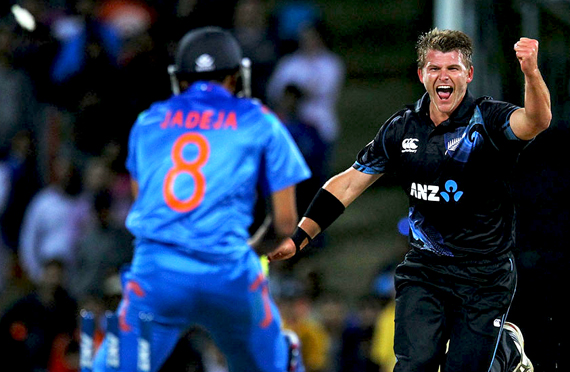
India surrender top ODI ranking after back-to-back defeats

January 22, 2014

India_ODI_ranking

Hamilton, Jan 22: India were on Wednesday dethroned as the number one ODI team after they suffered an agonizing 15-run defeat in a rain-truncated second ODI against New Zealand, who have now taken a 2-0 lead in the five-match series.

India, who desperately needed a win to retain their top spot, made a valiant effort to overhaul the revised target of 297 in 42 overs but failed to cross the finishing line scoring 277 for nine in 41.3 overs, giving Australia pole position in the ICC ODI rankings. The Duckworth-Lewis par score in 41.3 overs was 293.

Put into bat, the Kiwis rattled up 271 for seven riding on Kane Williamson's 76 and all-rounder Corey Anderson's rampaging 17-ball-44 that included five huge sixes as the hosts amassed a whopping 101 runs in 8.4 overs after rain interruption.

India were left with a daunting task of chasing a revised target of 297 as per the D/L method and were again done in by a shaky start and lack of big partnerships which has been their bane of late.

Virat Kohli, who hit a century in the first ODI, again top-scored with a sparkling 78 while skipper Mahendra Singh Dhoni (56), Suresh Raina (35), Ajinkya Rahane (36) got the starts but could not translate them into match-winning knocks.

Tim Southee (4/72) was pick of the New Zealand bowlers while Anderson again displayed his all-round prowess picking up three for 67 with wickets of Dhoni, Ravindra Jadeja and Bhuvneshwar Kumar.

Shikhar Dhawan (12, 22 balls) and Rohit Sharma (20, 34 balls) wasted a lot of deliveries upfront as India couldn't take advantage of the bowling Powerplay.

The loss was all the more heartbreaking for India as they conceded the No. 1 ODI position to Australia, having relinquished their top position in Tests to England back in 2011 after 0-4 whitewash.

India now travel to Auckland for the third ODI at the Eden Park on January 25, which will be a do-or-die match for Dhoni's men.

During the chase on Wednesday, Kohli and Rahane added 90 runs for the third wicket after Dhawan was bowled by a fullish delivery from Southee and Sharma edged one to Luke Ronchi behind the stumps.

Both Kohli and Rahane played confident strokes but the Mumbaikar was done in by Mitchell McClenaghan, who got one to kick up and Rahane only got a thickish edge to the keeper.

Kohli was obviously the more aggressive batsman in this pairing, bringing up his 29th ODI fifty in the 23rd over of the innings. In the next over, they brought up their 50-run partnership, off only 49 balls.

Skipper Dhoni came out to bat ahead of Suresh Raina but they could not take the score closer to the target unlike Napier.

Kohli was looking to accelerate when he mistimed and hit straight to the substitute fielder at mid-on. He made 78 runs off 65 balls, with seven fours and two sixes, and walked off dejected as there was yet another hundred for the taking.

Raina then came out fighting, looking more comfortable at number six than he has batting higher up, as he chipped in with a quick-fire 35 off 22 balls with six fours.

He put on 62 runs in only 39 balls with Dhoni as the chase started looking hopeful once again. But he fell in the 37th over, much to the disappointment of his captain.

Thereafter Dhoni reached his 50 in the 39th over, off 41 balls, looking to take India home single-handedly.

His efforts came to nought though as he holed out in the deep in the 40th over.

Earlier, Indian bowlers dished out yet another listless performance as New Zealand scored an imposing 271 for seven in 42 overs.

Williamson set the platform with a polished knock of 77 helping all-rounder Anderson to cut loose as he played a brilliant cameo smashing 44 off only 17 balls with five huge sixes. Ross Taylor also hit 57 off 56 balls with seven hits to the fence.

For India, Mohammed Shami (3-55) was once again the most successful bowler. Bhuvneshwar Kumar (1-43), Ishant Sharma (1-46), Ravindra Jadeja (1-46) and Suresh Raina (1-18) took a wicket apiece while R Ashwin (0-50)'s poor form with the ball continued.

The lengthy rain break didn't put the brakes on home team's scoring although they lost five wickets post interval.

Williamson and Taylor started off after the rain break, looking to up the ante immediately as the Kiwis had a little over eight overs left to play.

Williamson was stumped in the 34th over off Jadeja. Williamson's 77 came off 87 balls, with five fours and one six and he added 60 runs with Taylor.

Skipper Brendon McCullum's decision to send Anderson ahead of himself to take advantage of the bowling Powerplay was a good move.

Anderson made full use of it as he pummelled the Indian bowling for five sixes in his 17 ball stay, carting two each off Ashwin and Ishant. His 50-run partnership with Taylor came up in only 21 balls, and in total adding a massive 74 runs in 4.4 overs.

His partner Taylor was not quiet either, reaching his 26th ODI fifty in the process.

The big-hitting all-rounder was out caught in the deep in the 39th over, but by then, he had done his job. Off the four Powerplay overs, 58 runs had come with the loss of just one wicket.

New Zealand slowed down a little bit thereafter, with Taylor and McCullum (0) falling in the 40th over bowled by Shami. Kumar then bowled Nathan McCullum (1), but Luke Ronchi (18 not out, 10 balls, two fours, one six) and Kyle Mills (2 not out, 2 balls) helped them cross 270 run mark.

Earlier, MS Dhoni won a second toss in a row and elected to field once again. The threat of rain could have perhaps proved a factor in this decision, given his team did not chase too well in the first match at Napier.

The first wicket came in the sixth over, but once again it was more fault on part of the batsman. For a second consecutive match, Jesse Ryder played a nothing shot to Shami, and this time edged a rising delivery outside off-stump to Dhoni. He threw away his quick start, wherein he scored 20 runs off only 11 balls, with four fours.

It brought Kane Williamson to the crease, who carried on from where he left at Napier. Against the erring Indian bowling, Ishant in particular bowling a middle-leg line, he settled in quickly.

At the other end, Guptill found the going good as well and the two batsmen rotated the strike well enough to bring up their 50-run partnership, off only 49 balls, in the 14th over.

Then they took New Zealand past the 100-run mark in the 18th over, after a first rain-break of the day.

Their second-wicket pairing lasted until the 19th over, costing India 89 runs when Guptill top-edged Raina to be caught at short fine leg. He scored 44 runs off 65 balls, with five fours and one six.

It was Raina's first over of the innings, with Dhoni rotating his bowling in a bid to not let the batsmen settle down.

Spin had been introduced in the 12th over with Jadeja coming on to bowl, while Kohli was brought on in the 14th over. Ashwin only came on to bowl in the 18th over, after the initial rain-break.

Williamson had reached his second successive half-century of the series, following up his 71 runs at Napier. He reached the mark in the 22nd over, off only 52 balls inclusive of four fours and one six, scoring his 4th ODI fifty overall.

At the other end, he had Ross Taylor for company and the duo looked as ominous as the clouds above carrying their good work from the previous match forward.

Comments

Add new comment

  • Coastaldigest.com reserves the right to delete or block any comments.
  • Coastaldigset.com is not responsible for its readers’ comments.
  • Comments that are abusive, incendiary or irrelevant are strictly prohibited.
  • Please use a genuine email ID and provide your name to avoid reject.
News Network
May 15,2020

New Delhi, May 15: Former England skipper David Gower feels Sourav Ganguly has the right "political skills" to lead the ICC one day and he has already displayed that as BCCI president, which is a "far tougher job".

The elegant left-hander is very impressed with Ganguly's leadership abilities and believes that he has what it takes to head the global body in the future.

"One thing I have learnt over the years is that if you are going to run BCCI, you need to be many, many things. Having a reputation like he (Ganguly) has is a very good start, but you need to be a very deft politician.

"You need to have control of a million different things," Gower said ahead of "Q20", a unique chat show for the fans presented by 'GloFans'.

Gower reckons being president of the BCCI is the toughest job imaginable in world cricket.

"And of course, you need to be responsible for a game that is followed by, I mean, should we say a billion people here in India," he said.

"We all know about the immense following for cricket in India. So it is indeed a wonderful thing to behold. Sourav has the toughest task imaginable in charge of BCCI, but so far I would say the signs are very good.

"He has listened, given his own opinion and has pulled strings gently," he said.

Political skills are a must in administration and that's where Gower finds his fellow left-hander ticking all the boxes.

"He is a very, very good man and has those political skills. He has the right attitude and can keep things together and will do good job. And if you do a good job as BCCI chief in the future, who knows?

"But I would actually say the more important job, to be honest, is running BCCI. Being head of ICC is an honour, there is a lot that can be done by ICC, but actually look at the rankings, look at where the power is heading up. BCCI is definitely the bigger job," he said.

On the cricketing front, Gower believes World Test Championship has given the format much-needed context.

"The idea of this World Test Championship has come about for one very simple reason that people are worried about the survival of Tests. Back in the seventies, eighties, I don't think we needed context to be fair.

"Test cricket was very much more obviously the most important format and if there was anything to be judged by, it was the performances in Test matches both as an individual and as a team.

Comments

Add new comment

  • Coastaldigest.com reserves the right to delete or block any comments.
  • Coastaldigset.com is not responsible for its readers’ comments.
  • Comments that are abusive, incendiary or irrelevant are strictly prohibited.
  • Please use a genuine email ID and provide your name to avoid reject.
Agencies
January 16,2020

New Delhi, Jan 16: Veteran cricketer Mithali Raj was on Thursday demoted to Grade B from A in the BCCI central contracts while Radha Yadav and Taniya Bhatia were elevated to the middle bracket.

Mithali not being kept in the Rs 50 lakh category was expected as the 37-year-old retired from T20s in September last year. However, she remains the ODI captain and plans to carry on till the 2021 World Cup.

T20 skipper Harmanpreet Kaur retained his A category contract alongside Smriti Mandhana and Poonam Yadav.

Radha and Taniya, who both had a Grade C contract worth Rs 10 lakh last year, have now entered Grade B (Rs 30 lakh).

Players getting a central contract for the first time are 15-year-old opener Shafali Verma and Harleen Deol, who like the teenager is an attacking batter.

Shafali has attracted a lot of attention ever since making her India debut last year. She recently made 124 against Australia A in Brisbane. The opener will be expected to deliver in the upcoming T20 World Cup Down Under.

Dropped from the list is Mona Meshram, who was in Grade C last year and hasn't played a single game in recent times.

The latest contracts run from October 2019 to September 2020.

Grade A (Rs 50 lakh): Harmanpreet Kaur, Smriti Mandhana, Poonam Yadav.

Grade B (Rs 30 lakh): Mithali Raj, Jhulan Goswami, Ekta Bisht, Radha Yadav, Taniya Bhatia, Shikha Pandey, Jemimah Rodrigues, Deepti Sharma.

Grade C (Rs 10 lakh): Veda Krishnamurthy, Punam Raut, Anuja Patil, Mansi Joshi, D Hemlatha, Arundhati Reddy, Rajeshwari Gayakwad, Pooja Vastrakar, Harleen Deol, Priya Punia, Shafali Verma.

Comments

Add new comment

  • Coastaldigest.com reserves the right to delete or block any comments.
  • Coastaldigset.com is not responsible for its readers’ comments.
  • Comments that are abusive, incendiary or irrelevant are strictly prohibited.
  • Please use a genuine email ID and provide your name to avoid reject.
Agencies
April 2,2020

Lausanne, Apr 2: The postponement of the Tokyo Olympics and the shutdown of the sporting calendar because of the coronavirus pandemic are going to hit international sports federations hard financially.

Many sports that are part of the Games depend heavily on the payouts every four years from the International Olympic Committee (IOC).

"The situation is tense and very gloomy. An assessment will be made, but clearly some posts are under threat," said an official of a major international federation.

The 28 international federations (IF) of the sports that were due to be present at the Tokyo Olympics, would have received substantial sums from the IOC.

However, the postponement of the Games until 2021 could lead to a freeze of their payment.

"We have a lot of IF with substantial reserves, but others work on a different business model, they have income from major events which are suspended, which can be a problem for the cashflow if they don't have enough reserves," said Andrew Ryan, director general of the Association of International Olympic Summer Sports Federations (ASOIF), which is responsible for distributing this money.

The five additions to the Tokyo Games programme - karate, surfing, skateboarding, climbing and baseball/softball - are not eligible.

The Olympic payout totalled 520 million after the Rio Games, four years ago.

"The Olympic money could be less than for Rio 2016," Ryan warned before adding: "My advice is to budget the same as in Rio".

The federations receive money on a sliding scale determined by their audience and size.

The three largest (athletics, swimming and gymnastics) can expect approximately 40 million.

For the second tier, made up of cycling, basketball, volleyball, football and tennis, the sum is 25 million.

For group three, which contains eight sports, including boxing, rowing, judo and table tennis, it is 17 million.

The nine sports in the next level (including sailing, canoing and fencing) receive 12 million.

For the three in the last category (rugby, golf, modern pentathlon) the payout is 7 million.

For the largest associations, such as football's FIFA which has a 1.5 billion nest egg, or basketball body FIBA which has CHF 44.4 million (42 million euros) in reserves, IOC aid represents a small proportion of their income.

For others, it is vital.

"Some IF probably don't have the cashflow to survive one year," said Ryan.

For most federations, the postponement of the Olympic Games has a domino effect, forcing them to reschedule their own money-earning competitions.

"The revenues from these events will eventually come in," said Ryan. "But this impacts the cashflow." World Athletics has already postponed the 2021 World Championships in Eugene, Oregon to 2022.

The International Swimming Federation (FINA) will have to do the same for its World Championships scheduled for next summer in Fukuoka, Japan, when they would probably clash with the Tokyo Games.

"One edition of the World Championships means for us 10 million in revenues," said one sports federation official, speaking on condition of anonymity.

"If this income is postponed, totally or partially, for a year, we will face major problems, especially if the IOC money, originally expected in September, is not paid out."

The Singapore-based International Table Tennis Federation has already taken steps, with "the Executive Committee agreeing to reduce their expenses and senior staff offering to take a salary reduction," said marketing director Matt Pound, but, he added,"further cuts will take place if needed."

- 'Significant loss of revenue' -

The ITTF has suspended all its competitions until June and that is costly.

Kim Andersen, the Danish president of London-based World Sailing, said commercial revenues are not immune.

"The IOC will eventually pay out its aid, but what weighs most heavily is the uncertainty about whether our competitions will be held and whether our sponsors will be maintained," he said.

The IOC is not prepared to go into details of what it plans.

"It is not possible at this stage to assess the overall impact" of the postponement of the Tokyo Olympics, an official told AFP.

"It depends on a number of variables that are currently being studied." According to an official of one federation: "the IOC will discuss on a case-by-case basis, sport by sport".

Another option is for the federations to ask for a share of the public aid set up to deal with the coronavirus crisis, in Switzerland, where 22 ASOIF members are based and also in the United Kingdom, home of World Sailing.

"Can sports federations benefit from federal aid? The answer is yes, in principle," Philippe Leuba, State Councillor of the canton of Vaud, in charge of the economy and sport, told.

Comments

Add new comment

  • Coastaldigest.com reserves the right to delete or block any comments.
  • Coastaldigset.com is not responsible for its readers’ comments.
  • Comments that are abusive, incendiary or irrelevant are strictly prohibited.
  • Please use a genuine email ID and provide your name to avoid reject.