


India will not become a 'pawn' for Japan: Chinese media

November 12, 2016

Beijing, Nov 12: India will not become a "pawn" for Japan to contain China, a Chinese state-run media today said, accusing Japan of exploiting Sino-India disputes for its own interests.
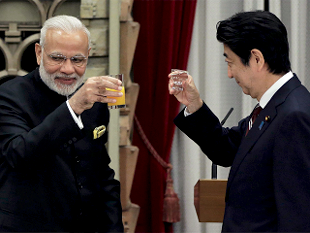
indiapawn"Japan wants to use the disputes between China and India to court India to help contain China. Japan seeks to urge India to meddle in the South China Sea issue, even at the cost of changing its long-held position of reducing nuclear usage to offer special benefits of civil nuclear cooperation to India," Global Times said in an editorial on Prime Minister Narendra Modi's three-day visit to Japan.

"Looking at Japan's diplomatic policies over the past few years, (Japanese Prime Minister Shinzo) Abe administration has become more active trying to sway regional powers to encircle China," the daily said.

It said that India is in need of acquiring nuclear and military technology from Japan and attracting more investment for its manufacturing industries and infrastructure, like high-speed railways.

The daily, however, said that India is not likely to change its position according to the wishes of Japan.

"India takes a multilateral approach to diplomacy and pursues a status as a leading power. Japan's plans are full of antagonism, which contradict India's policies. Therefore India will practically assess specific cooperation with Japan case by case," the daily said.

"India will not become a pawn for Japan to contain China, as it wants to become a power on par with China and Japan and benefit from both sides. India will get closer to Japan but will not enter into a brotherhood relationship," it said.

The editorial, which was apparently written before India and Japan issued joint statement yesterday, said that "both sides hinted they would include the South China Sea Arbitration in their joint statement".

India and Japan yesterday sought a peaceful solution to the territorial disputes in the strategic South China Sea, saying parties involved in the matter must not resort to "threat or use of force", in remarks that could anger China which is opposed to any outside interference.

There is no official reaction by China yet about the outcome of Modi's visit, but ahead of his visit Chinese foreign ministry spokesman Lu Kang told media that New Delhi and Tokyo should respect the legitimate concerns of their neighbours.

A Chinese state media report on Wednesday warned India that it may suffer "great losses" in bilateral trade if it joins Japan in asking China to abide by an international tribunal's ruling quashing Beijing's claims over the SCS.

China has been making aggressive advances in the strategic region - parts of which are also claimed by Vietnam, the Philippines, Taiwan, Malaysia and Brunei - by rapidly building artificial islets that experts fear could be potentially used as military posts.

Comments

Add new comment

  • Coastaldigest.com reserves the right to delete or block any comments.
  • Coastaldigset.com is not responsible for its readers’ comments.
  • Comments that are abusive, incendiary or irrelevant are strictly prohibited.
  • Please use a genuine email ID and provide your name to avoid reject.
News Network
June 12,2020

Washington, Jun 12: US President Donald Trump is considering suspending a number of employment visas including the H-1B, most sought-after among Indian IT professionals, in view of the massive unemployment in America due to the coronavirus pandemic, according to a media report.

The proposed suspension could extend into the government’s new fiscal year beginning October 1, when many new visas are issued, The Wall Street Journal reported on Thursday, quoting unnamed administration officials.

“That could bar any new H-1B holder outside the country from coming to work until the suspension is lifted, though visa holders already in the country are unlikely to be affected,” the daily reported.

H-1B is the most coveted foreign work visas for technology professionals from India.

Such a decision by the Trump administration is likely to have an adverse impact on thousands of Indian IT professionals. Already a large number of Indians on the H-1B visas have lost their jobs and are headed back home during the coronavirus pandemic.

The White House, however, said that no final decision has been made and the administration is considering various proposals.

“The administration is currently evaluating a wide range of options, formulated by career experts, to protect American workers and job seekers especially disadvantaged and underserved citizens — but no decisions of any kind have been made,” White House spokesman Hogan Gidley said in a statement.

In addition to the H-1B visas, the suspension could apply to the H-2B visa for short-term seasonal workers, the J-1 visa for short-term workers including camp counselors and au pairs and the L-1 visa for internal company transfers, the financial daily reported.

Meanwhile, the US Chambers of Commerce CEO Thomas Donohue on Thursday wrote a letter to Trump, expressing concern over his reported move on temporary work visas.

“As the economy rebounds, American businesses will need assurances that they can meet all their workforce needs. To that end, it is crucial that they have access to talent both domestically and from around the world,” Donohue wrote in a letter to Trump.

According to The Hill newspaper, Donohue said that American businesses need L-1 visa holders, who have a work visa valid for a relatively short amount of time, for necessary expertise.

He noted the importance of H-1B visa holders, who have a work visa valid for multiple years, for various industries, including technology, accounting and manufacturers, the newspaper said.

“Policies that would, for example, impose wide-ranging bans on the entry of nonimmigrant workers or impose burdensome new regulatory requirements on businesses that employ foreign nationals would undermine that access to talent and in the process, undercut our economy’s ability to grow and create jobs,” Donohue added.

Comments

Add new comment

  • Coastaldigest.com reserves the right to delete or block any comments.
  • Coastaldigset.com is not responsible for its readers’ comments.
  • Comments that are abusive, incendiary or irrelevant are strictly prohibited.
  • Please use a genuine email ID and provide your name to avoid reject.
News Network
January 2,2020

Washington, Jan 2: The number of people killed in large commercial airplane crashes fell by more than 50% in 2019 despite a high-profile Boeing 737 MAX crash in Ethiopia in March, a Dutch consulting firm said on Wednesday. Aviation consulting firm To70 said there were 86 accidents involving large commercial planes - including eight fatal incidents - resulting in 257 fatalities last year. In 2018, there were 160 accidents, including 13 fatal ones, resulting in 534 deaths, the firm said.

To70 said the fatal accident rate for large airplanes in commercial passenger air transport was just 0.18 fatal accident per million flights in 2019, or an average one fatal accident every 5.58 million flights, a significant improvement over 2018. The fatality numbers include passengers, air crew such as flight attendants and any people on the ground killed in a plane accident

Large passenger airplanes in the study are aircraft used by nearly all travelers on airlines worldwide but excludes small commuter airplanes in service, including the Cessna Caravan and some smaller turboprop airplanes, according to To70.

On Dec. 23, Boeing's board said it had fired Chief Executive Dennis Muilenburg after a pair of fatal crashes involving the 737 MAX forced it to announce it was halting output of its best-selling jetliner. The 737 MAX has been grounded since March after an October 2018 crash in Indonesia and the crash of a MAX in Ethiopia in March killed a total of 346 people.

To70 said the aviation industry spent significant effort in 2019 "focusing on so-called 'future threats' such as drones." But the MAX crashes "are a reminder that we need to retain our focus on the basics that make civil aviation so safe: well-designed and well-built aircraft flown by fully informed and well-trained crews."

The Aviation Safety Network said on Wednesday that, despite the MAX crash, 2019 "was one of the safest years ever for commercial aviation." The 157 people killed in March on Ethiopian Airlines Flight 302 accounted for more than half of all deaths last year worldwide in passenger airline crashes.

Over the last two decades, aviation deaths around the world have been falling dramatically even as travel has increased. As recently as 2005, there were 1,015 deaths aboard commercial passenger flights worldwide, the Aviation Safety Network said.

Last week, 12 people were killed when a Fokker 100 operated by Kazakh carrier Bek Air crashed near Almaty after takeoff. In May, a Russian Sukhoi Superjet 100 aircraft caught fire as it made an emergency landing at Moscow’s Sheremetyevo airport, killing 41 people.

The figures do not include accidents involving military flights, training flights, private flights, cargo operations and helicopters.

Comments

Add new comment

  • Coastaldigest.com reserves the right to delete or block any comments.
  • Coastaldigset.com is not responsible for its readers’ comments.
  • Comments that are abusive, incendiary or irrelevant are strictly prohibited.
  • Please use a genuine email ID and provide your name to avoid reject.
News Network
February 6,2020

Beijing, Feb 6: The number of confirmed fatalities from China's coronavirus outbreak rose to at least 560, after authorities in hardest-hit Hubei province reported 70 new deaths on February 6.

In its daily update, the health commission in Hubei also confirmed the number of confirmed infections in the outbreak has reached 28,018 nationwide with 3,694 new cases reported.

The epidemic, which has spiralled into a global health emergency, is believed to have emerged in December from a market that sold wild game in Hubei's capital Wuhan.

Hu Lishan, an official in Wuhan, warned Wednesday that despite building a hospital from scratch and converting public buildings to accommodate thousands of extra patients, there was still a "severe" lack of beds in the region.

There was also a shortage of "equipment and materials," he told reporters, adding that officials were looking to convert other hotels and schools in the city into treatment centres.

Authorities in several other cities in China have placed restrictions on the number of people allowed to leave their homes.

Global concerns have also risen about the virus, with cases confirmed in more than 20 countries.

Comments

Add new comment

  • Coastaldigest.com reserves the right to delete or block any comments.
  • Coastaldigset.com is not responsible for its readers’ comments.
  • Comments that are abusive, incendiary or irrelevant are strictly prohibited.
  • Please use a genuine email ID and provide your name to avoid reject.