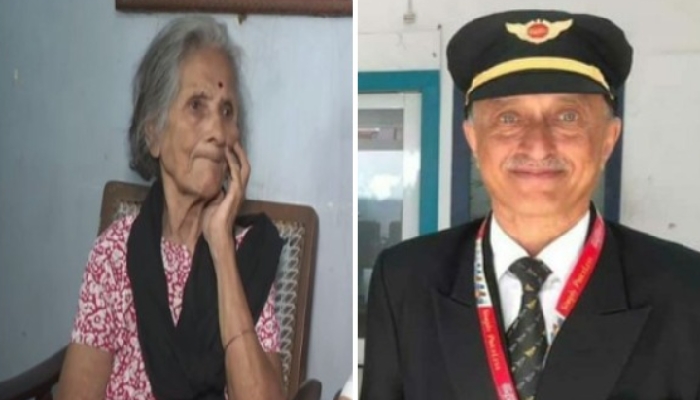
A great son, always ready to help others, says mother of pilot who died plane crash

News Network
August 8, 2020

Nagpur, Aug 8: "He was a great son and always the first one to help others in need. He sacrificed his life for the country," said Neela Sathe, the mother of late captain DV Sathe, who was flying the Air India flight that crash-landed at Kozhikode airport on Friday, claiming 18 lives.

Indian Army Retired Colonel Vasant Sathe and his wife Neela lost both their sons in line of duty. The couple is originally from Nagpur, Maharashtra.

Speaking to news agency, Neela broke into tears and said, "He was a great son and always the first one to help others in need. 

His teachers still appreciate him. During the Ahmedabad floods, he saved the children of the soldiers by lifting them in his arms. I wish God would have called us instead of him."

"Both our children sacrificed their lives for the country," she added.

Remembering DV Sathe's childhood, Neela talked about every that moment when he made his parents proud.

Neela told with great pride that Captain DV Sathe had received the Sword of Honor and had also won eight medals in the Air Force.

Neela last talked to DV Sathe over phone call a few days ago during which captain told her mother not to go out of the house amid COVID-19 crisis as if something happens to her, he won't be able to bear that.

Vasant, captain's father retired as a colonel after serving in the Army for 30 years, following the footsteps of their father, both his sons joined too the Army.

Their elder son Vikas, was in the Army, and at the age of 22, he was martyred in an accident in Ferozepur in 1981. Their younger son Deepak (DV Sathe), who served as a pilot in Air India after serving in the Indian Air Force, died in the plane crash on Friday.

An Air India Express plane carrying 190 passengers including 10 infants skidded while landing at Karipur Airport in Kozhikode on Friday evening.

Comments

Add new comment

  • Coastaldigest.com reserves the right to delete or block any comments.
  • Coastaldigset.com is not responsible for its readers’ comments.
  • Comments that are abusive, incendiary or irrelevant are strictly prohibited.
  • Please use a genuine email ID and provide your name to avoid reject.
News Network
January 1,2020

Jan 1: The ban on the practice of instant triple talaq, making it a penal offence and the increase in the strength of Supreme Court judges were two of the major achievements of the law ministry in 2019.

In July, Parliament gave its nod to The Muslim Women (Protection of Rights on Marriage) Bill, 2019. The new law makes talaq-e-biddat or any other similar form of talaq having the effect of instantaneous and irrevocable divorce pronounced by a Muslim husband void and illegal.

It makes it illegal to pronounce talaq three times in spoken, written or through SMS or WhatsApp or any other electronic chat in one sitting.

According to the new law, any Muslim who pronounces the illegal form of talaq upon his wife shall be punished with imprisonment for a term which may extend to three years, and shall also be liable to fine.

During the year, four new judges were appointed to the Supreme Court in September, taking its strength to 34, the highest-ever.

However, vacancies in high courts and lower courts are on the rise and convincing state governments and the 25 high courts to come on board to create an all-India judicial service to recruit judges for the subordinate courts tops the agenda of the Law Ministry in 2020.

Besides creating a consensus on setting up the All-India Judicial Services, the ministry will also have to focus on filling up vacancies in the high court. On an average, the vacancies stood at 400 throughout this year.

With more than 5,000 positions of judicial officers in district and subordinate courts lying vacant, the Law Ministry has pitched for setting up all-India judicial services.

The sanctioned strength of the judicial officers in district and subordinate courts was 22,644. The number of judicial officers in position and vacant posts is 17,509 and 5,135, respectively.

The government has proposed that while states and high courts can recruit judicial officers, the Union Public Service Commission (UPSC) can hold pan-India entrance tests.

The ministry has made it clear that such services would not encroach on the powers of the states.

As of now, the selection and appointment of judges in subordinate courts is the responsibility of the high courts and state governments concerned.

The Narendra Modi government has given a fresh push to the long-pending proposal to set up the new service to have a separate cadre for the lower judiciary in the country.

But there is a divergence of opinion among state governments and respective high courts on the constitution of the All India Judicial Service (AIJS).

One of the problems cited is that since several states have used powers under Code of Criminal Procedure (CrPC) and Code of Civil Procedure (CPC) to declare that the local language would be used in lower courts even for writing orders, a person say selected from Tamil Nadu may find it difficult to hold proceedings in states like Uttar Pradesh and Bihar.

The other point of opposition is that an all India service may hamper the career progression of state judicial services officers.

Another key issue the ministry has to handle in 2020 is vacancies in the 25 high courts.

Throughout 2019, on an average, the high courts faced a shortage of 400 judges.

According to Law Ministry data, as on September 1, the high courts had 414 vacant positions as compared to the sanctioned strength of 1,079 judges. The figure was 409 in August and 403 in July, as per the data.

A three-member Supreme Court collegium recommends the names of candidates for appointment as high court judges. In case of appointments to the Supreme Court, the collegium consists of five top judges of the top court.

High court collegiums shortlist candidates for their respective high courts and send the names to the law ministry.

The ministry, along with background check reports by the Intelligence Bureau, forwards it to the Supreme Court collegium for a final call.

The government has maintained that appointment of judges in the high courts is a "continuous collaborative process" between the Executive and the Judiciary, as it requires consultation and approval from various Constitutional authorities.

Vacancies keep arising on account of retirement, resignation or elevation of judges and increase in judges' strength. In June last year, the vacancy position stood at 399, while it was 396 in May.

In April, 399 posts of judges were vacant, while the figure was 394 in March. The vacancy position in February stood at 400 and in January, it was 392, according to the data collated by the Department of Justice.

Over 43 lakh cases are pending in the 25 high courts.

Another priority would be the finalisation of the memorandum of the procedure to guide the appointment and transfer of the Supreme Court and high court judges. The issue had now been pending for over two years now with the SC collegium and the government failing to reach a consensus.

Successive governments have also been working on making India a hub of international arbitration. It has taken several steps to change laws dealing with commercial disputes.


Comments

Add new comment

  • Coastaldigest.com reserves the right to delete or block any comments.
  • Coastaldigset.com is not responsible for its readers’ comments.
  • Comments that are abusive, incendiary or irrelevant are strictly prohibited.
  • Please use a genuine email ID and provide your name to avoid reject.
Agencies
January 16,2020

New Delhi, Jan 16: The Arvind Kejriwal-led Delhi government on Thursday rejected the mercy plea of Mukesh, one of the convicts in the 2012 Nirbhaya case.

The mercy plea was then forwarded to Lieutenant Governor, who has now sent it to Union Ministry of Home Affairs.

The convicts were sentenced to death for raping a 23-year-old woman in a moving bus in the national capital on the intervening night of December 16-17, 2012.

The victim, who was later given the name Nirbhaya, had succumbed to injuries at a hospital in Singapore where she had been airlifted for medical treatment.

Comments

Add new comment

  • Coastaldigest.com reserves the right to delete or block any comments.
  • Coastaldigset.com is not responsible for its readers’ comments.
  • Comments that are abusive, incendiary or irrelevant are strictly prohibited.
  • Please use a genuine email ID and provide your name to avoid reject.
News Network
April 11,2020

New Delhi, Apr 11: Calling upon chief ministers to popularise Aarogya Setu app, Prime Minister Narendra Modi on Saturday said it will an essential tool in India's fight against coronavirus and referred to the possibility of the app being an "e-pass which could subsequently facilitate travel from one place to other".

Interacting with chief ministers through video conference, the Prime Minister mentioned how South Korea and Singapore had got success in contact tracing and said India has made its own effort through the app amid efforts to contain the spread of coronavirus.

A PMO release said that the Prime Minister spoke about popularizing the Aarogya Setu app to ensure downloads in greater numbers.

"He referred to how South Korea and Singapore got success in contact tracing. Based on those experiences, India has made its own effort through the app which will be an essential tool in India's fight against the pandemic, he said. He also referred to the possibility of the app being an e-pass which could subsequently facilitate travel from one place to another," the release said.

The Prime Minister had earlier this week urged people to download the app saying it is an important step in the fight against COVID-19 and its effectiveness will increase as more people use it.

"Aarogya Setu is an important step in our fight against COVID-19. By leveraging technology, it provides important information. As more and more people use it, it's effectiveness will increase. I urge you all to download it," he had said in a tweet.

The app launched earlier this month in public-private partnership enables people to themselves assess the risk for their catching the coronavirus infection.

The app makes its calculations based on a person's interaction with others, using Bluetooth technology, algorithms and artificial intelligence.

Comments

Add new comment

  • Coastaldigest.com reserves the right to delete or block any comments.
  • Coastaldigset.com is not responsible for its readers’ comments.
  • Comments that are abusive, incendiary or irrelevant are strictly prohibited.
  • Please use a genuine email ID and provide your name to avoid reject.