



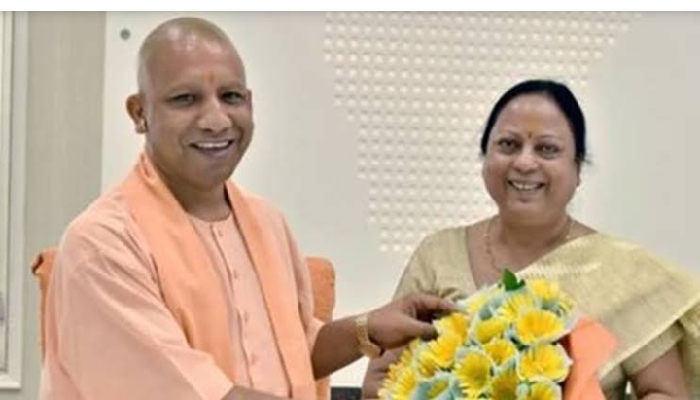
Kamal Rani, minister in Yogi Adityanath led UP cabinet, dies of covid-19

Agencies
August 2, 2020

Lucknow, Aug 2: Uttar Pradesh's cabinet minister for Technical Education Kamal Rani Varun succumbed to COVID-19 on Sunday at the Sanjay Gandhi Postgraduate Institute of Medical Sciences.

Kamal Rani is the first minister in Uttar Pradesh to die after contracting coronavirus. She was 62.

On 18 July, the minister tested positive for coronavirus and was admitted to the Shyama Prasad Mukherjee Hospital.

She was later shifted to the Sanjay Gandhi Postgraduate Institute of Medical Sciences.

Uttar Pradesh chief minister Yogi Adityanath has expressed grief over the minister's death.

In a condolence message issued on Sunday, Adityanath said, "Kamal Rani Varun died on Sunday at around 9.30 am. She was an experienced and capable leader. She discharged her responsibilities with competence. She was a dedicated public representative, who was always working for the welfare of deprived and oppressed sections of the society."

Kamal Rani was the MLA from Ghatampur in Kanpur. She was also twice a Member of Parliament in the Lok Sabha.

Meanwhile, Adityanath has cancelled his visit to Ayodhya scheduled for the day, Additional Chief Secretary (Home) Awanish Awasthi said on Sunday.

Comments

Add new comment

  • Coastaldigest.com reserves the right to delete or block any comments.
  • Coastaldigset.com is not responsible for its readers’ comments.
  • Comments that are abusive, incendiary or irrelevant are strictly prohibited.
  • Please use a genuine email ID and provide your name to avoid reject.
Agencies
May 19,2020

Lucknow, May 19: The administration of the Sanjay Gandhi Post Graduate Institute of Medical Sciences (SGPGI) has ordered a probe into the cardiac procedure conducted on a corona positive patient in the hospital.

The patient underwent a cardiac procedure without being tested for corona before the surgery. He later tested positive for COVID-19, leading to panic among the staff and other patients.

The medical staff that came in contact with the patient were quarantined on Monday while the area was sanitized.

As per orders from the State Medical Education Department, even in emergency cases, patients are to be screened for Covid-19 before procedures are done.

According to the SGPGI administration, the incident took place late on Sunday night.

In an official statement, director, Prof R.K. Dhiman said, "The 63-year-old patient was a case of complete cardiac blockage and needed an urgent temporary pacemaker. The patient was admitted to the holding area of the institute and later shifted to the MICU for permanent pace making."

He said that when the patient's corona status was found to be positive on the Hospital Information System, she was shifted to the Rajdhani COVID Hospital.

The Director said, "Though the involved areas have been sanitized and healthcare workers were quarantined as per protocol, a probe has been ordered to investigate the lapses."

Comments

Add new comment

  • Coastaldigest.com reserves the right to delete or block any comments.
  • Coastaldigset.com is not responsible for its readers’ comments.
  • Comments that are abusive, incendiary or irrelevant are strictly prohibited.
  • Please use a genuine email ID and provide your name to avoid reject.
News Network
January 7,2020

Jan 7: India’s monetary authority allowed banks to offer foreign-currency transactions outside of local market hours, a move aimed at boosting trading volumes at home.

Interbank deals, as well as those with customers in and outside India, can be undertaken by banks or their overseas branches and units at all times, the Reserve Bank of India said in a statement late Monday. It stopped short of saying whether the timing of the onshore over-the-counter market has been extended from the current 9 a.m. to 5 p.m.

The move is in line with recent recommendations to reverse the trend of the partially convertible rupee being traded more abroad than in India. London has overtaken Mumbai to become the top center for trading the rupee, adding to a sense of urgency among local authorities to deepen the onshore market.

Average daily volumes for rupee in the U.K. soared to $46.8 billion in April, a more than fivefold jump from $8.8 billion in 2016, according to a survey from the Bank for International Settlements published in September. That exceeded the $34.5 billion recorded in India.

Analysts say more trading abroad could amplify volatility in the domestic market and reduce the effectiveness of policy actions.

India’s decision comes as the London Stock Exchange Group Plc has started asking market participants if they want the bourse to function fewer hours, signaling it’s open to an argument driven by changing trading patterns and calls for a better work-life balance.

Comments

Add new comment

  • Coastaldigest.com reserves the right to delete or block any comments.
  • Coastaldigset.com is not responsible for its readers’ comments.
  • Comments that are abusive, incendiary or irrelevant are strictly prohibited.
  • Please use a genuine email ID and provide your name to avoid reject.
News Network
June 8,2020

Jun 8: Petrol and diesel prices were hiked by 60 paisa per litre on Monday, for the second day in a row, as state-owned oil firms reverted to daily price revisions after a 83-day hiatus.

Petrol price in Delhi was hiked to Rs 72.46 per litre from Rs 71.86 on Sunday, while diesel rates were increased to Rs 70.59 a litre from Rs 69.99, according to a price notification of state oil marketing companies.

This is the second daily increase in rates in a row. Oil companies had on Sunday raised prices by 60 paisa per litre on both petrol and diesel after ending a 83-day hiatus in daily rate revision.

Daily price revision has restarted, an oil company official said.

While oil PSUs have regularly revised ATF and LPG prices, they had since March 16 kept petrol and diesel prices on hold, ostensibly on account of extreme volatility in the international oil markets.

Auto fuel prices were frozen soon after the government raised excise duty on petrol and diesel by Rs 3 per litre each to mop up gains arising from falling international rates.

The government on May 6 again raised excise duties by Rs 10 per litre on petrol and Rs 13 per litre on diesel.

Oil companies, instead of passing on the excise hike to consumers, decided to adjust them against the reduction required because of the drop in international oil prices. They used the same tool and did not pass on the Re 1 per litre hike required for switching over to ultra-clean BS-VI grade fuel from April 1.

Comments

Add new comment

  • Coastaldigest.com reserves the right to delete or block any comments.
  • Coastaldigset.com is not responsible for its readers’ comments.
  • Comments that are abusive, incendiary or irrelevant are strictly prohibited.
  • Please use a genuine email ID and provide your name to avoid reject.