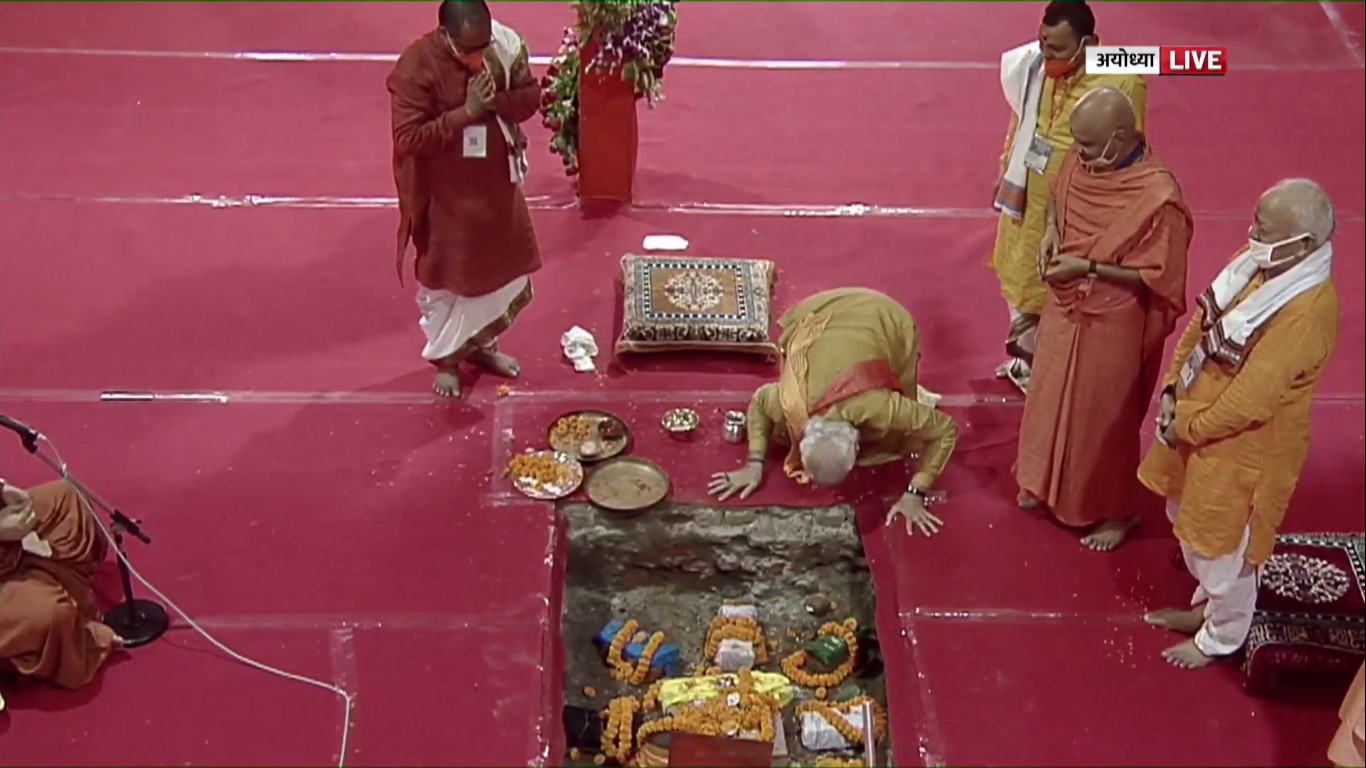
PM Modi lays the foundation stone for Ram Mandir in the presence of RSS chief

Agencies
August 5, 2020

Ayodhya, Aug 5: After laying the foundation stone for the Ram temple in Ayodhya on Wednesday, Prime Minister Narendra Modi termed the 'bhoomi pujan' event as an "emotional moment" for the entire country and added that "every heart is illuminated today".

"Every heart is illuminated; it is an emotional moment for the entire country... A long wait ends today... A grand temple will now be built for our Ram Lalla who had been living under a tent for many years," said Prime Minister Modi at foundation stone-laying ceremony of the Ram temple.

"With the construction of this temple, not only history is being made, but is being repeated. 

The way boatmen to tribals helped Lord Ram, the way children helped Lord Krishna lift Govardhan mountain, similarly, with everyone's efforts temple construction will be completed," he added.

Earlier today, Prime Minister Modi conducted 'bhoomi pujan' for the construction work of Ram temple.

Comments

Add new comment

  • Coastaldigest.com reserves the right to delete or block any comments.
  • Coastaldigset.com is not responsible for its readers’ comments.
  • Comments that are abusive, incendiary or irrelevant are strictly prohibited.
  • Please use a genuine email ID and provide your name to avoid reject.
News Network
March 29,2020

New Delhi, Mar 29: Prime Minister Narendra Modi on Sunday said that people should not think of COVID-19 quarantine facilities as a prison and spoke with two survivors of the infection during his radio show 'Mann Ki Baat' to establish that it was curable.
The Prime Minister spoke to coronavirus survivors -- Ramagampa Teja and Ashok Kapoor - and urged them to share their success against the infection with people.
The Prime Minister asked people to listen to the survivors who had successfully defeated the coronavirus.
"I have spoken to a few people who were infected from the virus and speaking to such people. While I tried to boost their morale they also lifted my spirits when I talked to them," he said.
Speaking to the Prime Minister during the show, Ramagampa Teja, an IT professional, who tested positive for COVID-19 after returning from Dubai, said that he was frightened when he tested positive for the disease and could not believe that this has happened to him.
He said even his family was very stressed after finding out his COVID-19 positive status. "But their test results came negative, which I took as a great blessing. And since then, there were improvements every day," he said.
Teja was admitted to a government hospital in Hyderabad and was released after 14 days as he successfully overcame the infection. "The first few days were the hardest but the dedicated doctors and nurses at the hospital ensured that I recovered," he added.
He asked people not to be afraid of being quarantined. "People feel that going into quarantine means going to prison. They should know that the government quarantine is for them and their families. I want to emphasise that people must get tested and do not fear quarantine," he added.
The Prime Minister congratulated him and his family and asked him to share an audio clip of his experience. "I would like you to make an audio of your experiences and share it on social media so that it goes viral and removes fear from people's minds," the Prime Minister said.
The Prime Minister also spoke to another coronavirus survivor, Ashok Kapoor, six members of whose family in Agra were tested positive for the deadly virus.
On being asked by the Prime Minister whether they had feared for their lives, Kapoor said, "We were not scared as we received excellent cooperation from the doctors and support staff at Delhi's Safdarjung Hospital."
The six of them were shifted to Delhi and put under quarantine for 14 days where all of them successfully recovered from the infection.
The Prime Minister also commended the spirit of Ashok Kapoor and said: "Your experience came in handy for all. My best wishes to you and your family."
He also urged the Kapoor family to spread awareness regarding COVID-19 in the way they see fit. "Please spread awareness your way and you can feed whoever is hungry, look out for the poor and also spread awareness to people urging them to follow the rules," the Prime Minister said.
"If everyone follows the rules, the country will be saved," the Prime Minister said.
The Prime Minister also thanked the people involved in ensuring the continuous supply of goods and services in the country and advised them to "follow all the safety precautions, take care of themselves and their family members."
Earlier in his address, Modi had asked for the forgiveness of all countrymen, and especially the poor, for the nationwide lockdown in the country in the view of the novel coronavirus. He had then termed it a necessary measure needed to defeat the infection in India.

Comments

Add new comment

  • Coastaldigest.com reserves the right to delete or block any comments.
  • Coastaldigset.com is not responsible for its readers’ comments.
  • Comments that are abusive, incendiary or irrelevant are strictly prohibited.
  • Please use a genuine email ID and provide your name to avoid reject.
News Network
March 27,2020

Mumbai, Mar 27: Reserve Bank of India (RBI) Governor Shaktikanta Das on Friday said that Monetary Policy Committee (MPC) has taken note of the global economic activity coming to a near standstill due to the coronavirus pandemic and added that large parts of the world could slip into recession in the coming days to the coronavirus crisis.
"The MPC noted that global economic activity has come to a near stand-still as COVID-19 related lockdowns and social distancing are imposed across a widening swath of affected countries. Expectations of a shallow recovery in 2020, from 2019's decade low in global growth, have been dashed," Das said.
"The outlook is now heavily contingent upon the intensity, spread and duration of the pandemic. There is a rising probability that large parts of the world will slip into recession," he added.
The RBI Governor further added that "the implied GDP growth of 4.7 per cent in Quarter 4 of 2019-20, in the second advance estimates of the National Statistics Office which was released in February 2020, within the annual estimate of 5 per cent for the year as a whole is now at risk."
As per the outlook for the year 2020-21, Das said, "Apart from continuing resilience of agriculture and allied activities most other sectors of the economy will be adversely impacted by the pandemic depending upon, its intensity, spread and duration."
Das also announced a reduction in the repo and reverse repo rates for banks.
"The repo rate has been reduced by 75 basis points to 4.4 per cent. The reserve repo rate has been reduced by 90 basis points to 4 per cent," Das said addressing the media.
The decision for "a sizeable reduction" in the policy repo rate, according to the RBI Governor was taken to "revive growth and mitigate the impact of COVID-19 and ensure financial stability." 

Comments

Add new comment

  • Coastaldigest.com reserves the right to delete or block any comments.
  • Coastaldigset.com is not responsible for its readers’ comments.
  • Comments that are abusive, incendiary or irrelevant are strictly prohibited.
  • Please use a genuine email ID and provide your name to avoid reject.
News Network
January 24,2020

New Delhi, Jan 24: Although India's Ujjwala programme encouraged adoption of liquefied petroleum gas (LPG) for cooking among the poor, households availing the scheme have not shifted away from using highly polluting fuels like firewood, a study reveals.

The researchers, including those from the University of British Columbia (UBC) in Canada, found that additional incentives to encourage regular use of cooking gas are necessary for a complete transition to clean cooking fuel among poor rural households.

They noted that about 2.9 billion people across Asia, Africa, and Latin America burn solid fuels like firewood to meet their cooking energy needs.

This has significant negative implications for public health, the environment, and societal development, according to the researchers.

Through the Pradhan Mantri Ujjwala Yojana (PMUY), India has provided capital cost subsidies to poor women to adopt a clean-burning cooking fuel or LPG.

The researchers explained that within the first 40 months of the scheme, more than 80 million households obtained LPG stoves.

However, the full benefits of LPG adoption depend on near complete replacement of polluting fuels with LPG, according to a research-based policy brief published in the journal Nature Energy.

The scientists said this cannot be assumed solely on the basis of LPG presence in the household.

"Our research shows that Ujjwala was able to attract new consumers rapidly, but those consumers did not start using LPG on a regular basis," Abhishek Kar, a postdoc at Columbia University in the US, told PTI.

The study analysed LPG sales data for over 25,000 consumers, including PMUY beneficiaries, as well as general rural LPG consumers in Koppal district of Karnataka.

The scientists employed data covering all LPG purchases of PMUY beneficiaries through their first year in the programme.

They also assessed the general rural population's purchases during their first five years as consumers to assess the effect of experience on use.

The findings estimate that an average rural family needs to purchase five 14.2 kilogramme-cylinders annually to meet half of their cooking needs.

However, the study said just seven per cent of PMUY beneficiaries in Koppal purchased five or more cylinders annually, suggesting that the beneficiaries seldom use LPG.

The general (nonPMUY) consumers in this region use on average two times more LPG cylinders than PMUY beneficiaries, the researchers noted.

Yet, only 45 per cent of nonPMUY consumers use five or more cylinders per year -- even after several years of experience with LPG, they said.

The team assessed price and seasonal factors affecting LPG use among the general population over a three-year period.

It found that LPG consumers are sensitive to price and seasonality -- LPG cylinder refill rates are lower in the summer when agricultural activity is limited, and cash is scarce.

"There was no scheme incentives to promote use, except general LPG subsidies which is available to all, including the urban middle class," said Kar, who was a Ph.D. scholar at UBC when the research was published.

"If there is no additional income, what cost would a poor family on an already tight budget cut to pay for an extra expense on a regular basis.

"Ujjwala has started the scheme of 5 kg-cylinder in response, but the impact of that on LPG sales is still publicly unknown," he said.

These findings, the researchers noted, suggest the need for additional measures to promote regular LPG use for all rural populations.

Although the finding come from a single district in Southern India, it may also apply to other areas with similar socio-economic conditions, they said.

A more expansive evaluation of PMUY would help design targeted incentives to transform infrequent users to regular users, according to the researchers.


Comments

Add new comment

  • Coastaldigest.com reserves the right to delete or block any comments.
  • Coastaldigset.com is not responsible for its readers’ comments.
  • Comments that are abusive, incendiary or irrelevant are strictly prohibited.
  • Please use a genuine email ID and provide your name to avoid reject.