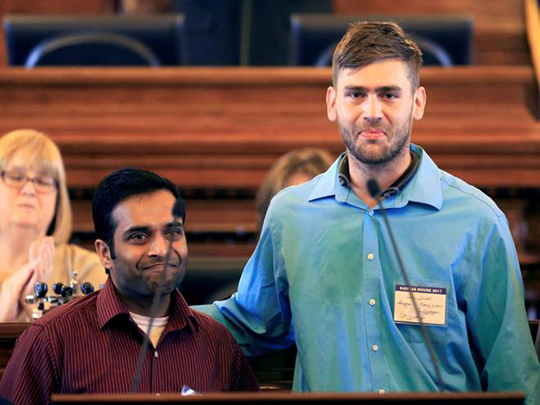
Indian-Americans raise USD 100,000 for Kansas survivor

March 26, 2017

Houston, Mar 26: A 24-year-old American, who took a bullet for an Indian, has been honoured as 'A True American Hero' by the Indian-American community in Houston which raised USD 100,000 to help him buy a house in his hometown Kansas.

kansas

Ian Grillot, who was injured when he tried to intervene in the shooting by a Navy veteran targetting Indians at a bar in Olathe, Kansas last month, was honoured as 'A True American Hero' at the 14th annual gala of India House Houston here. Srinivas Kuchibhotla, 32, was killed and his colleague Alok Madasani was critically injured in the shooting.

"On behalf of the Indian-American community in Houston, India House recognised this selfless act beyond the call of duty and has extended the community's gratitude to Ian Grillot by helping him to buy a house," said a statement posted on the India House Houston Facebook page.

India House raised USD 100,000 as part of an initiative supported by the Consul General of India in Houston Dr. Anupam Ray to help Ian buy a house in his hometown, it said.

India's Ambassador to the US Navtej Sarna handed over a cheque of USD 100,000 to Ian. "I don't know if I could've lived with myself if I wouldn't have stopped or attempted to stop the shooter because that would've been completely devastating.

"I do now have a very powerful message and if I can help empower people and spread hope and love, then why not? I am honored to be at India House that serves so many families from so many communities in the Houston area," Ian said.

India House is a community center built by Americans of Indian origin in the Greater Houston area. "It is not every day that one meets a genuine hero — a person who risks his life for another, and takes a bullet for a complete stranger. Ian Grillot is a man who reminds us of the promise of America and its greatness," said Jiten Agarwal, a prominent Houstonian and Chair of the annual gala.

Comments

Add new comment

  • Coastaldigest.com reserves the right to delete or block any comments.
  • Coastaldigset.com is not responsible for its readers’ comments.
  • Comments that are abusive, incendiary or irrelevant are strictly prohibited.
  • Please use a genuine email ID and provide your name to avoid reject.
News Network
June 15,2020

Beijing, Jun 15: China is locking now ten more neighbourhoods in Beijing to try and contain the spread of a new coronavirus outbreak linked to a food market, authorities announced Monday.

City official Li Junjie said at a press conference that fresh cases had been found in a second wholesale market in northwestern Haidian district, and as a result, the market and nearby schools would be closed, and people living in ten communities around it placed under lockdown.

Comments

Add new comment

  • Coastaldigest.com reserves the right to delete or block any comments.
  • Coastaldigset.com is not responsible for its readers’ comments.
  • Comments that are abusive, incendiary or irrelevant are strictly prohibited.
  • Please use a genuine email ID and provide your name to avoid reject.
News Network
May 19,2020

May 19: A Chinese laboratory has been developing a drug it believes has the power to bring the coronavirus pandemic to a halt.

The outbreak first emerged in China late last year before spreading across the world, prompting an international race to find treatments and vaccines.

A drug being tested by scientists at China's prestigious Peking University could not only shorten the recovery time for those infected, but even offer short-term immunity from the virus, researchers say.

Sunney Xie, director of the university's Beijing Advanced Innovation Center for Genomics, told AFP that the drug has been successful at the animal testing stage.

"When we injected neutralising antibodies into infected mice, after five days the viral load was reduced by a factor of 2,500," said Xie.

"That means this potential drug has (a) therapeutic effect."

The drug uses neutralising antibodies -- produced by the human immune system to prevent the virus infecting cells -- which Xie's team isolated from the blood of 60 recovered patients.

A study on the team's research, published Sunday in the scientific journal Cell, suggests that using the antibodies provides a potential "cure" for the disease and shortens recovery time.

Xie said his team had been working "day and night" searching for the antibody.

"Our expertise is single-cell genomics rather than immunology or virology. When we realised that the single-cell genomic approach can effectively find the neutralising antibody we were thrilled."

He added that the drug should be ready for use later this year and in time for any potential winter outbreak of the virus, which has infected 4.8 million people around the world and killed more than 315,000.

"Planning for the clinical trial is underway," said Xie, adding it will be carried out in Australia and other countries since cases have dwindled in China, offering fewer human guinea pigs for testing.

"The hope is these neutralised antibodies can become a specialised drug that would stop the pandemic," he said.

China already has five potential coronavirus vaccines at the human trial stage, a health official said last week.

But the World Health Organization has warned that developing a vaccine could take 12 to 18 months.

Scientists have also pointed to the potential benefits of plasma -- a blood fluid -- from recovered individuals who have developed antibodies to the virus enabling the body's defences to attack it.

More than 700 patients have received plasma therapy in China, a process which authorities said showed "very good therapeutic effects".

"However, it (plasma) is limited in supply," Xie said, noting that the 14 neutralising antibodies used in their drug could be put into mass production quickly.

Using antibodies in drug treatments is not a new approach, and it has been successful in treating several other viruses such as HIV, Ebola and Middle East Respiratory Syndrome (MERS).

Xie said his researchers had "an early start" since the outbreak started in China before spreading to other countries.

Ebola drug Remdesivir was considered a hopeful early treatment for COVID-19 -- clinical trials in the US showed it shortened the recovery time in some patients by a third -- but the difference in mortality rate was not significant.

The new drug could even offer short-term protection against the virus.

The study showed that if the neutralising antibody was injected before the mice were infected with the virus, the mice stayed free of infection and no virus was detected.

This may offer temporary protection for medical workers for a few weeks, which Xie said they are hoping to "extend to a few months".

More than 100 vaccines for COVID-19 are in the works globally, but as the process of vaccine development is more demanding, Xie is hoping that the new drug could be a faster and more efficient way to stop the global march of the coronavirus.

"We would be able to stop the pandemic with an effective drug, even without a vaccine," he said.

Comments

Add new comment

  • Coastaldigest.com reserves the right to delete or block any comments.
  • Coastaldigset.com is not responsible for its readers’ comments.
  • Comments that are abusive, incendiary or irrelevant are strictly prohibited.
  • Please use a genuine email ID and provide your name to avoid reject.
News Network
January 7,2020

Jan 7: Body of the senior Iranian military commander, Qasem Soleimani killed in a U.S. drone strike in Iraq last week, has arrived in his home town of Kerman in southeast Iran for burial, the official IRNA news agency said on Tuesday.

State TV broadcast live images of thousands of people in the streets of the town, many of them dressed in black, to mourn Soleimani's death.

Soleimani was widely seen as Iran’s second most powerful figure behind Supreme Leader Ayatollah Ali Khamenei, 80, who wept in grief along with hundreds of thousands of mourners who thronged the streets of Tehran for Soleimani’s funeral on Monday.

Khamenei led prayers at the funeral in the Iranian capital, pausing as his voice cracked with emotion. Soleimani, 62, was a national hero even to many who do not consider themselves supporters of Iran’s clerical rulers.

He was killed while leaving Baghdad airport last Friday. Mourners packed the streets, chanting: “Death to America!” - a show of national unity after anti-government protests in November in which many demonstrators were killed.

The crowd, which state media said numbered in the millions, recalled the masses gathered in 1989 for the funeral of the Islamic Republic’s founder, Ayatollah Ruhollah Khomeini.

The killing of Soleimani has prompted fears around the world of a broader regional conflict, as well as calls in the U.S. Congress for legislation to keep President Donald Trump from going to war against Iran.

Comments

Add new comment

  • Coastaldigest.com reserves the right to delete or block any comments.
  • Coastaldigset.com is not responsible for its readers’ comments.
  • Comments that are abusive, incendiary or irrelevant are strictly prohibited.
  • Please use a genuine email ID and provide your name to avoid reject.